
The security audit evaluated the BurnMintERC20Upgrade system across key dimensions including 7.1 Architecture, 7.2 Code Security, 7.3 Access Control, 7.4 Economic, 7.5 Governance, 7.6 External, 7.7 Upgrades, and 7.8 Operations. The protocol demonstrates robust foundation with a multi-sig owner, 2-step ownership transfers, and standard ERC-20 transfer logic with zero transfer taxes. However, technical analysis revealed state variable shadowing across inherited contracts and centralized token minting capabilities that could dilute token holders.
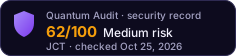

On-chain security analysis — is it a scam or legit?
Is Janction Safe?
Not verified
This record has not gone through deep verification and is not being monitored. The score is a dated snapshot — the token’s risk can change at any time.Own this token? Put it under verification →The security audit evaluated the BurnMintERC20Upgrade system across key dimensions including 7.1 Architecture, 7.2 Code Security, 7.3 Access Control, 7.4 Economic, 7.5 Governance, 7.6 External, 7.7 Upgrades, and 7.8 Operations.
Read the full analysis- Mintable supply, capped at 26%/year
- Upgradeable proxy — the admin can replace the logic
- Liquidity not locked
- Liquidity < $50k
- Top-10 concentration > 30%
- Code: State Variable Shadowing Across Inherited Base Contracts
Exact factors
- Mintable supply, capped at 26%/year
- Upgradeable proxy — the admin can replace the logic
- Liquidity NOT locked (100% of the pool; this pool is 52% of DEX liquidity) — who holds it cannot be verified
- Liquidity < $50k ($29,943 across 14 pairs — thin market)
- Top-10 concentration > 30% (100.0% total → 40.0% effective; 0.0% in EOAs, 100.0% in contracts)
- Code: State Variable Shadowing Across Inherited Base Contracts (High, static analysis)
Each factor is an on-chain fact recorded at the time of this analysis. The score is computed from them by a deterministic function, so the same contract returns the same score for anyone who runs the audit. How scores are computed
Security Checklist
as of audit · Oct 25Holders
as of audit · Oct 25, 2026- Contractstreasury, vesting, bridge, staking100.0%
How holder types affect the score
Share held by contracts — treasury, vesting, bridge or staking — is discounted against share held by wallets when the score is computed: a contract cannot decide to sell the way an anonymous holder can, though it can still be drained or voted to sell. Effective concentration is the figure the risk score is actually calculated from.
Holder balances as recorded by the audit of Oct 25, 2026
Liquidity
as of audit · Oct 25- Uniswap v4USDTAnalysed$15.7K52.4%
- Uniswap v4USDT$5.0K16.8%
- Uniswap v4USDT$3.3K10.9%
- Uniswap v4USDC$2.0K6.7%
- Uniswap v4USDC$4941.7%
Show 4 more pairs
The 4 remaining pairs hold $172 between them and are not listed. The risk score reads depth across every pair.
The LP tokens of the analysed pool are not locked or burned, so whoever holds them can withdraw that liquidity.
0xb0f3…6e730x3b0c…3fcd0xf061…d0ae0x2ee3…55d50xd906…472c0x5222…c349Security Findings
HighState Variable Shadowing Across Inherited Base Contracts
The contract defines state variables that duplicate names already declared in its parent or base contracts. This causes compiler-level shadowing where internal logic and proxy storage slots can diverge or overwrite each other, potentially leading to unintended state corruption during contract execution or future upgrades.CD-01
Issue
The contract defines state variables that duplicate names already declared in its parent or base contracts. This causes compiler-level shadowing where internal logic and proxy storage slots can diverge or overwrite each other, potentially leading to unintended state corruption during contract execution or future upgrades.
Fix
Review all variable declarations across inherited contracts, eliminate duplicate variable names, and verify storage layout continuity across the implementation hierarchy.
Status
Unresolved
MediumPrivileged Token Minting Enabling Supply Dilution
Addresses assigned the minter role through grantMintRole or grantMintAndBurnRoles can call mint(address,uint256) to issue new tokens directly to any address up to i_maxSupply. This administrative capability can dilute the value and voting power of existing token holders without requiring community consensus or timelock delays.CP-01
Issue
Addresses assigned the minter role through grantMintRole or grantMintAndBurnRoles can call mint(address,uint256) to issue new tokens directly to any address up to i_maxSupply. This administrative capability can dilute the value and voting power of existing token holders without requiring community consensus or timelock delays.
Fix
Bind the mint function to a verifiable timelock contract or enforce an on-chain programmatic rate limit on minting volume to give holders advance notice of supply increases.
Status
Unresolved
MediumLiquidity not locked
0.0% of the pool's LP is burned or time-locked. 100.0% is held, unlocked, by 4 address(es) other than the owner/deployer. One of them — a contract, 0xb0f3…6e73 — holds 69.5% and can remove that share at once; who controls it is not visible on-chain, so it is not treated as an independent provider. Some pools are concentrated-liquidity (V3/V4) positions; shares above are by position as GoPlus reports them. This assessment covers the main pool, which holds 52% of the token's DEX liquidity; the other pools were not assessed.QA-LIQUIDITY
Issue
0.0% of the pool's LP is burned or time-locked. 100.0% is held, unlocked, by 4 address(es) other than the owner/deployer. One of them — a contract, 0xb0f3…6e73 — holds 69.5% and can remove that share at once; who controls it is not visible on-chain, so it is not treated as an independent provider. Some pools are concentrated-liquidity (V3/V4) positions; shares above are by position as GoPlus reports them. This assessment covers the main pool, which holds 52% of the token's DEX liquidity; the other pools were not assessed.
Fix
Check the lock's end date and beneficiary on the locker's own page before relying on it.
Status
Acknowledged
InfoWho holds the supply
The ten largest holders own 100.0% of supply. What remains: 0.0% in wallets, 100.0% in other contracts. 735 holders in total.QA-HOLDERS
Issue
The ten largest holders own 100.0% of supply. What remains: 0.0% in wallets, 100.0% in other contracts. 735 holders in total.
Fix
Watch the largest wallets that are not exchanges, pools or locks — those are the ones that can move the price.
Status
Acknowledged
InfoIdentity verified by independent sources
Listed on CoinGecko as Janction (JCT), market cap $73M, rank #341. 735 holders. Verified by: CoinGecko.QA-IDENTITY
Issue
Listed on CoinGecko as Janction (JCT), market cap $73M, rank #341. 735 holders. Verified by: CoinGecko.
Fix
Match the contract address against the project's official channels before trading.
Status
Acknowledged
InfoThe market for this token
Liquidity $30K (DexScreener, all pools). 24h trading volume $85.0M (CoinGecko, all markets, daily snapshot). 24h trading volume $127K (DexScreener, all pools).QA-MARKET
Issue
Liquidity $30K (DexScreener, all pools). 24h trading volume $85.0M (CoinGecko, all markets, daily snapshot). 24h trading volume $127K (DexScreener, all pools).
Fix
Size any position to the liquidity and daily volume shown — they set how much you can sell and at what price.
Status
Acknowledged
InfoAsset class: Project token
A token issued by a project for use, governance or fundraising. Scored on its contract and market facts. The class itself adds no points; the contract and market facts decide the score. Basis: no class-specific evidence. Tokenomics — Supply: mintable, capped at 26.0% of supply per year. Control: a 5-of-7 multisig. Code: upgradeable proxy. Fees: no buy or sell tax. Market: $30K of DEX liquidity across 14 pools. Launch: 348 days of market history.QA-PROFILE
Issue
A token issued by a project for use, governance or fundraising. Scored on its contract and market facts. The class itself adds no points; the contract and market facts decide the score. Basis: no class-specific evidence. Tokenomics — Supply: mintable, capped at 26.0% of supply per year. Control: a 5-of-7 multisig. Code: upgradeable proxy. Fees: no buy or sell tax. Market: $30K of DEX liquidity across 14 pools. Launch: 348 days of market history.
Fix
Check the project's own documentation for what the token is used for; this report covers what the contract allows.
Status
Acknowledged
Analysis
AI Copilotas of audit · Oct 25Under 7.1 Architecture and 7.2 Code Security, the contract demonstrates robust foundational structure using standard OpenZeppelin upgradeable building blocks and safe arithmetic. Standard transfer execution paths are completely decoupled from privileged pause or fee vectors, ensuring unencumbered token movements for users. However, regarding 7.3 Access Control and 7.6 External interactions, state variable shadowing creates severe risks of storage corruption or inconsistent logic during execution. Specifically, inheritance collisions in state definitions between the implementation and base contracts undermine predictable contract behavior despite solid function access guards.
In 7.4 Economic and 7.5 Governance, ownership is properly controlled via a 5-of-7 multi-signature scheme and enforced through Ownable2StepUpgrade, mitigating unilateral key compromise. Operational token distribution remains predictable with no hidden balance skimming or transfer taxes during standard user operations under 7.8 Operations. Nonetheless, designated minter accounts retain the ability to call mint(address,uint256) up to i_maxSupply, introducing potential dilution risks for token holders. Additionally, the lack of strict on-chain minting schedules allows administrative roles to rapidly inflate circulating supply without timelock delays.
Reviewing 7.7 Upgrades alongside 7.1 Architecture, the implementation leverages the established UUPS proxy standard (ERC-1967) to enable secure implementation updates. Access to upgradeTo and upgradeToAndCall is strictly restricted to s_owner via two-step ownership, preventing unauthorized implementation swaps. However, inheritance state shadowing poses a distinct upgrade risk if child and parent contract storage layouts conflict during future contract migrations. Without comprehensive storage gap management and alignment, proxy upgrades risk overwriting critical operational storage slots.
Resolve the state variable shadowing issue immediately by inspecting all inherited contracts and renaming or removing overlapping variables to ensure storage layout consistency across proxy upgrades.
Additionally, introduce transparent minting constraints, such as a timelock or rate-limited minting schedule, to protect token holders from unannounced supply inflation.
Contract & Record
Free for any token on the record. It links to this page and always shows the current score and the date it was checked.
- Oct 25, 202662Medium
Score changes are recorded as dated snapshots — history is append-only and cannot be edited.
Would You Like a More Detailed Audit of Janction?
Our AI-powered scanner gives you a deeper, real-time smart contract analysis — free, with every scoring factor shown.
Get Detailed Audit Is this your token? Publish your own audit on this page