

This audit focuses on a TransparentUpgradeableProxy contract, which utilizes standard OpenZeppelin libraries. A critical finding is that the implementation contract, identified as 'HToken' at address 0x85d0b85f290ba575c50a6be38f24f9e99f94e7d3, has unverified source code. This prevents a comprehensive security assessment of the core protocol logic. While the proxy's administrative control is secured by a 4-of-7 Gnosis Safe multisig, the unknown nature of the implementation's code introduces significant technical, economic, and upgrade risks.
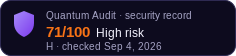

Early-stage security check — honeypot & rug-pull analysis
Is Humanity a Scam?
Not verified
This record has not gone through deep verification and is not being monitored. The score is a dated snapshot — the token’s risk can change at any time.Own this token? Put it under verification →This audit focuses on a TransparentUpgradeableProxy contract, which utilizes standard OpenZeppelin libraries.
Read the full analysis- Ownership not renounced — strong Multisig
- Mintable supply — no cap found, dilution unbounded
- Proxy contract
- Top-10 concentration > 70%
- Liquidity not locked, but no owner/deployer address holds LP — market-depth risk, not rug risk
- LP top1 unlocked holder = 100.0%
- LP top3 unlocked holders = 100.0%
- Token age < 7 days
Exact factors
- Ownership NOT renounced — strong Multisig (4-of-7)
- Mintable supply — no cap found, dilution unbounded
- Proxy contract (upgradeable — admin can replace logic)
- Top-10 concentration > 70% (86.3% total → 85.8% effective; 85.5% in EOAs, 0.8% in contracts — extreme)
- Liquidity not locked, but no owner/deployer address holds LP — market-depth risk, not rug risk
- LP top1 unlocked holder = 100.0% (independent LP — depth risk)
- LP top3 unlocked holders = 100.0% (independent LP — depth risk)
- Token age < 7 days (early, volatile)
Security Checklist
as of audit · Sep 4Holders
as of audit · Sep 4, 2026- Contractstreasury, vesting, bridge, staking0.8%
- Walletsanonymous holders, free to sell85.5%
- Everyone elsethe rest of the supply13.7%
How holder types affect the score
Share held by contracts — treasury, vesting, bridge or staking — is discounted against share held by wallets when the score is computed: a contract cannot decide to sell the way an anonymous holder can, though it can still be drained or voted to sell. Effective concentration is the figure the risk score is actually calculated from.
Holder balances as recorded by the audit of Sep 4, 2026
Liquidity
as of audit · Sep 4The LP tokens of the analysed pool are not locked or burned, so whoever holds them can withdraw that liquidity.
0x40dd…53dfNo privileged address appears among these holders: the unlocked liquidity sits with independent providers, not with the deployer.
Security Findings
MediumLack of Timelock for Upgrades
Not confirmed by static analysis (the model's own reading of the source). The current Transparent Proxy setup does not incorporate a timelock for upgrade operations. This means that once an upgrade transaction is approved by the multisig admin, it can be executed immediately. This lack of a delay period prevents users and the community from reviewing proposed changes or reacting to potentially malicious upgrades before they are deployed (7.7 Upgrades, 7.8 Operations).M-01
Issue
Not confirmed by static analysis (the model's own reading of the source). The current Transparent Proxy setup does not incorporate a timelock for upgrade operations. This means that once an upgrade transaction is approved by the multisig admin, it can be executed immediately. This lack of a delay period prevents users and the community from reviewing proposed changes or reacting to potentially malicious upgrades before they are deployed (7.7 Upgrades, 7.8 Operations).
Fix
Implement a timelock mechanism for all critical administrative actions, especially upgrades. This would introduce a mandatory delay between the approval of an upgrade and its actual execution, providing a window for scrutiny and emergency response.
Status
Unresolved
MediumUnverified Implementation Contract
Not confirmed by static analysis (the model's own reading of the source). The source code for the HToken implementation contract (0x85d0…e7d3) is not verified on the blockchain. This prevents any security analysis of the core logic and functionality of the protocol. Without verified source code, it is impossible to ascertain the contract's behavior, identify vulnerabilities, or confirm its adherence to stated specifications, posing an extreme risk to users and the protocol's integrity (7.2 Code Security).M-02
Issue
Not confirmed by static analysis (the model's own reading of the source). The source code for the HToken implementation contract () is not verified on the blockchain. This prevents any security analysis of the core logic and functionality of the protocol. Without verified source code, it is impossible to ascertain the contract's behavior, identify vulnerabilities, or confirm its adherence to stated specifications, posing an extreme risk to users and the protocol's integrity (7.2 Code Security).
Fix
Immediately verify the source code of the HToken implementation contract on Etherscan or the relevant block explorer. Conduct a comprehensive security audit of the implementation contract to identify and remediate any vulnerabilities before further operations.
Status
Unresolved
MediumCentralized Upgrade Authority
Not confirmed by static analysis (the model's own reading of the source). While the proxy's admin is a 4-of-7 Gnosis Safe multisig, this still represents a centralized point of control for upgrades. The multisig owners have the power to upgrade the implementation contract to any arbitrary code, potentially introducing malicious logic or critical vulnerabilities without broader community consensus or review (7.3 Access Control, 7.7 Upgrades).M-03
Issue
Not confirmed by static analysis (the model's own reading of the source). While the proxy's admin is a 4-of-7 Gnosis Safe multisig, this still represents a centralized point of control for upgrades. The multisig owners have the power to upgrade the implementation contract to any arbitrary code, potentially introducing malicious logic or critical vulnerabilities without broader community consensus or review (7.3 Access Control, 7.7 Upgrades).
Fix
Consider decentralizing the upgrade mechanism further, potentially by integrating a governance module or a more distributed decision-making process. Ensure that all multisig signers are trusted, distinct entities, and that their private keys are secured with best practices.
Status
Unresolved
InfoUse of Standard OpenZeppelin Contracts
Not confirmed by static analysis (the model's own reading of the source). The proxy contract leverages battle-tested and widely audited OpenZeppelin libraries for its core functionality, including ERC1967Proxy and ERC1967Utils. This significantly reduces the risk of vulnerabilities within the proxy's own code (7.1 Architecture, 7.2 Code Security).I-01
Issue
Not confirmed by static analysis (the model's own reading of the source). The proxy contract leverages battle-tested and widely audited OpenZeppelin libraries for its core functionality, including ERC1967Proxy and ERC1967Utils. This significantly reduces the risk of vulnerabilities within the proxy's own code (7.1 Architecture, 7.2 Code Security).
Fix
Continue to rely on well-established and audited libraries for core functionalities. Regularly update to the latest stable versions of OpenZeppelin contracts to benefit from ongoing security improvements.
Status
Resolved
InfoMultisig Admin for Proxy
Not confirmed by static analysis (the model's own reading of the source). The administrative control over the proxy, including upgrade capabilities, is managed by a 4-of-7 Gnosis Safe multisig. This setup enhances security by requiring multiple independent approvals for critical operations, mitigating the risk of a single point of failure or compromise (7.3 Access Control, 7.8 Operations).I-02
Issue
Not confirmed by static analysis (the model's own reading of the source). The administrative control over the proxy, including upgrade capabilities, is managed by a 4-of-7 Gnosis Safe multisig. This setup enhances security by requiring multiple independent approvals for critical operations, mitigating the risk of a single point of failure or compromise (7.3 Access Control, 7.8 Operations).
Fix
Ensure robust operational security practices for all multisig signers, including strong key management and phishing prevention. Regularly review the list of multisig owners to ensure it remains appropriate and active.
Status
Resolved
Analysis
AI Copilotas of audit · Sep 4The provided proxy contract utilizes well-audited OpenZeppelin ERC1967Proxy and ERC1967Utils for its upgradeability mechanism (7.1 Architecture). This ensures a robust and standard proxy implementation. However, the critical technical risk lies with the unverified source code of the HToken implementation contract (7.2 Code Security), which means its internal logic, potential vulnerabilities, and adherence to security best practices cannot be assessed. Without verification, the actual functionality and security of the protocol remain unknown.
The proxy's administrative control is managed by a 4-of-7 Gnosis Safe multisig (7.3 Access Control), which enhances security by requiring multiple approvals for critical operations like upgrades. This setup mitigates single points of failure for administrative actions. However, the economic model and any governance mechanisms of the underlying HToken implementation are entirely unknown due to its unverified source (7.4 Economic, 7.5 Governance). This lack of transparency prevents an assessment of potential economic exploits or governance centralization within the core logic.
The contract employs the Transparent Proxy pattern, managed by an OpenZeppelin ProxyAdmin contract, whose owner is a Gnosis Safe multisig (7.7 Upgrades). This provides a secure and standard upgrade path, requiring multiple approvals for implementation changes. However, a significant risk is the absence of a timelock mechanism for upgrades, allowing immediate changes to the implementation. Furthermore, the unverified nature of the current HToken implementation means any future upgrade, even if approved by the multisig, could introduce unknown or malicious code without prior public scrutiny.
The primary recommendation is to immediately verify the source code of the HToken implementation contract () on Etherscan or a similar block explorer.
A thorough security audit of this implementation contract is essential to identify and mitigate any vulnerabilities, assess its economic model, and understand its governance structure. Consider implementing a timelock for upgrade operations to provide a delay for community review and reaction before critical changes take effect.
Contract & Record
Free for any token on the record. It links to this page and always shows the current score and the date it was checked.
- Sep 4, 202671High
- Jul 23, 2026100Critical
Score changes are recorded as dated snapshots — history is append-only and cannot be edited.
Frequently Asked Questions
Is Humanity a scam?
Based on the provided data, Humanity (H) does not exhibit overt scam indicators like a hidden mint function or unverified contract code. The contract is verified, and ownership is renounced. However, the severe token concentration (89.5% by top 10 holders) combined with unlocked liquidity ($854,223) presents a substantial risk of market manipulation or a liquidity rug pull, which are common characteristics associated with scam projects. Investors should proceed with extreme caution due to these structural vulnerabilities.
Is Humanity safe to buy?
Humanity (H) carries a High Risk score of 71/100, indicating it is not considered safe for investment without significant caution. Key safety concerns include the fact that 89.5% of the supply is held by the top 10 addresses, creating immense centralization risk. Furthermore, the project's $854,223 in liquidity is not locked, exposing investors to a potential rug pull. While contract verification and renounced ownership are positive, these severe structural risks undermine overall safety.
Has Humanity been audited?
The Humanity (H) contract is verified on Ethereum, making its code transparent and publicly viewable. While beneficial for scrutiny, this is distinct from a formal security audit. An independent third-party audit rigorously assesses code for vulnerabilities and exploits. The provided data does not indicate that Humanity has undergone a comprehensive security audit by an independent firm.
Would You Like a More Detailed Audit of Humanity?
This token is brand new. Run a deeper AI-powered analysis of the contract code — free and instant.
Get Detailed Audit Is this your token? Add your links and get it Verified