

The GyndToken contract is a standard ERC-20 token with ERC-20 Permit functionality, built upon battle-tested OpenZeppelin libraries. The contract's logic is minimal and straightforward, primarily delegating core token functionalities to its inherited components. The audit identified no critical or high-severity vulnerabilities. A low-severity finding was noted regarding an incomplete code snippet for the permit function, which hinders full verification of that specific implementation detail. Informational findings highlight the reliance on OpenZeppelin and the fixed initial supply model.
Early-stage security check — honeypot & rug-pull analysis
Is Gyndore a Scam?
Not verified
This record has not gone through deep verification and is not being monitored. The score is a dated snapshot — the token’s risk can change at any time.Own this token? Put it under verification →The GyndToken contract is a standard ERC-20 token with ERC-20 Permit functionality, built upon battle-tested OpenZeppelin libraries.
Read the full analysis- Ownership status UNKNOWN
- Top-10 concentration > 70%
- Liquidity not locked, but no owner/deployer address holds LP — market-depth risk, not rug risk
- LP top3 unlocked holders = 100.0%
- Token age < 24h
Exact factors
- Ownership status UNKNOWN (owner could not be resolved)
- Top-10 concentration > 70% (92.8% total → 86.8% effective; 82.8% in EOAs, 10.0% in contracts — extreme)
- Liquidity not locked, but no owner/deployer address holds LP — market-depth risk, not rug risk
- LP top3 unlocked holders = 100.0% (independent LP — depth risk, pool = 74% of DEX liquidity)
- Token age < 24h (brand new — bot activity, unproven)
Security Checklist
as of audit · Sep 24Holders
as of audit · Sep 24, 2026- Contractstreasury, vesting, bridge, staking10.0%
- Walletsanonymous holders, free to sell82.8%
- Everyone elsethe rest of the supply7.2%
How holder types affect the score
Share held by contracts — treasury, vesting, bridge or staking — is discounted against share held by wallets when the score is computed: a contract cannot decide to sell the way an anonymous holder can, though it can still be drained or voted to sell. Effective concentration is the figure the risk score is actually calculated from.
Holder balances as recorded by the audit of Sep 24, 2026
Liquidity
as of audit · Sep 24The LP tokens of the analysed pool are not locked or burned, so whoever holds them can withdraw that liquidity.
0x0c0e…f1020xd537…9ce70x233c…2a18No privileged address appears among these holders: the unlocked liquidity sits with independent providers, not with the deployer.
Security Findings
LowIncomplete ERC20Permit Code Snippet
Not confirmed by static analysis (the model's own reading of the source).L-01
ERC20Permit Code SnippetIssue
Not confirmed by static analysis (the model's own reading of the source). The provided source code for the permit function within the ERC20Permit contract is truncated. Specifically, the critical if (signer != owner) check, which is essential for validating the signature's authenticity against the intended owner, is cut off. While it is assumed that the full, correct OpenZeppelin implementation is used, an incomplete code snippet prevents a thorough review of the entire function's logic, particularly the security-critical signature verification and signer validation steps.
Fix
Ensure that the complete and verified source code for all inherited contracts, especially security-sensitive functions like permit, is available for auditing and public transparency. This allows for a comprehensive review of the entire logic and confirms that no unintended modifications or omissions exist.
Status
Unresolved
InfoStandard OpenZeppelin Implementation
Not confirmed by static analysis (the model's own reading of the source).I-01
Issue
Not confirmed by static analysis (the model's own reading of the source). The GyndToken contract is a straightforward implementation of ERC-20 and ERC-20 Permit functionality, built upon battle-tested OpenZeppelin contracts. This approach significantly reduces the risk of common vulnerabilities often found in custom token implementations, as OpenZeppelin libraries undergo extensive audits and community review.
Fix
Continue to leverage well-audited and maintained libraries like OpenZeppelin. Ensure that the specific versions of OpenZeppelin contracts used are up-to-date and free from known vulnerabilities.
Status
Unresolved
InfoFixed Initial Supply and Distribution
Not confirmed by static analysis (the model's own reading of the source).I-02
Issue
Not confirmed by static analysis (the model's own reading of the source). The token's entire supply of 10,000,000 tokens is minted to a single recipient address during contract deployment. This is a standard and transparent distribution model for a fixed-supply token, clearly defining the initial state of token ownership. It implies a centralized initial control over the total supply by the recipient.
Fix
Document the purpose and implications of the initial supply distribution for transparency to token holders and the community. This is a design choice and not a vulnerability.
Status
Unresolved
Analysis
AI Copilotas of audit · Sep 24The technical architecture (7.1) is robust, leveraging OpenZeppelin's ERC-20 and ERC-20 Permit implementations, which are widely audited and secure. Code security (7.2) benefits from these well-vetted libraries, mitigating common vulnerabilities like reentrancy and integer overflows through built-in checks and unchecked blocks. Access control (7.3) is limited to standard ERC-20 permissions, with no additional administrative roles, simplifying the attack surface. A minor concern (L-01) is the truncated permit function snippet, preventing full verification of its implementation.
The economic model (7.4) of the GyndToken is simple: a fixed supply of 10,000,000 tokens is minted to a single recipient during deployment. This transparent initial distribution is a clear design choice. There are no complex economic incentives, staking mechanisms, or oracle dependencies, which minimizes economic attack vectors. Governance (7.5) is not implemented within this token contract, as it functions purely as a standard ERC-20 asset without administrative control beyond its initial deployment.
The GyndToken contract is not designed to be upgradeable (7.7), as it does not implement any proxy patterns. This eliminates the complexities and potential risks associated with upgrade mechanisms, such as storage collisions or improper initialization. The contract is immutable once deployed, providing a fixed and predictable operational environment (7.8). This design choice simplifies long-term security considerations by removing the need for upgrade safety audits.
It is recommended to ensure that the full, verified source code for all inherited OpenZeppelin contracts, especially the ERC20Permit component, is available for any future audits or public review to confirm the integrity of the permit function's implementation.
While the contract is simple and relies on well-audited libraries, consider the broader ecosystem's needs, such as the potential utility of an emergency pause mechanism if the token were to be integrated into more complex DeFi protocols. For a standalone token, the current design is robust.
Contract & Record
Free for any token on the record. It links to this page and always shows the current score and the date it was checked.
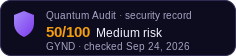
- Sep 24, 202650Medium
Score changes are recorded as dated snapshots — history is append-only and cannot be edited.
Would You Like a More Detailed Audit of Gyndore?
This token is brand new. Run a deeper AI-powered analysis of the contract code — free and instant.
Get Detailed Audit Is this your token? Add your links and get it Verified