

Quantum Audit Logo

Is Gnosis Token Safe?

On-chain security analysis — is it a scam or legit?

Is this your token? Publish your own audit on this page →

Gnosis Token GNO
0x6810…6b96
Ethereum Not verifiedLast checked 3d ago 1 audit on record
Executive SummaryAI Copilot

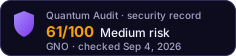
The GnosisToken contract, an ERC-20 compliant token, was audited for security vulnerabilities. The contract exhibits several issues related to its use of an older Solidity compiler version (0.4.10), including the `throw` keyword for error handling and susceptibility to the ERC-20 `approve` race condition. While core token functionalities are present, adherence to modern security practices is lacking, contributing to a Medium overall risk level.

2 High2 Medium2 Informational
Volume 24h
$44.3K
Liquidity
$93.7K
Price
$118.2300
Token Age
5y
Top 10 Holders
96.0%

Security Findings

High

Deprecated `throw` Keyword for Error Handling

H-01The contract uses the `throw` keyword for error handling, which is deprecated since Solidity 0.4.22. `throw` consumes all remaining gas, making it less gas-efficient than `revert()` or `require()`, which were introduced later and allow for more precise error messages and gas refunds. This can lead to higher transaction costs for failed operations.
IssueThe contract uses the `throw` keyword for error handling, which is deprecated since Solidity 0.4.22. `throw` consumes all remaining gas, making it less gas-efficient than `revert()` or `require()`, which were introduced later and allow for more precise error messages and gas refunds. This can lead to higher transaction costs for failed operations.
FixUpdate the contract to use `require()` or `revert()` statements for error handling. This improves gas efficiency and allows for clearer error messages, aligning with modern Solidity best practices.
StatusUnresolved
High

ERC-20 `approve` Race Condition Vulnerability

H-02The `approve` function is susceptible to a known ERC-20 race condition. If a user calls `approve(spender, newAmount)` while the `spender` is simultaneously trying to spend the `oldAmount`, the `spender` might be able to spend both `oldAmount` and `newAmount`, effectively doubling the allowance. This can lead to unintended token transfers.
IssueThe `approve` function is susceptible to a known ERC-20 race condition. If a user calls `approve(spender, newAmount)` while the `spender` is simultaneously trying to spend the `oldAmount`, the `spender` might be able to spend both `oldAmount` and `newAmount`, effectively doubling the allowance. This can lead to unintended token transfers.
FixImplement the `increaseAllowance` and `decreaseAllowance` pattern, as recommended by OpenZeppelin, to safely modify allowances. This pattern prevents the race condition by requiring explicit increments or decrements, ensuring atomic updates.
StatusUnresolved
Medium

Outdated Solidity Compiler Version

M-01The contract is compiled with Solidity version 0.4.10. This version is significantly outdated and lacks numerous security features, bug fixes, and optimizations introduced in later versions (e.g., 0.5.x, 0.6.x, 0.8.x). Using an old compiler increases the risk of undiscovered compiler bugs or missing modern security patterns.
IssueThe contract is compiled with Solidity version 0.4.10. This version is significantly outdated and lacks numerous security features, bug fixes, and optimizations introduced in later versions (e.g., 0.5.x, 0.6.x, 0.8.x). Using an old compiler increases the risk of undiscovered compiler bugs or missing modern security patterns.
FixUpgrade the contract to a recent and stable Solidity compiler version (e.g., 0.8.x). This would allow leveraging modern language features, improved security checks (like built-in overflow/underflow checks for `uint` types), and better gas optimization.
StatusUnresolved
Medium

Potential Integer Overflow on Addition

M-02The contract performs addition operations (e.g., `balances[_to] += _value` in `transfer` and `transferFrom`, `assignedTokens += tokens[i]` in the constructor) without explicit overflow checks. While `uint256` provides a large range, a malicious or accidental input exceeding `type(uint256).max` could lead to an overflow, resulting in incorrect balance calculations.
IssueThe contract performs addition operations (e.g., `balances[_to] += _value` in `transfer` and `transferFrom`, `assignedTokens += tokens[i]` in the constructor) without explicit overflow checks. While `uint256` provides a large range, a malicious or accidental input exceeding `type(uint256).max` could lead to an overflow, resulting in incorrect balance calculations.
FixImplement SafeMath or similar libraries for all arithmetic operations to prevent integer overflows. Modern Solidity versions (0.8.0+) include built-in overflow/underflow checks for `uint` types, which would mitigate this risk if the compiler is updated.
StatusUnresolved
Info

Constructor Gas Limit Risk for Large Arrays

I-01The `GnosisToken` constructor iterates through `owners` and `tokens` arrays to assign initial balances. If these arrays are excessively large, the constructor's gas consumption could exceed the block gas limit, preventing the contract from being deployed successfully.
IssueThe `GnosisToken` constructor iterates through `owners` and `tokens` arrays to assign initial balances. If these arrays are excessively large, the constructor's gas consumption could exceed the block gas limit, preventing the contract from being deployed successfully.
FixFor very large initial distributions, consider an alternative mechanism such as a separate function for claiming tokens or a batched distribution function that can be called multiple times post-deployment to avoid hitting block gas limits.
StatusUnresolved
Info

`totalSupply()` Signature Mismatch in Interface

I-02The `Token` interface declares `totalSupply() constant returns (uint256 supply) {}` with an empty body and `constant` keyword. While `StandardToken` correctly implements `totalSupply` as a public state variable, the interface definition is slightly inconsistent with modern ERC-20 interfaces which typically declare `function totalSupply() external view returns (uint256);`. The `constant` keyword for functions was deprecated in 0.5.0.
IssueThe `Token` interface declares `totalSupply() constant returns (uint256 supply) {}` with an empty body and `constant` keyword. While `StandardToken` correctly implements `totalSupply` as a public state variable, the interface definition is slightly inconsistent with modern ERC-20 interfaces which typically declare `function totalSupply() external view returns (uint256);`. The `constant` keyword for functions was deprecated in 0.5.0.
FixWhile not a functional bug in `StandardToken`, for future compatibility and clarity, the `Token` interface could be updated to reflect modern ERC-20 standards, using `view` instead of `constant` and removing the empty function body.
StatusUnresolved

Category Ratings

TechnicalLow8/10

The GnosisToken contract implements a standard ERC-20 token with a fixed supply and initial distribution logic (7.1 Architecture). The core `transfer` and `transferFrom` functions include checks to prevent underflow, demonstrating basic security considerations (7.2 Code Security). However, the contract uses Solidity 0.4.10, which lacks modern security features like `revert()` and `require()`, instead relying on `throw` for error handling, which is less gas-efficient. Furthermore, the `approve` function is vulnerable to the known ERC-20 race condition (7.3 Access Control).

GovernanceHigh1/10

The token's economic model is straightforward, with a fixed total supply and initial distribution defined in the constructor (7.4 Economic). There are no complex governance mechanisms or external dependencies that introduce economic risk (7.5 Governance). The initial distribution logic includes checks to ensure the total supply is correctly assigned, mitigating some deployment risks.

UpgradesMedium6/10

The contract is not designed with an upgrade mechanism, meaning its logic is immutable once deployed (7.7 Upgrades). This eliminates upgrade-related risks but also prevents future bug fixes or feature enhancements without a full redeployment and migration.

Security Checklist

Contract VerifiedPass
Ownership Renounced?
No Mint FunctionPass
Liquidity LockedFail
Not a ProxyPass

Holder Composition

32.6% in wallets63.4% in contracts
Effective Concentration57.9%

Share held by contracts — treasury, vesting, bridge or staking — is discounted against share held by wallets when the score is computed: a contract cannot decide to sell the way an anonymous holder can, though it can still be drained or voted to sell. Effective concentration is the figure the risk score is actually calculated from.

Liquidity Depth

The risk score reads depth across every pair. The volume figure and the volume-to-liquidity ratio elsewhere on this page describe only the pair this audit analysed, so the two are not directly comparable.

LP Distribution

Top-1 Unlocked Holder55.6%
Top-3 Unlocked98.6%

Key Addresses

Deployer
0xbe4e…f901
Unlocked LP Held By
0x2b23…e60d0xee31…a3ed0x75c6…1cfb0x9823…d98e0xd2da…418d0x40d3…ef600x25f8…91ba

No privileged address appears among these holders: the unlocked liquidity sits with independent providers, not with the deployer.

What Raised This Score

  • Ownership status UNKNOWN (owner could not be resolved)
  • Top-10 concentration > 50% (96.0% total → 57.9% effective; 32.6% in EOAs, 63.4% in contracts — heavy)
  • Liquidity not locked, but no owner/deployer address holds LP — market-depth risk, not rug risk
  • LP top1 unlocked holder = 55.6% (independent LP — depth risk, pool = 84% of DEX liquidity)
  • LP top3 unlocked holders = 98.6% (independent LP — depth risk, pool = 84% of DEX liquidity)
  • 2 High finding(s) from audit
  • 2 Medium finding(s) from audit

Each factor is an on-chain fact recorded at the time of this analysis. The score is computed from them by a deterministic function, so the same contract returns the same score for anyone who runs the audit. How scores are computed

Related Audits

HarryPotterObamaSonic10Inu (BITCOIN)High RiskLego Pepe (LEPE)High RiskGraph Token (GRT)High RiskInterfold (FOLD)High RiskTokenFi (TOKEN)High RiskANyONe Protocol (ANYONE)High Risk

Would You Like a More Detailed Audit of Gnosis Token?

Our AI-powered scanner gives you a deeper, real-time smart contract analysis — free, with every scoring factor shown.

Get Detailed Audit