
Quantum Audit Logo
Launch App

On-chain security analysis — is it a scam or legit?

Is Global Dollar Safe?

USDGArbitrum
Not verified This record has not gone through deep verification and is not being monitored. The score is a dated snapshot — the token’s risk can change at any time.Own this token? Put it under verification →
Last checked Oct 26, 2026 · 1 audit on record
SummaryAI Copilot

The USDG token is a complex, upgradeable ERC-20 implementation utilizing UUPS proxy patterns and extensive role-based access control.

Read the full analysis
What raised the score
  • Issuer controls retained
  • Code: Uninitialized State Variables
Exact factors
  • Issuer controls retained (admin key, mint, upgrade) — counterparty risk on a known issuer, not a rug vector
  • Code: Uninitialized State Variables (High, static analysis)

Each factor is an on-chain fact recorded at the time of this analysis. The score is computed from them by a deterministic function, so the same contract returns the same score for anyone who runs the audit. How scores are computed

Security Checklist

as of audit · Oct 263 of 7 checks passed
Contract verifiedVerified
OwnershipRetained
MintMintable
Liquidity lockNot locked
UpgradeabilityUpgradeable
HoneypotNone found
Buy / sell tax0% / 0%

Holders

as of audit · Oct 26, 2026411 holders
91.4%Contracts8.6%Everyone else
91.4%Contracts8.6%
ContractsEveryone elseBubble area = share of supply
91.4%of supply sits with the top 10 holders
  • Contractstreasury, vesting, bridge, staking91.4%
  • Everyone else401 holders8.6%
Effective concentrationwhat the score reads36.6%
How holder types affect the score

Share held by contracts — treasury, vesting, bridge or staking — is discounted against share held by wallets when the score is computed: a contract cannot decide to sell the way an anonymous holder can, though it can still be drained or voted to sell. Effective concentration is the figure the risk score is actually calculated from.

Holder balances as recorded by the audit of Oct 26, 2026

Liquidity

as of audit · Oct 26$543.0K across 7 pairs
LP tokensNot locked

The LP tokens of the analysed pool are not locked or burned, so whoever holds them can withdraw that liquidity.

Analysed pool$234.5KShare of depth43.2%
Top-1 Unlocked Holder50.3%
Top-3 Unlocked100.0%
Unlocked LP held by
0x3fcb…be310x7c59…d3110x6394…e2cc0xa055…99bb0xdc89…73da

No privileged address appears among these holders: the unlocked liquidity sits with independent providers, not with the deployer.

Security Findings

1 High6 Info
High

Uninitialized State Variables

Several critical functions, including _getMultiplierAtTime and _isAuthorizedAsClaimer, rely on state variables that are never initialized. This can lead to logic errors or transaction reverts when these functions are invoked.CD-01

Issue

Several critical functions, including _getMultiplierAtTime and _isAuthorizedAsClaimer, rely on state variables that are never initialized. This can lead to logic errors or transaction reverts when these functions are invoked.

Fix

Ensure all state variables are explicitly initialized within the contract constructor or the initialize function before they are accessed by any logic.

Status

Unresolved

Info

Centralized Minting Capability

Privileged addresses possess the authority to increase or decrease the total token supply via increaseSupply and decreaseSupply functions. This allows for arbitrary dilution of existing token holders.CP-01

Issue

Privileged addresses possess the authority to increase or decrease the total token supply via increaseSupply and decreaseSupply functions. This allows for arbitrary dilution of existing token holders.

Fix

Implement a supply cap or require multi-signature approval for any supply adjustments to prevent unauthorized or excessive minting.

Status

Unresolved

Info

Who holds the supply

The ten largest holders own 91.4% of supply. What remains: 0.0% in wallets, 91.4% in other contracts. 411 holders in total. For a verified reference asset the largest holders are custodians, exchanges and bridges; concentration is reported, not scored.QA-HOLDERS

Issue

The ten largest holders own 91.4% of supply. What remains: 0.0% in wallets, 91.4% in other contracts. 411 holders in total. For a verified reference asset the largest holders are custodians, exchanges and bridges; concentration is reported, not scored.

Fix

Watch the largest wallets that are not exchanges, pools or locks — those are the ones that can move the price.

Status

Acknowledged

Info

Identity verified by independent sources

Listed on CoinGecko as Global Dollar (USDG), market cap $3.1B, rank #34. 411 holders. Verified by: CoinGecko.QA-IDENTITY

Issue

Listed on CoinGecko as Global Dollar (USDG), market cap $3.1B, rank #34. 411 holders. Verified by: CoinGecko.

Fix

Match the contract address against the project's official channels before trading.

Status

Acknowledged

Info

The market for this token

Liquidity $543K (DexScreener, all pools). 24h trading volume $388.2M (CoinGecko, all markets, daily snapshot). 24h trading volume $918K (DexScreener, all pools).QA-MARKET

Issue

Liquidity $543K (DexScreener, all pools). 24h trading volume $388.2M (CoinGecko, all markets, daily snapshot). 24h trading volume $918K (DexScreener, all pools).

Fix

Size any position to the liquidity and daily volume shown — they set how much you can sell and at what price.

Status

Acknowledged

Info

Asset class: Stablecoin — issuer-backed (fiat reserves)

A token designed to hold a fixed value (usually $1). Its safety rests on what backs it and on who can mint, freeze or pause it. Scored as an established reference asset: its identity is verified, so the issuer's or protocol's controls (listed as findings) are real and are priced once as counterparty risk, and LP locks and holder concentration are not scored — its pools belong to market makers and its largest holders are exchanges, bridges and custody. Basis: CoinGecko category: Fiat-backed Stablecoin. Tokenomics — Supply: issued and redeemed by the issuer against its backing. Control: a timelock with a 24h delay. Code: upgradeable proxy. Fees: no buy or sell tax. Market: $543K of DEX liquidity across 7 pools. Launch: 17 days of market history.QA-PROFILE

Issue

A token designed to hold a fixed value (usually $1). Its safety rests on what backs it and on who can mint, freeze or pause it. Scored as an established reference asset: its identity is verified, so the issuer's or protocol's controls (listed as findings) are real and are priced once as counterparty risk, and LP locks and holder concentration are not scored — its pools belong to market makers and its largest holders are exchanges, bridges and custody. Basis: CoinGecko category: Fiat-backed Stablecoin. Tokenomics — Supply: issued and redeemed by the issuer against its backing. Control: a timelock with a 24h delay. Code: upgradeable proxy. Fees: no buy or sell tax. Market: $543K of DEX liquidity across 7 pools. Launch: 17 days of market history.

Fix

Check what backs the peg and who controls supply: reserve attestations for an issuer-backed coin, collateral and governance for a protocol coin.

Status

Acknowledged

Info

Recently launched — 17 days of market history

The token's oldest DEX pool is 17 days old. Age is not part of the risk score — a new token is not a risky one by default — but a short history means fewer trades and holder changes behind the facts in this report.QA-RECENT

Issue

The token's oldest DEX pool is 17 days old. Age is not part of the risk score — a new token is not a risky one by default — but a short history means fewer trades and holder changes behind the facts in this report.

Fix

Re-check ownership, liquidity and holder distribution as the token matures; those are the facts that move early.

Status

Acknowledged

Analysis

AI Copilotas of audit · Oct 26
Executive SummaryWhat the contract is and what the review found

The USDG token is a complex, upgradeable ERC-20 implementation utilizing UUPS proxy patterns and extensive role-based access control. While the architecture follows standard industry practices for upgradeability, the presence of uninitialized state variables and centralized minting capabilities introduces significant operational and economic risks. The protocol relies on a Timelock for administrative actions, which provides a necessary buffer for governance decisions.

Technical8/10Low risk

The architecture utilizes a robust UUPS proxy pattern, ensuring clear separation between logic and storage. Code security is generally high, with standard ERC-20 compliance and well-defined access control roles. However, the reliance on uninitialized state variables in critical reward-related functions poses a risk of unexpected behavior or transaction reverts.

Governance8/10Low risk

Economic control is centralized, allowing privileged roles to mint or burn tokens at will, which directly impacts token holder value. Governance is managed via a Timelock, providing a 24-hour delay for administrative changes. This structure balances agility with security, though it remains a single point of failure for token supply management.

Upgrades5/10Medium risk

The UUPS upgrade mechanism is correctly implemented with appropriate access restrictions. Upgrades are gated by the DEFAULT_ADMIN_ROLE, which is further protected by a Timelock. This ensures that any logic change is transparent and subject to a mandatory delay period.

Final RecommendationWhat to do about this score

Immediate remediation of the uninitialized state variables is required to prevent potential runtime failures in reward calculation functions.

It is recommended to implement a comprehensive initialization check in the constructor or initializer to ensure all state variables are set to expected default values before the contract becomes operational. Furthermore, consider implementing a hard cap on the total supply or a multi-signature requirement for the minting functions to mitigate the risks associated with centralized supply control. Regular monitoring of the Timelock queue is advised to ensure transparency for all administrative actions.

Contract & Record

1 audit on record
TypeERC1967Proxy
NetworkArbitrum
Token age17d
Contract0x004b…9bbc
Deployer0xbc86…366a
Proxy Upgrade Controls
Proxy TypeEip1967 Uups
ImplementationVerified source
Upgrades (30d)0 · stable
Badge for your website
Global Dollar security record badge

Free for any token on the record. It links to this page and always shows the current score and the date it was checked.

Audit History
  1. Oct 26, 202635Medium

Score changes are recorded as dated snapshots — history is append-only and cannot be edited.

Frequently Asked Questions

What is the USDG contract address?

The Global Dollar (USDG) contract on Arbitrum is 0x004b506865409877c9fa29bfb1eba929984b9bbc. Compare it with the address the project itself publishes before trading: other contracts can carry the same name and ticker.

Is Global Dollar a scam?

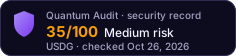
Quantum Audit's risk score for Global Dollar is 35/100 (Medium risk) as of Oct 26, 2026, computed by a deterministic function from on-chain facts — Contract verified: Verified; Ownership: Retained; Mint: Mintable; Liquidity lock: Not locked; Upgradeability: Upgradeable; Honeypot: None found; Buy / sell tax: 0% / 0%. A score is a dated snapshot of those facts, not a guarantee; each one is listed on this page.

Is USDG liquidity locked?

Liquidity lock: Not locked (as of Oct 26, 2026). Total DEX liquidity: $543.0K.

Who holds USDG?

As of Oct 26, 2026, the 10 largest holders own 91.4% of the supply across 411 holders. The Holders section on this page shows who they are by holder type.

Would You Like a More Detailed Audit of Global Dollar?

Our AI-powered scanner gives you a deeper, real-time smart contract analysis — free, with every scoring factor shown.

Get Detailed Audit Is this your token? Add your links and get it Verified