Quantum Audit Logo

Is Giggle Fund Safe?

On-chain security analysis — is it a scam or legit?

Is this your token? Publish your own audit on this page →

Giggle Fund GIGGLE
0x20d6…ce0e
BNB Chain Not verifiedLast checked 3d ago 1 audit on record
Executive SummaryAI Copilot

The GIGGLE token contract is a standard ERC-20 implementation. The code adheres to common patterns and best practices for token contracts. No critical or high-severity vulnerabilities were identified. Minor informational findings relate to unused code and inherent ERC-20 design considerations. The contract appears robust for its intended purpose as a basic token.
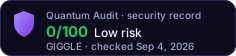

1 Low3 Informational
Volume 24h
$37.0K
Liquidity
$831.9K
Price
$36.7400
Token Age
10mo
Top 10 Holders
92.3%

Security Findings

Low

Inherent ERC-20 `approve()` Front-Running Risk

L-01The standard ERC-20 `approve()` function is susceptible to a known front-running vulnerability. If a user approves an amount for a spender and then attempts to change that approval to a different amount, a malicious actor could front-run the second transaction. This allows the attacker to spend the original approved amount before the new approval takes effect, potentially leading to the malicious actor spending both the original and the new approved amounts. While `increaseAllowance()` and `decreaseAllowance()` mitigate this for specific use cases, the base `approve()` function remains.
IssueThe standard ERC-20 `approve()` function is susceptible to a known front-running vulnerability. If a user approves an amount for a spender and then attempts to change that approval to a different amount, a malicious actor could front-run the second transaction. This allows the attacker to spend the original approved amount before the new approval takes effect, potentially leading to the malicious actor spending both the original and the new approved amounts. While `increaseAllowance()` and `decreaseAllowance()` mitigate this for specific use cases, the base `approve()` function remains.
FixUsers should be aware of this inherent risk when interacting with `approve()`. For critical operations, consider using `increaseAllowance()` and `decreaseAllowance()` or a 'permit' style approval (not implemented here) which offers a more secure alternative to direct `approve()` calls.
StatusUnresolved
Info

Unused SafeMath Library

I-01The `SafeMath` library is imported and declared but not utilized within the `ERC20` contract. Solidity 0.8.11 automatically includes overflow/underflow checks, making `SafeMath` redundant unless specific `unchecked` blocks are used without prior validation. In this contract, all `unchecked` blocks are correctly guarded by `require` statements, rendering `SafeMath` unnecessary.
IssueThe `SafeMath` library is imported and declared but not utilized within the `ERC20` contract. Solidity 0.8.11 automatically includes overflow/underflow checks, making `SafeMath` redundant unless specific `unchecked` blocks are used without prior validation. In this contract, all `unchecked` blocks are correctly guarded by `require` statements, rendering `SafeMath` unnecessary.
FixRemove the `SafeMath` library import and declaration to reduce contract size, optimize deployment costs, and improve code clarity, as its functionality is not needed or used.
StatusUnresolved
Info

Unused Interfaces Declared

I-02The `IUniswapV2Pair` and `IUniswapV2Factory` interfaces are defined within the contract file but are not referenced or used by the `ERC20` contract itself. This indicates either incomplete code, vestigial declarations, or interfaces intended for external interaction not directly implemented here.
IssueThe `IUniswapV2Pair` and `IUniswapV2Factory` interfaces are defined within the contract file but are not referenced or used by the `ERC20` contract itself. This indicates either incomplete code, vestigial declarations, or interfaces intended for external interaction not directly implemented here.
FixRemove unused interfaces to reduce contract size and improve code clarity. If these interfaces are intended for future integration or external interaction, ensure they are properly documented to explain their purpose.
StatusUnresolved
Info

Internal Mint/Burn Functions

I-03The `_mint` and `_burn` functions are declared as `internal virtual`. This design choice means they can only be called by the `ERC20` contract itself or by contracts that inherit from `ERC20`. There are no public or external functions provided in this contract that expose minting or burning capabilities to external users. This implies that the token has a fixed supply unless a derived contract explicitly adds such functionality.
IssueThe `_mint` and `_burn` functions are declared as `internal virtual`. This design choice means they can only be called by the `ERC20` contract itself or by contracts that inherit from `ERC20`. There are no public or external functions provided in this contract that expose minting or burning capabilities to external users. This implies that the token has a fixed supply unless a derived contract explicitly adds such functionality.
FixDocument this design choice clearly for users and future developers. If a variable supply is intended, ensure that derived contracts implement secure access control for any externally exposed minting and burning functions.
StatusUnresolved

Category Ratings

TechnicalLow10/10

The technical architecture is a straightforward ERC-20 token, inheriting from `Context` and implementing `IERC20` and `IERC20Metadata`. The code security is high, utilizing Solidity 0.8.11's default overflow/underflow checks, with `unchecked` blocks correctly guarded by `require` statements (7.2 Code Security). Access control (7.3 Access Control) is standard for an ERC-20 token, with `_mint` and `_burn` functions being internal, preventing unauthorized supply manipulation. Minor issues include unused `SafeMath` and Uniswap interfaces, which do not pose security risks but affect code clarity.

GovernanceMedium6/10

The contract implements a basic ERC-20 token without complex economic models or governance mechanisms (7.4 Economic, 7.5 Governance). The supply is fixed as `_mint` and `_burn` functions are internal and not exposed externally, preventing arbitrary token creation or destruction. There are no owner-controlled parameters or special roles that could introduce centralized economic risks. The economic model is simple and transparent, relying on standard token transfer mechanics.

UpgradesLow10/10

The contract is not designed as an upgradeable proxy (7.7 Upgrades). It is a standard, non-upgradeable implementation. This design choice eliminates risks associated with upgrade mechanisms, such as proxy storage collisions or insecure upgrade paths. Users should be aware that the contract's logic cannot be modified post-deployment.

Security Checklist

Contract VerifiedPass
Ownership RenouncedPass
No Mint FunctionPass
Liquidity LockedPass
Not a ProxyPass

Holder Composition

90.7% in wallets1.6% in contracts
Effective Concentration91.3%

Share held by contracts — treasury, vesting, bridge or staking — is discounted against share held by wallets when the score is computed: a contract cannot decide to sell the way an anonymous holder can, though it can still be drained or voted to sell. Effective concentration is the figure the risk score is actually calculated from.

Liquidity Depth

The risk score reads depth across every pair. The volume figure and the volume-to-liquidity ratio elsewhere on this page describe only the pair this audit analysed, so the two are not directly comparable.

LP Distribution

LP Burned100.0% · ≈ permanent lock
LP Locked100.0% · Null Address

Key Addresses

Deployer
0x3286…2866
Unlocked LP Held By
0x5e1e…9f450x0ed9…97060xcff4…da570xa62e…db450x6f7d…dee5

No privileged address appears among these holders: the unlocked liquidity sits with independent providers, not with the deployer.

What Raised This Score

  • Top-10 concentration > 70% (92.3% total → 91.3% effective; 90.7% in EOAs, 1.6% in contracts — extreme)
  • 1 Low finding(s) from audit

Each factor is an on-chain fact recorded at the time of this analysis. The score is computed from them by a deterministic function, so the same contract returns the same score for anyone who runs the audit. How scores are computed

Related Audits

TCryptochicks (TCC)Low Risk币安人生Low RiskSKYAILow RiskBLow RiskDOYRLow RiskCREPELow Risk

Would You Like a More Detailed Audit of Giggle Fund?

Our AI-powered scanner gives you a deeper, real-time smart contract analysis — free, with every scoring factor shown.

Get Detailed Audit