Quantum Audit Logo

Is GAME by Virtuals Safe?

On-chain security analysis — is it a scam or legit?

GAME by Virtuals GAME
0x1c4c…63a3
Base Not verifiedLast checked 3d ago 1 audit on record
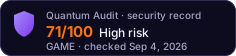
How is this score calculated? → Critical Risk
Executive SummaryAI Copilot

The AgentToken contract implements a custom ERC20-like token with tax mechanisms, bot protection, and Uniswap V2 integration. The contract uses OpenZeppelin's upgradeable patterns and 2-step ownership. A critical issue was identified regarding the absence of core ERC20 transfer functions in the provided code, rendering it non-functional as a standard token. Additionally, significant centralization risks exist due to the `onlyOwnerOrFactory` modifier.

1 Critical1 Medium1 Low1 Informational
Volume 24h
$134.5K
Liquidity
$2.64M
Price
$0.007092
Token Age
1y
Top 10 Holders
48.7%

Security Findings

Critical

Incomplete ERC20 Implementation (Missing Core Functions)

C-01The `AgentToken` contract defines private state variables for `_balances`, `_allowances`, `_totalSupply`, `_name`, and `_symbol`, which are typical for an ERC20 token. However, the public ERC20 interface functions such as `transfer`, `transferFrom`, `approve`, `allowance`, `balanceOf`, and `decimals` are not present in the provided code snippet. While `IAgentToken` is imported, its interface is not shown, and the implementation of these critical functions is absent, rendering the token non-functional as a standard ERC20.
IssueThe `AgentToken` contract defines private state variables for `_balances`, `_allowances`, `_totalSupply`, `_name`, and `_symbol`, which are typical for an ERC20 token. However, the public ERC20 interface functions such as `transfer`, `transferFrom`, `approve`, `allowance`, `balanceOf`, and `decimals` are not present in the provided code snippet. While `IAgentToken` is imported, its interface is not shown, and the implementation of these critical functions is absent, rendering the token non-functional as a standard ERC20.
FixImplement all standard ERC20 functions (`transfer`, `transferFrom`, `approve`, `allowance`, `balanceOf`, `decimals`, `totalSupply`) to ensure the token is fully functional and compliant with the ERC20 standard. Ensure these implementations correctly interact with the private state variables.
StatusUnresolved
Medium

Centralization Risk with `onlyOwnerOrFactory` Modifier

M-01The `onlyOwnerOrFactory` modifier grants significant control to the contract owner and the `_factory` contract. Functions such as `addLiquidityPool`, `removeLiquidityPool`, `addValidCaller`, `removeValidCaller`, `setProjectTaxRecipient`, and `setSwapThresholdBasisPoints` can be modified by these entities. This centralizes control over key operational parameters, including liquidity management, tax recipients, and auto-swap thresholds, posing a single point of failure and potential for misuse.
IssueThe `onlyOwnerOrFactory` modifier grants significant control to the contract owner and the `_factory` contract. Functions such as `addLiquidityPool`, `removeLiquidityPool`, `addValidCaller`, `removeValidCaller`, `setProjectTaxRecipient`, and `setSwapThresholdBasisPoints` can be modified by these entities. This centralizes control over key operational parameters, including liquidity management, tax recipients, and auto-swap thresholds, posing a single point of failure and potential for misuse.
FixConsider decentralizing control for critical functions by implementing a multi-signature wallet for the owner address or integrating a governance mechanism. For less critical functions, evaluate if the `_factory` contract's role can be limited or if a time-lock mechanism should be introduced for sensitive parameter changes.
StatusUnresolved
Low

Potential for Slippage and MEV in Initial Liquidity Provision

L-01The `_addInitialLiquidity` function adds liquidity to Uniswap V2 using `_uniswapRouter.addLiquidity`. While protected by `onlyOwnerOrFactory`, the `minAmountA` and `minAmountB` parameters are set to 0. This allows for arbitrary slippage during the liquidity addition. If the transaction is public, a sophisticated attacker could potentially front-run or sandwich this transaction, especially if the `pairToken` is volatile or the initial liquidity provision is substantial, leading to unfavorable exchange rates for the liquidity provider.
IssueThe `_addInitialLiquidity` function adds liquidity to Uniswap V2 using `_uniswapRouter.addLiquidity`. While protected by `onlyOwnerOrFactory`, the `minAmountA` and `minAmountB` parameters are set to 0. This allows for arbitrary slippage during the liquidity addition. If the transaction is public, a sophisticated attacker could potentially front-run or sandwich this transaction, especially if the `pairToken` is volatile or the initial liquidity provision is substantial, leading to unfavorable exchange rates for the liquidity provider.
FixSet reasonable minimum amounts for `minAmountA` and `minAmountB` in the `addLiquidity` call to protect against excessive slippage. Consider using a private transaction relay or a trusted third party for initial liquidity provision to mitigate MEV risks.
StatusUnresolved
Info

Truncated Code Prevents Full Audit

I-01The provided contract text for `AgentToken` is truncated. Critical sections of the contract, including the full implementation of ERC20 transfer functions, tax calculation and auto-swap logic (`_swapAndSendTax`), and bot protection mechanisms, are missing. This prevents a comprehensive security analysis of the entire contract's functionality and potential interactions.
IssueThe provided contract text for `AgentToken` is truncated. Critical sections of the contract, including the full implementation of ERC20 transfer functions, tax calculation and auto-swap logic (`_swapAndSendTax`), and bot protection mechanisms, are missing. This prevents a comprehensive security analysis of the entire contract's functionality and potential interactions.
FixProvide the complete and unabridged source code for all contracts intended for audit to enable a thorough and accurate security assessment.
StatusUnresolved

Category Ratings

TechnicalMedium6/10

The contract leverages OpenZeppelin's upgradeable patterns and `EnumerableSet` for efficient management of liquidity pools and valid callers (7.1 Architecture). However, a critical functional flaw exists where core ERC20 transfer functions are missing from the provided code, rendering the token non-functional as a standard ERC20 (7.2 Code Security). Additionally, the `onlyOwnerOrFactory` modifier centralizes control over key operational parameters (7.3 Access Control).

GovernanceHigh1/10

The contract's economic model includes buy and sell taxes, and an auto-swap mechanism for tax collection, which are common in DeFi (7.4 Economic). However, the `onlyOwnerOrFactory` modifier grants significant power to the owner and factory, allowing them to modify tax recipients, swap thresholds, and manage liquidity pools (7.5 Governance). This high degree of centralization introduces a single point of failure and potential for misuse.

UpgradesHigh1/10

The contract correctly implements OpenZeppelin's `Initializable` pattern, including `_disableInitializers()` in the constructor and an `initialize` function, ensuring proper upgrade safety (7.7 Upgrades). State variables are declared with appropriate visibility (`internal`, `private`) to prevent storage slot collisions during upgrades. The use of `Ownable2StepUpgradeable` also enhances the security of ownership transfers in an upgradeable context.

Security Checklist

Contract VerifiedPass
Ownership RenouncedFail
No Mint FunctionPass
Liquidity LockedFail
Not a ProxyFail
HoneypotNoneBuy Tax0.0%Sell Tax0.0%

Proxy Upgrade Controls

Proxy TypeEtherscan Detected Custom
ImplementationVerified source
Upgrades (30d)0 · stable

Holder Composition

25.5% in wallets23.2% in contracts
Effective Concentration34.8%

Share held by contracts — treasury, vesting, bridge or staking — is discounted against share held by wallets when the score is computed: a contract cannot decide to sell the way an anonymous holder can, though it can still be drained or voted to sell. Effective concentration is the figure the risk score is actually calculated from.

Liquidity Depth

Show 4 more pairsShow less

The 2 remaining pairs hold $4 between them and are not listed.

The risk score reads depth across every pair. The volume figure and the volume-to-liquidity ratio elsewhere on this page describe only the pair this audit analysed, so the two are not directly comparable.

LP Distribution

Top-1 Unlocked Holder67.3%
Top-3 Unlocked92.9%

Key Addresses

Deployer
0xd384…b8ef
Unlocked LP Held By
0xb4f5…ec680xfc13…a7810xe796…f9e20x9483…63640xc472…be240xdd62…bbb50x8163…30a80xc7af…7dab

No privileged address appears among these holders: the unlocked liquidity sits with independent providers, not with the deployer.

What Raised This Score

  • Ownership NOT renounced — owner is an EOA (single private key)
  • Proxy contract (upgradeable — admin can replace logic)
  • Non-standard proxy storage (Etherscan-confirmed)
  • Top-10 concentration > 30% (48.7% total → 34.8% effective; 25.5% in EOAs, 23.2% in contracts — moderate)
  • Liquidity not locked, but no owner/deployer address holds LP — market-depth risk, not rug risk
  • LP top1 unlocked holder = 67.3% (independent LP — depth risk, pool = 99% of DEX liquidity)
  • LP top3 unlocked holders = 92.9% (independent LP — depth risk, pool = 99% of DEX liquidity)
  • 1 Critical finding(s) from audit
  • 1 Medium finding(s) from audit
  • 1 Low finding(s) from audit

Each factor is an on-chain fact recorded at the time of this analysis. The score is computed from them by a deterministic function, so the same contract returns the same score for anyone who runs the audit. How scores are computed

Related Audits

XMAQUINA (DEUS)Critical RiskTownsCritical RiskICPCritical RiskRecallCritical RiskVANRYCritical RiskRIZEHigh Risk

Would You Like a More Detailed Audit of GAME by Virtuals?

Our AI-powered scanner gives you a deeper, real-time smart contract analysis — free, with every scoring factor shown.

Get Detailed Audit