

The protocol consists of a standard ERC-20 token implementation. While the architecture follows established patterns for token transfers, a critical flaw exists in the return logic of transfer functions, which may cause integration failures with external DeFi protocols. Coverage: 7.1 Architecture (Standard), 7.2 Code Security (High Risk), 7.3 Access Control (N/A), 7.4 Economic (N/A), 7.5 Governance (N/A), 7.6 External (High Risk), 7.7 Upgrades (N/A), 7.8 Operations (Standard).
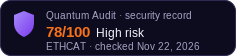

Early-stage security check — honeypot & rug-pull analysis
Is Ethereum Cat a Scam?
Not verified
This record has not gone through deep verification and is not being monitored. The score is a dated snapshot — the token’s risk can change at any time.Own this token? Put it under verification →The protocol consists of a standard ERC-20 token implementation.
Read the full analysis- Liquidity not locked
- Liquidity < $50k
- Code: Non-Compliant Return Values in Transfer Functions
Exact factors
- Liquidity NOT locked (100% of the pool) — withdrawable by the owner/deployer — rug-pull risk
- Liquidity < $50k ($29,579 across 3 pairs — thin market)
- Code: Non-Compliant Return Values in Transfer Functions (High, static analysis)
Each factor is an on-chain fact recorded at the time of this analysis. The score is computed from them by a deterministic function, so the same contract returns the same score for anyone who runs the audit. How scores are computed
Security Checklist
as of audit · Nov 22Holders
as of audit · Nov 22, 2026- Contractstreasury, vesting, bridge, staking12.1%
- Walletsanonymous holders, free to sell8.6%
- Burnedout of circulation11.2%
- Everyone else393 holders68.0%
How holder types affect the score
Share held by contracts — treasury, vesting, bridge or staking — is discounted against share held by wallets when the score is computed: a contract cannot decide to sell the way an anonymous holder can, though it can still be drained or voted to sell. Effective concentration is the figure the risk score is actually calculated from.
Holder balances as recorded by the audit of Nov 22, 2026
Liquidity
as of audit · Nov 22The risk score reads depth across every pair.
The LP tokens of the analysed pool are not locked or burned, so whoever holds them can withdraw that liquidity.
0xfeb9…eef5A privileged address — the deployer, the owner, or the token contract itself — is among these holders, so that party can withdraw liquidity.
Security Findings
HighNon-Compliant Return Values in Transfer Functions
The transfer and transferFrom functions do not correctly return the boolean success status required by the ERC-20 standard. This causes external smart contracts that rely on the return value to potentially revert or misinterpret the transaction outcome, leading to broken integrations.CD-01
Issue
The transfer and transferFrom functions do not correctly return the boolean success status required by the ERC-20 standard. This causes external smart contracts that rely on the return value to potentially revert or misinterpret the transaction outcome, leading to broken integrations.
Fix
Update the transfer and transferFrom functions to explicitly return the boolean 'true' upon successful execution, ensuring full compatibility with the ERC-20 standard.
Status
Unresolved
HighLiquidity withdrawable by the owner/deployer
0.0% of the pool's LP is burned or time-locked. 100.0% is held, unlocked, by the token's owner/deployer (0xfeb9…eef5) — they can pull that liquidity at any moment. This is the rug-pull path. Some pools are concentrated-liquidity (V3/V4) positions; shares above are by position as GoPlus reports them.QA-LIQUIDITY
Issue
0.0% of the pool's LP is burned or time-locked. 100.0% is held, unlocked, by the token's owner/deployer (0xfeb9…eef5) — they can pull that liquidity at any moment. This is the rug-pull path. Some pools are concentrated-liquidity (V3/V4) positions; shares above are by position as GoPlus reports them.
Fix
Check the lock's end date and beneficiary on the locker's own page before relying on it.
Status
Acknowledged
InfoWho holds the supply
The ten largest holders own 32.0% of supply. Of that, 11.2% burned — not holders that can sell, so excluded from the concentration score. What remains: 8.6% in wallets, 12.1% in other contracts. 403 holders in total.QA-HOLDERS
Issue
The ten largest holders own 32.0% of supply. Of that, 11.2% burned — not holders that can sell, so excluded from the concentration score. What remains: 8.6% in wallets, 12.1% in other contracts. 403 holders in total.
Fix
Watch the largest wallets that are not exchanges, pools or locks — those are the ones that can move the price.
Status
Acknowledged
InfoNot listed by any independent source
403 holders. Not listed by CoinGecko or any exchange GoPlus tracks. Nothing independent confirms who is behind this token, so every power its contract grants is scored at face value.QA-IDENTITY
Issue
403 holders. Not listed by CoinGecko or any exchange GoPlus tracks. Nothing independent confirms who is behind this token, so every power its contract grants is scored at face value.
Fix
Match the contract address against the project's official channels before trading.
Status
Acknowledged
InfoThe market for this token
Liquidity $30K (DexScreener, all pools). 24h trading volume $148K (DexScreener, all pools).QA-MARKET
Issue
Liquidity $30K (DexScreener, all pools). 24h trading volume $148K (DexScreener, all pools).
Fix
Size any position to the liquidity and daily volume shown — they set how much you can sell and at what price.
Status
Acknowledged
InfoAsset class: Meme token
A community token whose value comes from attention rather than a product. Being a meme is not a risk in itself: it is scored on exactly the same contract and market facts as any other token. The class itself adds no points; the contract and market facts decide the score. Basis: meme vocabulary in name/ticker (cat). Tokenomics — Supply: fixed — the contract has no mint function. Control: an owner that could not be resolved. Code: not upgradeable (no proxy). Fees: no buy or sell tax. Market: $30K of DEX liquidity across 3 pools. Launch: under a day of market history.QA-PROFILE
Issue
A community token whose value comes from attention rather than a product. Being a meme is not a risk in itself: it is scored on exactly the same contract and market facts as any other token. The class itself adds no points; the contract and market facts decide the score. Basis: meme vocabulary in name/ticker (cat). Tokenomics — Supply: fixed — the contract has no mint function. Control: an owner that could not be resolved. Code: not upgradeable (no proxy). Fees: no buy or sell tax. Market: $30K of DEX liquidity across 3 pools. Launch: under a day of market history.
Fix
Expect attention-driven volatility; the facts in this report say whether the contract itself can be used against holders.
Status
Acknowledged
InfoRecently launched — less than a day of market history
The token's oldest DEX pool is less than a day old. Age is not part of the risk score — a new token is not a risky one by default — but a short history means fewer trades and holder changes behind the facts in this report.QA-RECENT
Issue
The token's oldest DEX pool is less than a day old. Age is not part of the risk score — a new token is not a risky one by default — but a short history means fewer trades and holder changes behind the facts in this report.
Fix
Re-check ownership, liquidity and holder distribution as the token matures; those are the facts that move early.
Status
Acknowledged
Analysis
AI Copilotas of audit · Nov 22The contract utilizes standard OpenZeppelin-style ERC-20 logic for balance management and allowance tracking. The code is concise and avoids complex state dependencies, which minimizes the attack surface for reentrancy. However, the implementation of transfer functions fails to correctly handle return values, which is a significant deviation from the ERC-20 standard. This inconsistency can lead to failed transactions when interacting with automated market makers or lending protocols.
The contract does not implement any governance mechanisms or economic parameters. There are no minting, burning, or fee-collection functions present. The token supply is static, and there are no privileged roles that can influence the economic state of the contract.
The contract is not upgradeable and does not utilize proxy patterns. The logic is immutable upon deployment, which eliminates risks associated with malicious upgrades or proxy storage collisions. No further upgrade-related security considerations are applicable.
The primary recommendation is to refactor the transfer and transferFrom functions to ensure they strictly adhere to the ERC-20 specification regarding return values.
Ensure that all internal calls correctly propagate the success status to the caller to prevent integration issues with DeFi protocols. Additionally, perform comprehensive unit testing using a framework like Foundry or Hardhat to verify that the token behaves as expected when integrated with standard DEX routers. Ensure that all edge cases, such as zero-value transfers and transfers to the zero address, are handled according to the standard.
Contract & Record
Free for any token on the record. It links to this page and always shows the current score and the date it was checked.
- Nov 22, 202678High
Score changes are recorded as dated snapshots — history is append-only and cannot be edited.
Would You Like a More Detailed Audit of Ethereum Cat?
This token is brand new. Run a deeper AI-powered analysis of the contract code — free and instant.
Get Detailed Audit Is this your token? Add your links and get it Verified