Ethereum · Smart Contract Security · Updated May 29, 2026

Is Allora Safe? ALLO

On-chain security analysis — is it a scam or legit?

Contract 0x8408…0489 DexScreener ↗
High Risk
Volume 24h
$328.1K
Liquidity
$217.9K
Price
$0.2774
Token Age
6mo
Top 10 Holders
93.4%

Security Checklist

Contract VerifiedPass
Ownership RenouncedPass
No Mint FunctionPass
Liquidity LockedFail
Not a ProxyFail

Security Analysis

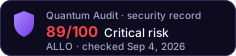
Allora (ALLO) operates on the Ethereum blockchain, presenting a mixed security profile for investors. Its contract is verified, allowing for public inspection of its code, and ownership has been renounced, meaning no single entity can alter the contract's core parameters post-deployment. Furthermore, the absence of a mint function prevents the unexpected creation of new tokens, offering supply predictability. However, the token exhibits notable concerns. A significant concentration of 93.4% of the total supply is held by the top 10 holders, indicating high centralization and potential for market manipulation. Compounding this, the project's liquidity, currently at $217,878 with a 24-hour volume of $328,103, is not locked. This absence of locked liquidity introduces a risk of a "rug pull," where liquidity providers could withdraw funds, severely impacting trading. The overall risk assessment for Allora is rated as 50/100, signifying a high-risk investment.

The most significant concerns for Allora (ALLO) revolve around its holder distribution and liquidity status. A substantial 93.4% of the token supply is concentrated within the top 10 holders. This extreme centralization grants considerable influence over the token's market dynamics, posing a risk of large-scale selling pressure that could significantly impact price and liquidity. Equally critical is the fact that the project's liquidity, currently $217,878, is not locked. Unlocked liquidity means that those providing it could withdraw their funds at any time, potentially leading to a sharp decline in available trading capital and hindering investor exits. These factors contribute heavily to Allora's high-risk classification.

Frequently Asked Questions

Is Allora a scam?

Based on available data, Allora (ALLO) does not exhibit typical contract-level scam indicators like a hidden mint function or unverified code. Its contract is verified, and ownership is renounced, providing transparency and immutability. However, the token faces significant risks from high holder concentration and unlocked liquidity, which could enable adverse market events. While not overtly a "scam" by these technical definitions, these structural vulnerabilities warrant extreme caution for investors.

Is Allora safe to buy?

Allora (ALLO) carries significant risks, making it difficult to categorize as "safe" for investment. The primary concerns are the extreme concentration of 93.4% of tokens among the top 10 holders and the absence of locked liquidity. These factors present considerable potential for market manipulation and liquidity removal. Coupled with its 50/100 high-risk score, investors should be aware of substantial potential volatility and exit challenges.

Has Allora been audited?

The Allora (ALLO) contract on Ethereum is verified, meaning its source code is publicly accessible for review. This enhances transparency. However, contract verification is distinct from a formal security audit. An audit involves an independent, in-depth security assessment. The provided data confirms verification but does not confirm a comprehensive third-party security audit for Allora.

Would You Like a More Detailed Audit of Allora?

Our AI-powered scanner gives you a deeper, real-time smart contract analysis — free, no signup required.

Get Detailed Audit
Run Free Audit →