
Quantum Audit Logo

Is Dot Safe?

On-chain security analysis — is it a scam or legit?

Dot DOT
0x23a2…fe51
Base Not verifiedLast checked 3d ago 1 audit on record
Executive SummaryAI Copilot

The provided contract code implements a standard ERC-20 token using OpenZeppelin's well-audited libraries. The code appears robust and follows modern Solidity best practices. Due to the truncated nature of the provided source, a full analysis of any custom logic or deployment-specific configurations could not be performed.
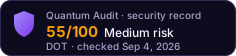

2 Low2 Informational
Volume 24h
$98.2K
Liquidity
$254.2K
Price
$0.002746
Token Age
2mo
Top 10 Holders
34.7%

Security Findings

Low

Multiple Pragma Directives

L-01The source code contains multiple `pragma solidity` directives (e.g., `>=0.4.16`, `>=0.6.2`, `^0.8.20`, `>=0.8.4`). While the compiler will use the most restrictive one for the relevant code blocks, having multiple pragmas can sometimes lead to confusion or potential compatibility issues if not consistently managed across the codebase, especially with different compiler versions.
IssueThe source code contains multiple `pragma solidity` directives (e.g., `>=0.4.16`, `>=0.6.2`, `^0.8.20`, `>=0.8.4`). While the compiler will use the most restrictive one for the relevant code blocks, having multiple pragmas can sometimes lead to confusion or potential compatibility issues if not consistently managed across the codebase, especially with different compiler versions.
FixConsolidate `pragma solidity` directives to a single, most restrictive version (e.g., `pragma solidity ^0.8.20;`) at the top of each file, or ensure consistent use if different versions are intentionally required for specific interfaces/libraries.
StatusUnresolved
Low

Missing Access Control for `_mint` and `_burn` (Contextual)

L-02The `_mint` and `_burn` functions are internal to the `ERC20` abstract contract. If a concrete token contract inherits from `ERC20` and exposes these functions externally without proper access control (e.g., only callable by an owner, minter role, or specific governance mechanism), it could allow unauthorized manipulation of the token supply, leading to severe economic consequences.
IssueThe `_mint` and `_burn` functions are internal to the `ERC20` abstract contract. If a concrete token contract inherits from `ERC20` and exposes these functions externally without proper access control (e.g., only callable by an owner, minter role, or specific governance mechanism), it could allow unauthorized manipulation of the token supply, leading to severe economic consequences.
FixFor any concrete token implementation, ensure that if `_mint` or `_burn` functionalities are exposed externally, they are protected by robust access control mechanisms (e.g., OpenZeppelin's `Ownable` or `AccessControl` contracts) to restrict their execution to authorized entities only.
StatusUnresolved
Info

Abstract ERC20 Implementation

I-01The provided code defines an abstract `ERC20` contract, which serves as a base for concrete token implementations. It is not directly deployable as a token. A concrete contract inheriting from `ERC20` would be required for deployment and would define the initial supply and any custom logic.
IssueThe provided code defines an abstract `ERC20` contract, which serves as a base for concrete token implementations. It is not directly deployable as a token. A concrete contract inheriting from `ERC20` would be required for deployment and would define the initial supply and any custom logic.
FixThis is an observation of the contract's structure. Ensure that the concrete token contract inheriting from this abstract base is fully reviewed for its specific implementation details, including constructor logic and any added functionalities.
StatusUnresolved
Info

Standard OpenZeppelin Components

I-02The `ERC20` and `ECDSA` implementations appear to be standard, well-audited OpenZeppelin libraries. These libraries are widely used and have undergone extensive security reviews, significantly reducing the likelihood of undiscovered vulnerabilities within these core components.
IssueThe `ERC20` and `ECDSA` implementations appear to be standard, well-audited OpenZeppelin libraries. These libraries are widely used and have undergone extensive security reviews, significantly reducing the likelihood of undiscovered vulnerabilities within these core components.
FixContinue to rely on well-established and audited libraries like OpenZeppelin. Ensure that any modifications or custom additions to these standard components are thoroughly tested and reviewed.
StatusUnresolved

Category Ratings

TechnicalLow8/10

The technical architecture is based on OpenZeppelin's battle-tested ERC-20 standard, ensuring a robust foundation (7.1 Architecture). Code security is high, utilizing modern Solidity features like custom errors and `unchecked` blocks where appropriate, which enhances safety and gas efficiency (7.2 Code Security). The core ERC-20 logic is well-implemented, preventing common vulnerabilities like integer overflows/underflows in critical paths. However, the provided code is an abstract contract, and any custom logic in a concrete implementation would require further review.

GovernanceHigh1/10

As a standard ERC-20 token, the contract does not inherently include complex economic models or governance mechanisms (7.4 Economic, 7.5 Governance). The economic stability relies on external market factors and the project's overall design. Access control (7.3 Access Control) for core token functions is standard, relying on `msg.sender` for transfers and approvals. If `_mint` or `_burn` are exposed in a concrete implementation, their access control would be critical.

UpgradesMedium5/10

The provided contract is not designed with upgradeability patterns (7.7 Upgrades) such as proxies. This means the contract's logic is immutable once deployed. For a simple token, this is often an acceptable design choice, ensuring predictability and reducing the attack surface associated with upgrade mechanisms. Any future changes would require a new deployment and migration.

Security Checklist

Contract VerifiedPass
Ownership Renounced?
No Mint FunctionPass
Liquidity LockedFail
Not a ProxyPass

Holder Composition

22.8% in wallets12.0% in contracts
Effective Concentration27.6%

Share held by contracts — treasury, vesting, bridge or staking — is discounted against share held by wallets when the score is computed: a contract cannot decide to sell the way an anonymous holder can, though it can still be drained or voted to sell. Effective concentration is the figure the risk score is actually calculated from.

Liquidity Depth

The risk score reads depth across every pair. The volume figure and the volume-to-liquidity ratio elsewhere on this page describe only the pair this audit analysed, so the two are not directly comparable.

LP Distribution

Top-1 Unlocked Holder72.3%
Top-3 Unlocked97.2%

Key Addresses

Deployer
0xd2be…9880
Unlocked LP Held By
0xd2be…98800xfa03…fd7a0x73e3…93d50x3945…6e360x4a4c…34eb

A privileged address — the deployer, the owner, or the token contract itself — is among these holders, so that party can withdraw liquidity.

What Raised This Score

  • Ownership status UNKNOWN (owner could not be resolved)
  • Top-10 concentration > 20% (34.7% total → 27.6% effective; 22.8% in EOAs, 12.0% in contracts — mild)
  • Liquidity NOT locked (owner can withdraw — rug-pull risk)
  • LP top1 unlocked holder = 72.3% (exit-liquidity risk)
  • LP top3 unlocked holders = 97.2% (exit-liquidity risk)
  • 2 Low finding(s) from audit

Each factor is an on-chain fact recorded at the time of this analysis. The score is computed from them by a deterministic function, so the same contract returns the same score for anyone who runs the audit. How scores are computed

Related Audits

EURCHigh RiskCoinbase Wrapped BTC (CBBTC)High RiskSekuya (SKYA)High RiskRibbita by Virtuals (TIBBIR)High RiskPromptHigh RiskCoinbase Wrapped XRP (CBXRP)High Risk

Would You Like a More Detailed Audit of Dot?

Our AI-powered scanner gives you a deeper, real-time smart contract analysis — free, with every scoring factor shown.

Get Detailed Audit