
The DapposToken contract is an ERC-20 token implementation leveraging battle-tested OpenZeppelin libraries for its core functionality, including pausable transfers and ownership management. The contract exhibits strong technical security due to its reliance on audited components and straightforward logic. However, the centralized control granted to the owner and the concentration of the initial token supply in a single treasury address introduce medium-level governance and economic risks.
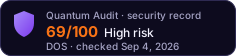

Early-stage security check — honeypot & rug-pull analysis
Is DAPPOS a Scam?
Not verified
This record has not gone through deep verification and is not being monitored. The score is a dated snapshot — the token’s risk can change at any time.Own this token? Put it under verification →The DapposToken contract is an ERC-20 token implementation leveraging battle-tested OpenZeppelin libraries for its core functionality, including pausable transfers and ownership management.
Read the full analysis- Ownership not renounced — strong Multisig
- Top-10 concentration > 70%
- LP lock status UNKNOWN — the pool's LP could not be read
- Liquidity < $50k
- Token age < 24h
- 2 Medium finding(s) from audit
Exact factors
- Ownership NOT renounced — strong Multisig (3-of-5)
- Top-10 concentration > 70% (100.0% total → 100.0% effective; 100.0% in EOAs, 0.0% in contracts — extreme)
- LP lock status UNKNOWN — the pool's LP could not be read
- Liquidity < $50k ($18,775 across 2 pairs — thin market)
- Token age < 24h (brand new — bot activity, unproven)
- 2 Medium finding(s) from audit
Each factor is an on-chain fact recorded at the time of this analysis. The score is computed from them by a deterministic function, so the same contract returns the same score for anyone who runs the audit. How scores are computed
Security Checklist
as of audit · Sep 4Holders
as of audit · Sep 4, 2026- Walletsanonymous holders, free to sell100.0%
How holder types affect the score
Share held by contracts — treasury, vesting, bridge or staking — is discounted against share held by wallets when the score is computed: a contract cannot decide to sell the way an anonymous holder can, though it can still be drained or voted to sell. Effective concentration is the figure the risk score is actually calculated from.
Holder balances as recorded by the audit of Sep 4, 2026
Liquidity
as of audit · Sep 4The risk score reads depth across every pair.
Whether the LP tokens are locked could not be determined.
Security Findings
MediumCentralized Control by Owner
The DapposToken contract utilizes the Ownable pattern, granting the contract owner the exclusive ability to pause and unpause all token transfers. This introduces a single point of control that can unilaterally halt all token operations, potentially impacting liquidity, user access, and the overall functionality of the token. While common for ERC-20 tokens, this level of centralization poses a significant governance risk.M-01
Issue
The DapposToken contract utilizes the Ownable pattern, granting the contract owner the exclusive ability to pause and unpause all token transfers. This introduces a single point of control that can unilaterally halt all token operations, potentially impacting liquidity, user access, and the overall functionality of the token. While common for ERC-20 tokens, this level of centralization poses a significant governance risk.
Fix
It is highly recommended to manage the contract owner address with a robust multi-signature wallet (e.g., Gnosis Safe) requiring a high threshold of approvals. This distributes control and reduces the risk of a single point of compromise or malicious action. Clearly communicate the owner's capabilities and operational procedures to the community.
Status
Unresolved
MediumInitial Supply Concentration in Treasury
The contract's constructor mints the entire _totalSupply to a single _treasury address. This concentration of all initial tokens in one address creates a significant single point of failure. If this treasury address were compromised, the entire token supply could be at risk. Furthermore, such a large concentration can lead to concerns about market manipulation or undue influence over the token's ecosystem.M-02
Issue
The contract's constructor mints the entire _totalSupply to a single _treasury address. This concentration of all initial tokens in one address creates a significant single point of failure. If this treasury address were compromised, the entire token supply could be at risk. Furthermore, such a large concentration can lead to concerns about market manipulation or undue influence over the token's ecosystem.
Fix
Consider distributing the initial token supply across multiple, distinct treasury addresses, potentially managed by different entities or multi-signature wallets. Implement vesting schedules or time-locks for portions of the supply to prevent sudden large-scale movements. Clearly document the purpose and management strategy for the treasury funds.
Status
Unresolved
InfoLack of Public Burn Functionality
The DapposToken contract does not expose a public function for burning tokens. While the underlying OpenZeppelin _burn internal function exists, it is not accessible by external users or the owner. The absence of a public burn mechanism might limit future tokenomics strategies, such as deflationary measures, supply reduction events, or mechanisms for users to burn tokens.I-01
Issue
The DapposToken contract does not expose a public function for burning tokens. While the underlying OpenZeppelin _burn internal function exists, it is not accessible by external users or the owner. The absence of a public burn mechanism might limit future tokenomics strategies, such as deflationary measures, supply reduction events, or mechanisms for users to burn tokens.
Fix
Evaluate if a public burn function is a desired feature for the token's long-term utility or tokenomics. If so, consider adding an onlyOwner or publicly accessible burn function that calls _burn to allow for controlled supply reduction.
Status
Unresolved
InfoFixed Decimals
The decimals() function in the DapposToken contract is hardcoded to return 18. While 18 decimals is a common standard for ERC-20 tokens, this fixed value means that any future requirement for a different decimal precision would necessitate the deployment of an entirely new token contract. This is a design choice rather than a vulnerability.I-02
Issue
The decimals() function in the DapposToken contract is hardcoded to return 18. While 18 decimals is a common standard for ERC-20 tokens, this fixed value means that any future requirement for a different decimal precision would necessitate the deployment of an entirely new token contract. This is a design choice rather than a vulnerability.
Fix
Ensure that 18 decimals aligns with all current and foreseeable future requirements for the token. If there's any possibility of needing a different precision, this should be addressed in the initial design phase, as it cannot be changed post-deployment.
Status
Unresolved
Analysis
AI Copilotas of audit · Sep 4The DapposToken contract demonstrates high technical security by inheriting from well-audited OpenZeppelin ERC20, ERC20Pausable, and Ownable contracts. The custom logic is minimal, primarily consisting of a constructor for initial minting and owner-controlled pause/unpause functions. The _update function override is correctly implemented to ensure proper functionality across inherited modules (7.1 Architecture, 7.2 Code Security). No reentrancy, integer overflow/underflow, or other common technical vulnerabilities were identified in the custom code.
The contract's governance and economic model presents a medium risk due to centralized control and initial supply distribution. The Ownable pattern grants the owner significant power, including the ability to pause all token transfers, which can impact liquidity and user access (7.3 Access Control, 7.5 Governance). Furthermore, the entire initial token supply is minted to a single treasury address, creating a single point of failure and potential for market manipulation if not managed securely (7.4 Economic, 7.8 Operations).
The DapposToken contract is not designed to be upgradeable, which simplifies its architecture and eliminates risks associated with upgrade mechanisms such as proxy patterns or mutable logic contracts (7.7 Upgrades). This design choice reduces the attack surface related to upgradeability, ensuring the deployed code remains immutable.
It is recommended to implement robust operational security measures for the contract owner address, ideally using a multi-signature wallet with a high threshold to mitigate the risks associated with centralized control.
For the initial token supply held by the treasury, consider distributing it across multiple addresses, implementing time-locks, or integrating it into a transparent vesting schedule to reduce concentration risk and enhance trust. Additionally, evaluate the necessity of a public burn function for future tokenomics flexibility.
Contract & Record
Free for any token on the record. It links to this page and always shows the current score and the date it was checked.
- Sep 4, 202669High
- Aug 11, 202664Medium
Score changes are recorded as dated snapshots — history is append-only and cannot be edited.
Would You Like a More Detailed Audit of DAPPOS?
This token is brand new. Run a deeper AI-powered analysis of the contract code — free and instant.
Get Detailed Audit Is this your token? Publish your own audit on this page