
Quantum Audit Logo

Is COTI Safe?

On-chain security analysis — is it a scam or legit?

Is this your token? Publish your own audit on this page →

COTI COTI
0xddb3…55c5
Ethereum Not verifiedLast checked 3d ago 1 audit on record
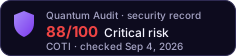
How is this score calculated? → Critical Risk
Executive SummaryAI Copilot

The audit covers an ERC-20 token implementation, including SafeMath, Ownable, Claimable, and HasNoEther contracts. The contract utilizes standard patterns for token functionality and access control. Key findings include an outdated Solidity compiler version and the inherent ERC-20 allowance race condition. The contract's design for ownership transfer and Ether handling is generally sound, though some areas could be improved for robustness and security.

2 High2 Medium1 Low1 Informational
Volume 24h
$38.6K
Liquidity
$176.7K
Price
$0.0134
Token Age
5y
Top 10 Holders
47.0%

Security Findings

High

ERC-20 `approve` Race Condition Vulnerability

H-01The `approve` function in the `StandardToken` contract is susceptible to a known ERC-20 race condition. If a user approves an allowance for a spender, and then attempts to change that allowance, a malicious spender could front-run the second transaction to spend the original allowance before the new allowance is set. This could result in the spender being able to spend both the old and new allowances. While `increaseApproval` is provided as a mitigation, the base `approve` function remains vulnerable.
IssueThe `approve` function in the `StandardToken` contract is susceptible to a known ERC-20 race condition. If a user approves an allowance for a spender, and then attempts to change that allowance, a malicious spender could front-run the second transaction to spend the original allowance before the new allowance is set. This could result in the spender being able to spend both the old and new allowances. While `increaseApproval` is provided as a mitigation, the base `approve` function remains vulnerable.
FixIt is recommended to deprecate the direct `approve` function or strongly advise users to always set the allowance to zero before setting a new non-zero allowance. Encourage the use of `increaseApproval` and `decreaseApproval` functions, which are designed to prevent this race condition.
StatusUnresolved
High

Outdated Solidity Compiler Version

H-02The contract is compiled with Solidity version 0.4.24. This version is significantly outdated and no longer actively maintained. Newer compiler versions (e.g., 0.8.x) include numerous bug fixes, security enhancements, and gas optimizations that address known vulnerabilities and improve overall contract robustness. Deploying with an old compiler version exposes the contract to potential undiscovered or unpatched compiler-level bugs.
IssueThe contract is compiled with Solidity version 0.4.24. This version is significantly outdated and no longer actively maintained. Newer compiler versions (e.g., 0.8.x) include numerous bug fixes, security enhancements, and gas optimizations that address known vulnerabilities and improve overall contract robustness. Deploying with an old compiler version exposes the contract to potential undiscovered or unpatched compiler-level bugs.
FixMigrate the contract to a recent, stable Solidity compiler version (e.g., 0.8.x). This will require careful testing and adaptation of the code to comply with newer syntax and semantics, such as explicit `unchecked` blocks for arithmetic and changes in visibility rules.
StatusUnresolved
Medium

Irreversible Ownership Renunciation

M-01The `renounceOwnership` function in the `Ownable` contract allows the current owner to set the `owner` address to `address(0)`. If this function is called without a prior transfer of ownership to a new, valid address, the contract will become permanently unmanageable, as no address will have the `onlyOwner` permissions to perform administrative actions.
IssueThe `renounceOwnership` function in the `Ownable` contract allows the current owner to set the `owner` address to `address(0)`. If this function is called without a prior transfer of ownership to a new, valid address, the contract will become permanently unmanageable, as no address will have the `onlyOwner` permissions to perform administrative actions.
FixConsider removing the `renounceOwnership` function if permanent ownership is desired. If renunciation is a required feature, ensure clear documentation and operational procedures are in place to prevent accidental unmanageability. Alternatively, implement a multi-signature wallet as the owner to add an extra layer of security and prevent single points of failure.
StatusUnresolved
Medium

Ether Transfer Failure Risk in `reclaimEther`

M-02The `reclaimEther` function in `HasNoEther` uses `owner.transfer(address(this).balance)` to send Ether to the owner. The `transfer()` function has a fixed gas stipend of 2300 gas. If the `owner` address is a contract with a fallback function that requires more than 2300 gas to execute, the Ether transfer will fail, potentially locking Ether in the contract if the owner is a contract.
IssueThe `reclaimEther` function in `HasNoEther` uses `owner.transfer(address(this).balance)` to send Ether to the owner. The `transfer()` function has a fixed gas stipend of 2300 gas. If the `owner` address is a contract with a fallback function that requires more than 2300 gas to execute, the Ether transfer will fail, potentially locking Ether in the contract if the owner is a contract.
FixReplace `owner.transfer()` with `owner.call{value: address(this).balance}("")` for more robust Ether transfers. This method forwards all available gas, making it more resilient to complex recipient fallback functions. Ensure proper checks for the success of the `call` operation (e.g., `(bool success,) = owner.call{value: address(this).balance}(""); require(success, "Ether transfer failed");`).
StatusUnresolved
Low

`SafeMath` uses `assert` instead of `require`

L-01The `SafeMath` library uses `assert` for its internal checks (e.g., `assert(b <= a)` in `sub`). In Solidity, `assert` consumes all remaining gas on failure, whereas `require` refunds the remaining gas. While `SafeMath` is an internal library, using `require` for input validation checks is generally considered a best practice for gas efficiency.
IssueThe `SafeMath` library uses `assert` for its internal checks (e.g., `assert(b <= a)` in `sub`). In Solidity, `assert` consumes all remaining gas on failure, whereas `require` refunds the remaining gas. While `SafeMath` is an internal library, using `require` for input validation checks is generally considered a best practice for gas efficiency.
FixConsider updating the `SafeMath` library to use `require` statements instead of `assert` for conditions that validate inputs or state. This would improve gas efficiency in cases where an invalid operation occurs.
StatusUnresolved
Info

Missing Zero Address Check for `approve` `_spender`

I-01The `approve` function does not explicitly check if the `_spender` address is `address(0)`. While `address(0)` cannot effectively spend tokens, adding an explicit `require(_spender != address(0))` check is a good practice to prevent accidental calls or wasted gas on invalid inputs.
IssueThe `approve` function does not explicitly check if the `_spender` address is `address(0)`. While `address(0)` cannot effectively spend tokens, adding an explicit `require(_spender != address(0))` check is a good practice to prevent accidental calls or wasted gas on invalid inputs.
FixAdd a `require(_spender != address(0), "ERC20: approve to the zero address")` check at the beginning of the `approve` function.
StatusUnresolved

Category Ratings

TechnicalMedium4/10

The technical architecture (7.1) is modular, separating concerns into libraries and base contracts. Code security (7.2) benefits from SafeMath for arithmetic operations, mitigating overflow/underflow risks. However, the use of Solidity 0.4.24 is a significant concern, as newer compiler versions include critical bug fixes and security enhancements. The ERC-20 `approve` function (7.2) is susceptible to a known race condition, despite the presence of `increaseApproval`. Access control (7.3) is well-implemented using the Ownable pattern and a two-step Claimable process for ownership transfer. External interactions (7.6) are limited, primarily for ERC-20 transfers, reducing reentrancy risks.

GovernanceHigh1/10

The economic model (7.4) appears to be a standard fixed-supply ERC-20 token with no minting or burning mechanisms visible in the provided code. Governance (7.5) is centralized via a single owner, with a secure two-step transfer process. However, the `renounceOwnership` function allows the owner to permanently relinquish control, which could lead to an unmanageable contract (7.8 Operations). The `HasNoEther` contract effectively prevents accidental Ether accumulation, but the `reclaimEther` function's use of `transfer()` could fail if the owner is a complex contract.

UpgradesHigh3/10

The contract is not designed with upgradeability in mind (7.7 Architecture). There are no proxy patterns or upgrade mechanisms implemented, meaning the contract's logic is immutable once deployed. This eliminates upgrade-specific risks but also prevents future bug fixes or feature enhancements without a new deployment.

Security Checklist

Contract VerifiedPass
Ownership RenouncedFail
No Mint FunctionFail
Liquidity LockedFail
Not a ProxyPass

Holder Composition

47.0% in wallets0.0% in contracts
Effective Concentration47.0%

Share held by contracts — treasury, vesting, bridge or staking — is discounted against share held by wallets when the score is computed: a contract cannot decide to sell the way an anonymous holder can, though it can still be drained or voted to sell. Effective concentration is the figure the risk score is actually calculated from.

Liquidity Depth

The risk score reads depth across every pair. The volume figure and the volume-to-liquidity ratio elsewhere on this page describe only the pair this audit analysed, so the two are not directly comparable.

LP Distribution

Top-1 Unlocked Holder90.7%
Top-3 Unlocked99.1%

Key Addresses

Deployer
0xe0e4…91ae
Unlocked LP Held By
0xf941…67be0xe6e5…c64b0x4d54…ed650x6ae9…4d500x2679…ffac0xaf96…262d0x1f57…9d300x3283…80d10x1900…46240x74c6…0785

No privileged address appears among these holders: the unlocked liquidity sits with independent providers, not with the deployer.

What Raised This Score

  • Ownership NOT renounced — owner is an EOA (single private key)
  • Mintable supply — no cap found, dilution unbounded
  • Top-10 concentration > 30% (47.0% total → 47.0% effective; 47.0% in EOAs, 0.0% in contracts — moderate)
  • Liquidity not locked, but no owner/deployer address holds LP — market-depth risk, not rug risk
  • LP top1 unlocked holder = 90.7% (independent LP — depth risk, pool = 93% of DEX liquidity)
  • LP top3 unlocked holders = 99.1% (independent LP — depth risk, pool = 93% of DEX liquidity)
  • 2 High finding(s) from audit
  • 2 Medium finding(s) from audit
  • 1 Low finding(s) from audit

Each factor is an on-chain fact recorded at the time of this analysis. The score is computed from them by a deterministic function, so the same contract returns the same score for anyone who runs the audit. How scores are computed

Related Audits

dmt-natCritical RiskAllora (ALLO)Critical RiskGensyn (AI)Critical RiskCaldera (ERA)Critical RiskBluzelle Token (BLZ)Critical RiskusocksCritical Risk

Would You Like a More Detailed Audit of COTI?

Our AI-powered scanner gives you a deeper, real-time smart contract analysis — free, with every scoring factor shown.

Get Detailed Audit