ClankerToken is an ERC-20 compliant token designed for cross-chain interoperability on the Base network. The contract utilizes standard OpenZeppelin libraries for governance and permit functionality. While the core token logic is robust, the protocol grants significant power to a specific bridge address to mint and burn tokens, which introduces centralized risks to token supply and holder balances.
On-chain security analysis — is it a scam or legit?
Is Claude Safe?
Not verified
This record has not gone through deep verification and is not being monitored. The score is a dated snapshot — the token’s risk can change at any time.Own this token? Put it under verification →ClankerToken is an ERC-20 compliant token designed for cross-chain interoperability on the Base network.
Read the full analysis- Mintable supply — no cap found, dilution unbounded
- Liquidity not locked
- Top-10 concentration > 30%
Exact factors
- Mintable supply — no cap found, dilution unbounded
- Liquidity NOT locked (100% of the pool) — held by independent providers — market-depth risk
- Top-10 concentration > 30% (100.0% total → 40.6% effective; 1.0% in EOAs, 99.0% in contracts)
Each factor is an on-chain fact recorded at the time of this analysis. The score is computed from them by a deterministic function, so the same contract returns the same score for anyone who runs the audit. How scores are computed
Security Checklist
as of audit · Nov 12Holders
as of audit · Nov 12, 2026- Contractstreasury, vesting, bridge, staking99.0%
- Walletsanonymous holders, free to sell1.0%
How holder types affect the score
Share held by contracts — treasury, vesting, bridge or staking — is discounted against share held by wallets when the score is computed: a contract cannot decide to sell the way an anonymous holder can, though it can still be drained or voted to sell. Effective concentration is the figure the risk score is actually calculated from.
Holder balances as recorded by the audit of Nov 12, 2026
Liquidity
as of audit · Nov 12The risk score reads depth across every pair.
The LP tokens of the analysed pool are not locked or burned, so whoever holds them can withdraw that liquidity.
0x7d60…4a33No privileged address appears among these holders: the unlocked liquidity sits with independent providers, not with the deployer.
Security Findings
MediumLiquidity not locked
0.0% of the pool's LP is burned or time-locked. 100.0% is held, unlocked, by 1 address(es) other than the owner/deployer. One of them — a wallet, 0x7d60…4a33 — holds 100.0% and can remove that share at once; who controls it is not visible on-chain, so it is not treated as an independent provider. Some pools are concentrated-liquidity (V3/V4) positions; shares above are by position as GoPlus reports them.QA-LIQUIDITY
Issue
0.0% of the pool's LP is burned or time-locked. 100.0% is held, unlocked, by 1 address(es) other than the owner/deployer. One of them — a wallet, 0x7d60…4a33 — holds 100.0% and can remove that share at once; who controls it is not visible on-chain, so it is not treated as an independent provider. Some pools are concentrated-liquidity (V3/V4) positions; shares above are by position as GoPlus reports them.
Fix
Check the lock's end date and beneficiary on the locker's own page before relying on it.
Status
Acknowledged
InfoCentralized Minting Authority
The crosschainMint function allows the SuperchainTokenBridge to create new tokens at will, which can dilute the value of existing holdings. Ownership is renounced, so no one can call these functions now.CP-01
Issue
The crosschainMint function allows the SuperchainTokenBridge to create new tokens at will, which can dilute the value of existing holdings. Ownership is renounced, so no one can call these functions now.
Fix
Implement a hard cap on the total supply or require multi-signature approval for large minting events.
Status
Unresolved
InfoCentralized Burn Authority
The crosschainBurn function allows the SuperchainTokenBridge to remove tokens from any user's balance, effectively allowing the bridge to seize or destroy user assets. Ownership is renounced, so no one can call these functions now.CP-02
Issue
The crosschainBurn function allows the SuperchainTokenBridge to remove tokens from any user's balance, effectively allowing the bridge to seize or destroy user assets. Ownership is renounced, so no one can call these functions now.
Fix
Restrict the burn functionality to only allow users to burn their own tokens, or implement a transparent, audited process for bridge-initiated burns.
Status
Unresolved
InfoWho holds the supply
The ten largest holders own 100.0% of supply. What remains: 1.0% in wallets, 99.0% in other contracts. 5,023 holders in total.QA-HOLDERS
Issue
The ten largest holders own 100.0% of supply. What remains: 1.0% in wallets, 99.0% in other contracts. 5,023 holders in total.
Fix
Watch the largest wallets that are not exchanges, pools or locks — those are the ones that can move the price.
Status
Acknowledged
InfoNot listed by any independent source
5,023 holders. Not listed by CoinGecko or any exchange GoPlus tracks. Nothing independent confirms who is behind this token, so every power its contract grants is scored at face value.QA-IDENTITY
Issue
5,023 holders. Not listed by CoinGecko or any exchange GoPlus tracks. Nothing independent confirms who is behind this token, so every power its contract grants is scored at face value.
Fix
Match the contract address against the project's official channels before trading.
Status
Acknowledged
InfoThe market for this token
Liquidity $10.3M (DexScreener, all pools). 24h trading volume $34.0M (DexScreener, all pools).QA-MARKET
Issue
Liquidity $10.3M (DexScreener, all pools). 24h trading volume $34.0M (DexScreener, all pools).
Fix
Size any position to the liquidity and daily volume shown — they set how much you can sell and at what price.
Status
Acknowledged
InfoAsset class: Project token
A token issued by a project for use, governance or fundraising. Scored on its contract and market facts. The class itself adds no points; the contract and market facts decide the score. Basis: no class-specific evidence. Tokenomics — Supply: mintable with no on-chain cap found. Control: nobody (ownership renounced). Code: not upgradeable (no proxy). Fees: no buy or sell tax. Market: $10.3M of DEX liquidity across 1 pools. Launch: 365 days of market history.QA-PROFILE
Issue
A token issued by a project for use, governance or fundraising. Scored on its contract and market facts. The class itself adds no points; the contract and market facts decide the score. Basis: no class-specific evidence. Tokenomics — Supply: mintable with no on-chain cap found. Control: nobody (ownership renounced). Code: not upgradeable (no proxy). Fees: no buy or sell tax. Market: $10.3M of DEX liquidity across 1 pools. Launch: 365 days of market history.
Fix
Check the project's own documentation for what the token is used for; this report covers what the contract allows.
Status
Acknowledged
Analysis
AI Copilotas of audit · Nov 12The contract architecture follows standard ERC-20 and ERC-7802 patterns, ensuring compatibility with cross-chain bridges. 7.1 Architecture and 7.2 Code Security are well-implemented using established libraries. 7.3 Access Control is strictly enforced via the SuperchainTokenBridge address. 7.6 External dependencies are limited to trusted pre-deployed bridge contracts.
7.4 Economic and 7.5 Governance risks are centered on the bridge's authority. The ability to mint and burn tokens allows for supply manipulation, which is a necessary feature for cross-chain functionality but represents a significant trust assumption. Users should be aware that the bridge acts as a central point of failure for token integrity.
7.7 Upgrades are not currently implemented as the contract is not a proxy. 7.8 Operations are straightforward, relying on the immutability of the deployed bytecode. No upgrade path exists for the current implementation.
The protocol should implement a timelock or multi-signature requirement if the bridge authority is ever transitioned to a governance-controlled contract.
Additionally, monitoring tools should be deployed to track cross-chain mint/burn events to ensure they align with expected bridge activity. Users should recognize that the security of their holdings is tied to the integrity of the SuperchainTokenBridge. Ensure that any future changes to the bridge address are communicated transparently to the community.
Contract & Record
Free for any token on the record. It links to this page and always shows the current score and the date it was checked.
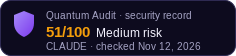
- Nov 12, 202651Medium
Score changes are recorded as dated snapshots — history is append-only and cannot be edited.
Frequently Asked Questions
What is the CLAUDE contract address?
The Claude contract on Base is 0xab35c8ec5e51e31a350aba8fbfc9ca132bc05b07. Compare it with the address the project itself publishes before trading: other contracts can carry the same name and ticker.
Is Claude a scam?
Quantum Audit's risk score for Claude is 51/100 (Medium risk) as of Nov 12, 2026, computed by a deterministic function from on-chain facts — Contract verified: Verified; Ownership: Renounced; Mint: Mintable; Liquidity lock: Not locked; Upgradeability: Fixed code; Honeypot: None found; Buy / sell tax: 0% / 0%. A score is a dated snapshot of those facts, not a guarantee; each one is listed on this page.
Is CLAUDE liquidity locked?
Liquidity lock: Not locked (as of Nov 12, 2026). Total DEX liquidity: $10.27M.
Who holds CLAUDE?
As of Nov 12, 2026, the 10 largest holders own 100.0% of the supply across 5,023 holders. The Holders section on this page shows who they are by holder type.
Would You Like a More Detailed Audit of Claude?
Our AI-powered scanner gives you a deeper, real-time smart contract analysis — free, with every scoring factor shown.
Get Detailed Audit Is this your token? Add your links and get it Verified