
The AWE token is a standard ERC-20 implementation utilizing OpenZeppelin's UUPS upgradeable pattern. The contract includes governance features such as ERC-20 Votes and Permit. Analysis confirms that the transfer logic is standard and free from backdoors or unauthorized modification capabilities. No critical vulnerabilities were identified in the provided source code.
On-chain security analysis — is it a scam or legit?
Is AWE Network Safe?
Not verified
This record has not gone through deep verification and is not being monitored. The score is a dated snapshot — the token’s risk can change at any time.Own this token? Put it under verification →The AWE token is a standard ERC-20 implementation utilizing OpenZeppelin's UUPS upgradeable pattern.
Read the full analysis- Upgradeable proxy — the admin can replace the logic
- Ownership status UNKNOWN
- Liquidity not locked
- Top-10 concentration > 50%
Exact factors
- Upgradeable proxy — the admin can replace the logic
- Ownership status UNKNOWN (owner could not be resolved)
- Liquidity NOT locked (100% of the pool) — held by independent providers — market-depth risk
- Top-10 concentration > 50% (69.8% total → 62.9% effective; 60.2% in EOAs, 6.7% in contracts; 2.9% burned, locked or in pools excluded)
Each factor is an on-chain fact recorded at the time of this analysis. The score is computed from them by a deterministic function, so the same contract returns the same score for anyone who runs the audit. How scores are computed
Security Checklist
as of audit · Oct 29Holders
as of audit · Oct 29, 2026- Contractstreasury, vesting, bridge, staking6.7%
- Walletsanonymous holders, free to sell60.2%
- Burnedout of circulation2.9%
- Everyone else12,652 holders30.2%
How holder types affect the score
Share held by contracts — treasury, vesting, bridge or staking — is discounted against share held by wallets when the score is computed: a contract cannot decide to sell the way an anonymous holder can, though it can still be drained or voted to sell. Effective concentration is the figure the risk score is actually calculated from.
Holder balances as recorded by the audit of Oct 29, 2026
Liquidity
as of audit · Oct 29The risk score reads depth across every pair.
The LP tokens of the analysed pool are not locked or burned, so whoever holds them can withdraw that liquidity.
0x375f…94910xfa2b…52bb0x7f42…98d80x1318…4113No privileged address appears among these holders: the unlocked liquidity sits with independent providers, not with the deployer.
Security Findings
MediumLiquidity not locked
0.0% of the pool's LP is burned or time-locked. 100.0% is held, unlocked, by 4 address(es) other than the owner/deployer. One of them — a wallet, 0x375f…9491 — holds 56.3% and can remove that share at once; who controls it is not visible on-chain, so it is not treated as an independent provider. Some pools are concentrated-liquidity (V3/V4) positions; shares above are by position as GoPlus reports them.QA-LIQUIDITY
Issue
0.0% of the pool's LP is burned or time-locked. 100.0% is held, unlocked, by 4 address(es) other than the owner/deployer. One of them — a wallet, 0x375f…9491 — holds 56.3% and can remove that share at once; who controls it is not visible on-chain, so it is not treated as an independent provider. Some pools are concentrated-liquidity (V3/V4) positions; shares above are by position as GoPlus reports them.
Fix
Check the lock's end date and beneficiary on the locker's own page before relying on it.
Status
Acknowledged
InfoNo issues identified in the reviewed source
The verified source code was reviewed and no issue rising to Informational severity or above was identified. This is a statement about the code that was read, not a guarantee: the review covers the published source only. Fact-layer checks (mint capability, holder concentration) were applied separately and feed the risk score.I-01
Issue
The verified source code was reviewed and no issue rising to Informational severity or above was identified. This is a statement about the code that was read, not a guarantee: the review covers the published source only. Fact-layer checks (mint capability, holder concentration) were applied separately and feed the risk score.
Fix
Re-check after any contract upgrade or ownership change, both of which can alter behaviour without changing this page.
Status
Acknowledged
InfoWho holds the supply
The ten largest holders own 69.8% of supply. Of that, 2.9% burned — not holders that can sell, so excluded from the concentration score. What remains: 60.2% in wallets, 6.7% in other contracts. 12,662 holders in total.QA-HOLDERS
Issue
The ten largest holders own 69.8% of supply. Of that, 2.9% burned — not holders that can sell, so excluded from the concentration score. What remains: 60.2% in wallets, 6.7% in other contracts. 12,662 holders in total.
Fix
Watch the largest wallets that are not exchanges, pools or locks — those are the ones that can move the price.
Status
Acknowledged
InfoIdentity verified by independent sources
Listed on CoinGecko as AWE Network (AWE), market cap $131M, rank #230. Traded on Coinbase. 12,662 holders. Verified by: CoinGecko, exchange listings.QA-IDENTITY
Issue
Listed on CoinGecko as AWE Network (AWE), market cap $131M, rank #230. Traded on Coinbase. 12,662 holders. Verified by: CoinGecko, exchange listings.
Fix
Match the contract address against the project's official channels before trading.
Status
Acknowledged
InfoThe market for this token
Liquidity $408K (DexScreener, all pools). 24h trading volume $4.3M (CoinGecko, all markets, daily snapshot). 24h trading volume $40K (DexScreener, all pools).QA-MARKET
Issue
Liquidity $408K (DexScreener, all pools). 24h trading volume $4.3M (CoinGecko, all markets, daily snapshot). 24h trading volume $40K (DexScreener, all pools).
Fix
Size any position to the liquidity and daily volume shown — they set how much you can sell and at what price.
Status
Acknowledged
InfoAsset class: Governance token
A token whose main use is voting on a protocol's decisions (delegation and vote checkpoints in its code). The class itself adds no points; the contract and market facts decide the score. Basis: vote delegation in its code. Tokenomics — Supply: fixed — the contract has no mint function. Control: an owner that could not be resolved. Code: upgradeable proxy. Fees: no buy or sell tax. Market: $408K of DEX liquidity across 1 pools. Launch: 526 days of market history.QA-PROFILE
Issue
A token whose main use is voting on a protocol's decisions (delegation and vote checkpoints in its code). The class itself adds no points; the contract and market facts decide the score. Basis: vote delegation in its code. Tokenomics — Supply: fixed — the contract has no mint function. Control: an owner that could not be resolved. Code: upgradeable proxy. Fees: no buy or sell tax. Market: $408K of DEX liquidity across 1 pools. Launch: 526 days of market history.
Fix
Check how much of the voting supply insiders hold and what governance can change.
Status
Acknowledged
Analysis
AI Copilotas of audit · Oct 29The architecture follows industry-standard OpenZeppelin upgradeable patterns, ensuring modularity and security. 7.1 Architecture is sound, utilizing UUPS for gas-efficient upgrades. 7.2 Code Security is high, relying on battle-tested libraries for core ERC-20 and governance logic. 7.3 Access Control is correctly implemented via AccessControlUpgradeable, restricting administrative functions to authorized roles.
7.4 Economic and 7.5 Governance aspects are handled via standard ERC-20Votes, allowing for decentralized decision-making. The tokenomics are standard, with no hidden minting or burning mechanisms observed in the transfer path. 7.6 External dependencies are limited to verified OpenZeppelin contracts, reducing third-party risk.
7.7 Upgrades are managed through the UUPS pattern, which is the current industry standard for proxy security. 7.8 Operations are protected by role-based access control, ensuring that only authorized addresses can trigger implementation changes. The upgrade path is transparent and follows established safety protocols.
Maintain the current security posture by ensuring that the private keys associated with the administrative roles are stored in a multi-signature wallet or a hardware security module.
Regularly monitor the implementation contract for any unauthorized changes to the upgrade logic. Continue to follow OpenZeppelin's best practices for upgradeable contracts. Ensure that any future changes to the contract logic undergo a thorough peer review and testing process before deployment to the mainnet.
Contract & Record
Free for any token on the record. It links to this page and always shows the current score and the date it was checked.
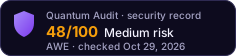
- Oct 29, 202648Medium
Score changes are recorded as dated snapshots — history is append-only and cannot be edited.
Frequently Asked Questions
What is the AWE contract address?
The AWE Network (AWE) contract on Base is 0x1b4617734c43f6159f3a70b7e06d883647512778. Compare it with the address the project itself publishes before trading: other contracts can carry the same name and ticker.
Is AWE Network a scam?
Quantum Audit's risk score for AWE Network is 48/100 (Medium risk) as of Oct 29, 2026, computed by a deterministic function from on-chain facts — Contract verified: Verified; Mint: No mint; Liquidity lock: Not locked; Upgradeability: Upgradeable; Honeypot: None found; Buy / sell tax: 0% / 0%. A score is a dated snapshot of those facts, not a guarantee; each one is listed on this page.
Is AWE liquidity locked?
Liquidity lock: Not locked (as of Oct 29, 2026). Total DEX liquidity: $408.1K.
Who holds AWE?
As of Oct 29, 2026, the 10 largest holders own 69.8% of the supply across 12,662 holders. The Holders section on this page shows who they are by holder type.
Would You Like a More Detailed Audit of AWE Network?
Our AI-powered scanner gives you a deeper, real-time smart contract analysis — free, with every scoring factor shown.
Get Detailed Audit Is this your token? Add your links and get it Verified