Quantum Audit Logo
Ethereum · Meme Token Security · Jul 24, 2026

Is Asteroid Shiba a Scam? ASTEROID

Honeypot, rug-pull and ownership checks

Contract 0xf280…4126 DexScreener ↗
i Our automated scanner reviewed Asteroid Shiba (ASTEROID) on Ethereum. 5 of 5 security checks passed — see the full breakdown below.
Volume 24h
$1.07M
Liquidity
$1.82M
Price
$0.00006393
Age
1y
Top 10 Holders
16.3%

Rug Pull Risk Checklist

Contract VerifiedPass
Ownership RenouncedPass
No Mint FunctionPass
Liquidity LockedPass
Not a ProxyPass

Audit History

Every audit run adds a dated snapshot — history is append-only and cannot be edited.

Audit Summary

The Asteroid Shiba (AS) token contract is an ERC-20 token with significant owner privileges, including the ability to modify tax rates, transaction limits, and wallet size limits. This high degree of centralization introduces critical risks, including the potential for a honeypot scenario where the owner could prevent users from selling or impose prohibitive taxes. While the contract implements anti-bot and anti-whale measures, these can be bypassed by the owner. The use of SafeMath is redundant in Solidity 0.8.25, and a lack of event emissions for critical state changes reduces transparency.
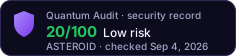

Final Recommendation: Given the critical centralization risks and potential for a honeypot, users should exercise extreme caution. It is strongly recommended to decentralize control over critical parameters by implementing a multi-signature wallet or a time-locked governance mechanism for sensitive functions. All critical state changes should emit events to ensure transparency and allow for off-chain monitoring. Consider removing the redundant SafeMath library to optimize gas usage. Thoroughly review and test all anti-bot and anti-whale mechanisms to ensure they function as intended and cannot be easily bypassed, especially by the owner.

Category Ratings

TechnicalMedium
5/10

The contract's technical architecture (7.1) is a standard ERC-20 implementation with added tax and anti-bot/anti-whale mechanisms. Code security (7.2) benefits from Solidity 0.8.25's built-in overflow checks, though SafeMath is redundantly used. However, the contract exhibits a lack of eve

GovernanceLow
7/10

The economic model (7.4) is highly centralized, granting the owner extensive control over all critical parameters, including buy/sell taxes, transaction limits, wallet size limits, and the ability to enable/disable trading. This level of control creates a significant honeypot risk, as the owner can

UpgradesLow
8/10

The contract is not designed to be upgradeable (7.7). There are no proxy patterns or upgrade interfaces implemented, meaning the contract's logic is immutable once deployed. This eliminates upgrade-related risks but also prevents any future bug fixes or feature enhancements without a new deploy

LP Distribution

LP Burned95.9% · ≈ permanent lock
LP Locked95.9% · Null Address

What Raised This Score

Each factor is an on-chain fact recorded at the time of this analysis. The score is computed from them by a deterministic function, so the same contract returns the same score for anyone who runs the audit. How scores are computed

Security Findings

2 Critical 1 High 2 Medium 1 Low 2 Info
C-01CriticalUnresolved

Extreme Centralization and Owner Privileges

The contract owner possesses extensive control over nearly all critical parameters, including tax rates (_initialBuyTax, _initialSellTax, _finalBuyTax, _finalSellTax), transaction limits (_maxTxAmount), wallet size limits (_maxWalletSize), swap thresholds (_taxSwapThreshold, _maxTaxSwap), anti-bot measures (sellsPerBlock, buysFirstBlock), and the ability to enable/disable trading (tradingOpen, swapEnabled). The owner can also whitelist addresses via the `isExile` mapping to bypass all restrictions. This level of centralization allows the owner to unilaterally alter the token's economic model and operational behavior, posing a severe risk to token holders.

Recommendation: Decentralize control over critical parameters. Implement a multi-signature wallet for sensitive operations or introduce a time-locked governance mechanism for changes to tax rates, limits, and trading status. Remove the `isExile` mapping or restrict its use to only essential protocol addresses, not arbitrary user addresses.
C-02CriticalUnresolved

Honeypot Potential

Due to the extreme centralization (C-01), the contract has significant honeypot potential. The owner can, at any time, set the sell tax to 100%, set the maximum transaction amount for sells to zero, or set the maximum wallet size to a value that prevents existing holders from selling. This would effectively trap user funds within the contract, making them unsellable and leading to total loss for investors.

Recommendation: Implement immutable tax rates and transaction limits, or subject any changes to a decentralized governance process with a time-lock. Ensure that minimum sell transaction amounts and maximum wallet sizes cannot be set to values that would prevent legitimate users from selling their tokens.
H-01HighUnresolved

Anti-Bot/Anti-Whale Mechanisms Bypass

The contract implements anti-bot (e.g., `sellsPerBlock`, `buysFirstBlock`) and anti-whale (`_maxTxAmount`, `_maxWalletSize`) mechanisms. However, the `isExile` mapping, controlled by the owner, allows any address to bypass these restrictions. This means the owner can whitelist their own addresses or those of favored parties, rendering the anti-bot/anti-whale measures ineffective for those addresses and creating an unfair advantage or potential for manipulation.

Recommendation: Re-evaluate the necessity and scope of the `isExile` mapping. If critical for protocol operations, restrict its use to only contract-internal addresses (e.g., router, treasury) and remove the owner's ability to add arbitrary user addresses. Ensure all users are subject to the same rules.
M-01MediumUnresolved

Lack of Event Emission for Critical State Changes

Many critical owner-controlled parameters, such as `_maxTxAmount`, `_maxWalletSize`, various tax rates, `swapEnabled`, `tradingOpen`, `sellsPerBlock`, `buysFirstBlock`, and `isExile` status, can be modified without emitting corresponding events. This lack of transparency makes it difficult for users and off-chain monitoring tools to track changes to the contract's behavior and economic model, increasing trust requirements.

Recommendation: Emit explicit events for every function that modifies a critical state variable. For example, `MaxTxAmountUpdated(uint256 newAmount)`, `TaxRatesUpdated(uint256 newBuyTax, uint256 newSellTax)`, `SwapEnabledToggled(bool status)`, `ExileStatusUpdated(address indexed account, bool isExiled)`. This improves transparency and auditability.
M-02MediumUnresolved

Potential for Stuck ETH in Swap Mechanism

The `swapAndLiquify` function transfers ETH to the `_taxWallet` after swapping tokens. If the `_taxWallet` address is a contract that does not have a `receive()` or `fallback()` function capable of accepting ETH, or if it reverts during the transfer, the entire swap operation could fail. This could lead to a denial of service for the automatic liquidity/tax collection mechanism, potentially accumulating tokens in the contract without being able to process them.

Recommendation: Implement robust error handling for external ETH transfers. Consider adding a mechanism for the owner to recover stuck ETH from the contract if the `_taxWallet` becomes problematic. Ensure the `_taxWallet` is a reliable address or a contract designed to accept ETH.
L-01LowUnresolved

Unchecked Return Values for External Calls

The contract makes external calls to `IUniswapV2Factory.createPair` and `IUniswapV2Router02.swapExactTokensForETHSupportingFeeOnTransferTokens` without explicitly checking their boolean return values. While Uniswap functions typically revert on failure, explicitly checking return values is a best practice to ensure expected behavior and prevent unexpected state. The `_approve` function is internal, but its usage in `transferFrom` relies on `SafeMath` for allowance checks.

Recommendation: Explicitly check the return values of external calls where applicable, especially for functions that return a boolean indicating success or failure. Although Uniswap functions often revert, defensive programming suggests checking for unexpected behavior.
I-01InformationalUnresolved

Redundant SafeMath Library

The contract uses the `SafeMath` library for arithmetic operations. However, the contract is compiled with Solidity 0.8.25, which includes built-in overflow and underflow checks by default. The use of `SafeMath` in this context is redundant and adds unnecessary gas overhead for each arithmetic operation.

Recommendation: Remove the `SafeMath` library and directly use native arithmetic operators. Solidity 0.8.0 and later versions automatically handle overflow/underflow, making `SafeMath` obsolete for basic arithmetic.
I-02InformationalUnresolved

Hardcoded Uniswap Router Address

The Uniswap V2 Router address (0x7a250d5630B4cF539739dF2C5dAcb4c659F2488D) is hardcoded in the constructor. While this is common for mainnet deployments, it reduces flexibility. If the Uniswap router address changes in the future or if the contract were to be deployed on a different network with a different router address, the contract would need to be redeployed.

Recommendation: Consider making the Uniswap router address configurable by the owner through a setter function, or pass it as a constructor argument. This would allow for greater flexibility and adaptability to future changes or multi-chain deployments.

Frequently Asked Questions

Is Asteroid Shiba a scam?

Based on available on-chain data, Asteroid Shiba exhibits characteristics that typically differentiate it from common scam projects. The contract is verified, ownership has been renounced, and no mint function exists, which collectively reduce the risk of rug pulls or unauthorized token creation by the deployer. These factors suggest a degree of technical robustness and transparency.

Is Asteroid Shiba safe to buy?

Asteroid Shiba features several safety measures, including locked liquidity and renounced ownership, which contribute to its low-risk score of 0/100 from a contract security standpoint. However, no cryptocurrency investment is entirely without risk. Investors should be aware of the 13.7% token concentration among the top 10 holders and the inherent volatility of the crypto market.

Has Asteroid Shiba been audited?

The provided data indicates the Asteroid Shiba contract is 'verified,' meaning its source code is publicly available and matches the deployed bytecode on the Ethereum blockchain. While this promotes transparency, it is distinct from a formal security audit conducted by an independent third party, which would typically involve a deeper code review for vulnerabilities.

Would You Like a More Detailed Audit of Asteroid Shiba?

Paste the contract address into our AI-powered scanner for a deeper real-time report — free, no signup required.

Get Detailed Audit
Check Any Token →