The DERC20 contract is a standard ERC-20 implementation with added governance, voting, and vesting capabilities. The protocol relies on a centralized owner to manage minting rates and pool access. While the code follows standard OpenZeppelin patterns, the high level of administrative control over token supply and transferability introduces significant trust requirements for token holders.
Early-stage security check — honeypot & rug-pull analysis
Is AOP a Scam?
Not verified
This record has not gone through deep verification and is not being monitored. The score is a dated snapshot — the token’s risk can change at any time.Own this token? Put it under verification →The DERC20 contract is a standard ERC-20 implementation with added governance, voting, and vesting capabilities.
Read the full analysis- Owner can pause all transfers
- A privileged address controls a switch that decides whether transfers go through
- Mintable supply — no cap found, dilution unbounded
- LP lock status UNKNOWN — the pool's LP could not be read
- Top-10 concentration > 30%
Exact factors
- Owner can pause all transfers
- A privileged address controls a switch that decides whether transfers go through
- Mintable supply — no cap found, dilution unbounded
- LP lock status UNKNOWN — the pool's LP could not be read
- Top-10 concentration > 30% (95.4% total → 38.5% effective; 0.5% in EOAs, 95.0% in contracts)
Each factor is an on-chain fact recorded at the time of this analysis. The score is computed from them by a deterministic function, so the same contract returns the same score for anyone who runs the audit. How scores are computed
Security Checklist
as of audit · Nov 7Holders
as of audit · Nov 7, 2026- Contractstreasury, vesting, bridge, staking95.0%
- Walletsanonymous holders, free to sell0.5%
- Everyone else144 holders4.6%
How holder types affect the score
Share held by contracts — treasury, vesting, bridge or staking — is discounted against share held by wallets when the score is computed: a contract cannot decide to sell the way an anonymous holder can, though it can still be drained or voted to sell. Effective concentration is the figure the risk score is actually calculated from.
Holder balances as recorded by the audit of Nov 7, 2026
Liquidity
as of audit · Nov 7The risk score reads depth across every pair.
Whether the LP tokens are locked could not be determined.
Security Findings
MediumCentralized Control Over Token Supply
The owner has the authority to call updateMintRate and release, which can increase the total supply of the token. This allows the owner to dilute the holdings of all existing token holders at their discretion.CP-01
Issue
The owner has the authority to call updateMintRate and release, which can increase the total supply of the token. This allows the owner to dilute the holdings of all existing token holders at their discretion.
Fix
Implement a timelock for minting operations or move the control to a decentralized governance mechanism to ensure community oversight.
Status
Unresolved
MediumCentralized Control Over Transferability
The owner can use the lockPool and unlockPool functions to toggle a switch that controls whether transfers are allowed. This gives the owner the power to freeze user funds or halt trading activity unilaterally.CP-05
Issue
The owner can use the lockPool and unlockPool functions to toggle a switch that controls whether transfers are allowed. This gives the owner the power to freeze user funds or halt trading activity unilaterally.
Fix
Remove the ability to arbitrarily lock transfers or restrict this functionality to emergency scenarios governed by a multi-sig or decentralized vote.
Status
Unresolved
InfoWho holds the supply
The ten largest holders own 95.4% of supply. What remains: 0.5% in wallets, 95.0% in other contracts. 154 holders in total.QA-HOLDERS
Issue
The ten largest holders own 95.4% of supply. What remains: 0.5% in wallets, 95.0% in other contracts. 154 holders in total.
Fix
Watch the largest wallets that are not exchanges, pools or locks — those are the ones that can move the price.
Status
Acknowledged
InfoNot listed by any independent source
154 holders. Not listed by CoinGecko or any exchange GoPlus tracks. Nothing independent confirms who is behind this token, so every power its contract grants is scored at face value.QA-IDENTITY
Issue
154 holders. Not listed by CoinGecko or any exchange GoPlus tracks. Nothing independent confirms who is behind this token, so every power its contract grants is scored at face value.
Fix
Match the contract address against the project's official channels before trading.
Status
Acknowledged
InfoThe market for this token
Liquidity $29.1M (DexScreener, all pools). 24h trading volume $244K (DexScreener, all pools).QA-MARKET
Issue
Liquidity $29.1M (DexScreener, all pools). 24h trading volume $244K (DexScreener, all pools).
Fix
Size any position to the liquidity and daily volume shown — they set how much you can sell and at what price.
Status
Acknowledged
InfoAsset class: Project token
A token issued by a project for use, governance or fundraising. Scored on its contract and market facts. The class itself adds no points; the contract and market facts decide the score. Basis: no class-specific evidence. Tokenomics — Supply: mintable with no on-chain cap found. Control: a ProxyAdmin contract. Code: not upgradeable (no proxy). Fees: no buy or sell tax. Market: $29.1M of DEX liquidity across 1 pools. Launch: under a day of market history.QA-PROFILE
Issue
A token issued by a project for use, governance or fundraising. Scored on its contract and market facts. The class itself adds no points; the contract and market facts decide the score. Basis: no class-specific evidence. Tokenomics — Supply: mintable with no on-chain cap found. Control: a ProxyAdmin contract. Code: not upgradeable (no proxy). Fees: no buy or sell tax. Market: $29.1M of DEX liquidity across 1 pools. Launch: under a day of market history.
Fix
Check the project's own documentation for what the token is used for; this report covers what the contract allows.
Status
Acknowledged
InfoRecently launched — less than a day of market history
The token's oldest DEX pool is less than a day old. Age is not part of the risk score — a new token is not a risky one by default — but a short history means fewer trades and holder changes behind the facts in this report.QA-RECENT
Issue
The token's oldest DEX pool is less than a day old. Age is not part of the risk score — a new token is not a risky one by default — but a short history means fewer trades and holder changes behind the facts in this report.
Fix
Re-check ownership, liquidity and holder distribution as the token matures; those are the facts that move early.
Status
Acknowledged
Analysis
AI Copilotas of audit · Nov 7The architecture utilizes robust OpenZeppelin standards for ERC-20, EIP-712, and voting mechanisms. Code security is high, with well-defined state transitions and clear logic for vesting and inflation. 7.1 Architecture and 7.2 Code Security are well-implemented, though 7.3 Access Control is highly centralized.
Economic parameters are governed by the owner, who can influence supply via minting and restrict liquidity via pool locking. 7.4 Economic and 7.5 Governance items are heavily reliant on the owner's address. There are no automated safeguards or timelocks for these administrative actions.
The contract is not a proxy and does not support upgrades. 7.7 Upgrades are not applicable as the logic is immutable. 7.8 Operations are limited to the owner's defined administrative functions.
To improve security, consider transitioning the owner role to a multi-signature wallet or a decentralized governance contract to mitigate single-point-of-failure risks.
Implementing a timelock on sensitive functions like updateMintRate would provide transparency and allow the community to react to significant economic changes.
Contract & Record
Free for any token on the record. It links to this page and always shows the current score and the date it was checked.
- Nov 7, 202656Medium
Score changes are recorded as dated snapshots — history is append-only and cannot be edited.
Frequently Asked Questions
What is the AOP contract address?
The AOP contract on Base is 0x19c2136e2466787676336fdcb3660fc843762bd5. Compare it with the address the project itself publishes before trading: other contracts can carry the same name and ticker.
Is AOP a scam?
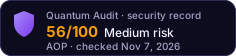
Quantum Audit's risk score for AOP is 56/100 (Medium risk) as of Nov 7, 2026, computed by a deterministic function from on-chain facts — Contract verified: Verified; Ownership: Retained; Mint: Mintable; Upgradeability: Fixed code; Honeypot: None found; Buy / sell tax: 0% / 0%. A score is a dated snapshot of those facts, not a guarantee; each one is listed on this page.
Who holds AOP?
As of Nov 7, 2026, the 10 largest holders own 95.4% of the supply across 154 holders. The Holders section on this page shows who they are by holder type.
Would You Like a More Detailed Audit of AOP?
This token is brand new. Run a deeper AI-powered analysis of the contract code — free and instant.
Get Detailed Audit Is this your token? Add your links and get it Verified