
Quantum Audit Logo
Ethereum · Smart Contract Security · Updated Jul 24, 2026

Is 01 Safe? 01

On-chain security analysis — is it a scam or legit?

Contract 0x3270…a4ca DexScreener ↗
Volume 24h
$536.3K
Liquidity
$681.1K
Price
$0.5855
Token Age
1mo
Top 10 Holders
9.0%

Security Checklist

Contract VerifiedPass
Ownership RenouncedUnknown
No Mint FunctionPass
Liquidity LockedFail
Not a ProxyPass

Audit History

Jul 2411

Every audit run adds a dated snapshot — history is append-only and cannot be edited.

Audit Summary

The Coin01 token contract is a standard ERC20 implementation with a fixed maximum supply and centralized minting/burning capabilities controlled by an immutable 'curve' address. The code is simple, leverages OpenZeppelin's audited libraries, and demonstrates good security practices for its scope. The primary risk stems from the centralized control over token supply and the immutability of the controlling address, which requires robust security measures for the 'curve' address itself.
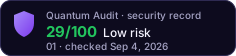

Final Recommendation: It is recommended to ensure the `curve` address is secured with robust multi-signature governance or a well-audited protocol contract to mitigate the risks associated with centralized control over token supply. Consider implementing an emergency pause mechanism in future iterations if the token is intended for integration into complex DeFi ecosystems, to provide a failsafe in critical situations.

Category Ratings

TechnicalLow
10/10

The technical architecture of Coin01 is straightforward, implementing a standard ERC20 token (7.1 Architecture). It utilizes OpenZeppelin's battle-tested ERC20 library, which significantly enhances code security and reduces the likelihood of common vulnerabilities like reentrancy or integer ove

GovernanceMedium
5/10

The economic model of Coin01 features a hard-capped maximum supply, preventing inflationary attacks beyond the defined limit (7.4 Economic). However, the `curve` address holds exclusive power to mint tokens up to this cap and burn tokens, representing a significant centralization of control over the

UpgradesMedium
6/10

The Coin01 contract is not designed to be upgradeable (7.7 Upgrades). The `curve` address, which controls minting and burning, is set as `immutable` in the constructor. This design choice eliminates upgrade-related risks for the token contract itself but introduces inflexibility, as the `curve` cont

LP Distribution

Top-1 Unlocked Holder6.2%

What Raised This Score

Each factor is an on-chain fact recorded at the time of this analysis. The score is computed from them by a deterministic function, so the same contract returns the same score for anyone who runs the audit. How scores are computed

Security Findings

1 Medium 1 Low 2 Info
M-01MediumUnresolved

Centralized Mint/Burn Control

The `curve` address has exclusive control over minting new tokens up to `MAX_SUPPLY` and burning existing tokens. This grants significant power over the token's supply, making the security of the `curve` address paramount. While a common design for protocol-controlled tokens, a compromise of this address could lead to arbitrary token minting (up to cap) or burning, severely impacting token value and user trust.

Recommendation: Implement robust security measures for the `curve` address, such as a multi-signature wallet, a time-locked contract, or a well-audited governance mechanism. Ensure that the operational security surrounding the `curve` address is of the highest standard to prevent unauthorized access or malicious actions.
L-01LowUnresolved

Immutability of `curve` Address

The `curve` address is set in the constructor and declared `immutable`. This design choice means the `curve` controller cannot be updated or replaced without deploying a new token contract. While preventing unauthorized changes, it introduces inflexibility and a single point of failure if the `curve` contract itself needs upgrades or if its private keys are compromised, requiring a full token migration.

Recommendation: Acknowledge this design constraint. If future flexibility is desired for the `curve` controller, consider a design pattern where the controller address can be updated by a trusted entity (e.g., a governance contract or a multi-sig) through a controlled mechanism. For the current design, ensure the `curve` address is extremely stable and secure.
I-01InformationalUnresolved

Dependency on OpenZeppelin Contracts

The contract relies heavily on OpenZeppelin's ERC20 implementation (v5.5.0). While OpenZeppelin contracts are well-audited and a standard for secure development, any future vulnerabilities discovered in the specific version used could indirectly affect this contract.

Recommendation: Regularly monitor OpenZeppelin's security advisories and updates. While direct action on this contract may not be possible if it's not upgradeable, awareness is key for future deployments or if a token migration becomes necessary due to a critical vulnerability in the underlying library.
I-02InformationalUnresolved

Lack of Emergency Pause Mechanism

The contract does not include a mechanism to pause token transfers or minting/burning operations in an emergency. In scenarios like critical vulnerabilities in integrated protocols or market manipulation, the absence of a pause function limits the ability to react and mitigate potential damage.

Recommendation: For tokens intended for complex DeFi ecosystems, consider adding a pause mechanism (e.g., using OpenZeppelin's `Pausable` module) controlled by a trusted entity (e.g., governance or multi-sig). This provides a crucial failsafe for unforeseen circumstances.

Would You Like a More Detailed Audit of 01?

Our AI-powered scanner gives you a deeper, real-time smart contract analysis — free, no signup required.

Get Detailed Audit
Run Free Audit →