
The protocol is a centralized stablecoin implementation featuring extensive administrative controls. While the core ERC-20 logic is standard and well-tested, the contract grants significant power to privileged roles, including minting, blacklisting, and forced burning of tokens. These features are typical for regulated stablecoins but introduce centralized trust requirements.
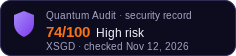
On-chain security analysis — is it a scam or legit?
Is XSGD Safe?
Not verified
This record has not gone through deep verification and is not being monitored. The score is a dated snapshot — the token’s risk can change at any time.Own this token? Put it under verification →The protocol is a centralized stablecoin implementation featuring extensive administrative controls.
Read the full analysis- Owner can change any holder's balance
- Owner can pause all transfers; held by pauser: Multisig
- Owner can blacklist or freeze individual holders; held by blacklister: Multisig
- Mintable supply — no cap found, dilution unbounded
- Upgradeable proxy — the admin can replace the logic; admin: Multisig
- LP lock status UNKNOWN — the deepest pool's LP could not be read; this pool is 65% of DEX liquidity
- Liquidity not locked
- Top-10 concentration > 70%
Exact factors
- Owner can change any holder's balance (seize or credit tokens); held by blacklister: Multisig
- Owner can pause all transfers; held by pauser: Multisig
- Owner can blacklist or freeze individual holders; held by blacklister: Multisig
- Mintable supply — no cap found, dilution unbounded
- Upgradeable proxy — the admin can replace the logic; admin: Multisig
- LP lock status UNKNOWN — the deepest pool's LP could not be read; this pool is 65% of DEX liquidity
- Liquidity NOT locked (100% of the pool; this pool is 1% of DEX liquidity) — held by independent providers — market-depth risk
- Top-10 concentration > 70% (93.1% total → 70.9% effective; 56.1% in EOAs, 37.0% in contracts)
Each factor is an on-chain fact recorded at the time of this analysis. The score is computed from them by a deterministic function, so the same contract returns the same score for anyone who runs the audit. How scores are computed
Security Checklist
as of audit · Nov 12Holders
as of audit · Nov 12, 2026- Contractstreasury, vesting, bridge, staking37.0%
- Walletsanonymous holders, free to sell56.1%
- Everyone else1,296 holders6.9%
How holder types affect the score
Share held by contracts — treasury, vesting, bridge or staking — is discounted against share held by wallets when the score is computed: a contract cannot decide to sell the way an anonymous holder can, though it can still be drained or voted to sell. Effective concentration is the figure the risk score is actually calculated from.
Holder balances as recorded by the audit of Nov 12, 2026
Liquidity
as of audit · Nov 12- AeroUSDCAnalysed$430.6K65.1%
- AeroWETH$198.2K30.0%
- AerodromeUSDC$20.8K3.2%
- Uniswap v3USDC$7.4K1.1%
- Uniswap v4THBT$3.0K0.5%
- AerodromeWETH$1.0K0.2%
Show 1 more pair
The risk score reads depth across every pair.
The LP tokens of the checked pool, Uniswap v3, are not locked or burned, so whoever holds them can withdraw that liquidity. The LP of the deepest pool (65.1% of depth) could not be read, so whether it is locked is unknown.
0xd2e9…69a40x3642…121e0xe5ec…70630xda94…85140xfed7…08170x504b…eee50x2566…31d60x9cc6…37510x486b…1ec60x4ffd…9a6cNo privileged address appears among these holders: the unlocked liquidity sits with independent providers, not with the deployer.
Security Findings
HighForced Balance Wiping
The lawEnforcementWipingBurn function allows the blacklister role to permanently remove tokens from any blacklisted address, effectively seizing user funds.CP-02
Issue
The lawEnforcementWipingBurn function allows the blacklister role to permanently remove tokens from any blacklisted address, effectively seizing user funds.
Fix
This function should only be used in strict compliance with legal requirements and documented procedures.
Status
Unresolved
MediumCentralized Minting Authority
The mint(address,uint256) function allows authorized minters to increase the total supply of the token at any time, which can dilute the value of existing holdings.CP-01
Issue
The mint(address,uint256) function allows authorized minters to increase the total supply of the token at any time, which can dilute the value of existing holdings.
Fix
Ensure that the minter addresses are managed by a secure, multi-signature wallet and that minting events are publicly monitored.
Status
Unresolved
MediumGlobal Pause Mechanism
The pauser role can invoke the pause() function to halt all token transfers, preventing users from moving or selling their assets during the pause period.CP-04
Issue
The pauser role can invoke the pause() function to halt all token transfers, preventing users from moving or selling their assets during the pause period.
Fix
Limit the use of the pause functionality to emergency scenarios only and provide clear communication to users when active.
Status
Unresolved
MediumAddress Blacklisting
The blacklister role can add any address to a blacklist, which prevents that address from transferring or receiving tokens, effectively freezing the user's assets.CP-06
Issue
The blacklister role can add any address to a blacklist, which prevents that address from transferring or receiving tokens, effectively freezing the user's assets.
Fix
Maintain a transparent policy for blacklisting and ensure that the process is subject to oversight.
Status
Unresolved
MediumLiquidity not locked
0.0% of the pool's LP is burned or time-locked. 100.0% is held, unlocked, by 10 address(es) other than the owner/deployer. No single one holds a majority: their exits thin the market rather than hand anyone the pool. Some pools are concentrated-liquidity (V3/V4) positions; shares above are by position as GoPlus reports them. This assessment covers the main pool, which holds 65% of the token's DEX liquidity; the other pools were not assessed.QA-LIQUIDITY
Issue
0.0% of the pool's LP is burned or time-locked. 100.0% is held, unlocked, by 10 address(es) other than the owner/deployer. No single one holds a majority: their exits thin the market rather than hand anyone the pool. Some pools are concentrated-liquidity (V3/V4) positions; shares above are by position as GoPlus reports them. This assessment covers the main pool, which holds 65% of the token's DEX liquidity; the other pools were not assessed.
Fix
Check the lock's end date and beneficiary on the locker's own page before relying on it.
Status
Acknowledged
InfoWho holds the supply
The ten largest holders own 93.1% of supply. What remains: 56.1% in wallets, 37.0% in other contracts. 1,306 holders in total.QA-HOLDERS
Issue
The ten largest holders own 93.1% of supply. What remains: 56.1% in wallets, 37.0% in other contracts. 1,306 holders in total.
Fix
Watch the largest wallets that are not exchanges, pools or locks — those are the ones that can move the price.
Status
Acknowledged
InfoListed, but not independently verified
Listed on CoinGecko as XSGD (XSGD), market cap $12M, rank #1058. 1,306 holders.QA-IDENTITY
Issue
Listed on CoinGecko as XSGD (XSGD), market cap $12M, rank #1058. 1,306 holders.
Fix
Match the contract address against the project's official channels before trading.
Status
Acknowledged
InfoThe market for this token
Liquidity $661K (DexScreener, all pools). 24h trading volume $615K (CoinGecko, all markets, daily snapshot). 24h trading volume $463K (DexScreener, all pools).QA-MARKET
Issue
Liquidity $661K (DexScreener, all pools). 24h trading volume $615K (CoinGecko, all markets, daily snapshot). 24h trading volume $463K (DexScreener, all pools).
Fix
Size any position to the liquidity and daily volume shown — they set how much you can sell and at what price.
Status
Acknowledged
InfoAsset class: Stablecoin — issuer-backed (fiat reserves)
A token designed to hold a fixed value (usually $1). Its safety rests on what backs it and on who can mint, freeze or pause it. Its identity is not independently verified, so it gets none of the allowances an established stablecoin gets: every power its owner holds over supply and transfers is scored in full, because a peg is only as good as whoever can mint. Basis: CoinGecko category: Fiat-backed Stablecoin. Tokenomics — Supply: mintable with no on-chain cap found. Control: a 3-of-5 multisig. Code: upgradeable proxy. Fees: no buy or sell tax. Market: $661K of DEX liquidity across 7 pools. Launch: 212 days of market history.QA-PROFILE
Issue
A token designed to hold a fixed value (usually $1). Its safety rests on what backs it and on who can mint, freeze or pause it. Its identity is not independently verified, so it gets none of the allowances an established stablecoin gets: every power its owner holds over supply and transfers is scored in full, because a peg is only as good as whoever can mint. Basis: CoinGecko category: Fiat-backed Stablecoin. Tokenomics — Supply: mintable with no on-chain cap found. Control: a 3-of-5 multisig. Code: upgradeable proxy. Fees: no buy or sell tax. Market: $661K of DEX liquidity across 7 pools. Launch: 212 days of market history.
Fix
Check what backs the peg and who controls supply: reserve attestations for an issuer-backed coin, collateral and governance for a protocol coin.
Status
Acknowledged
Analysis
AI Copilotas of audit · Nov 12The codebase utilizes established patterns for proxy-based upgradeability and standard ERC-20 compliance. 7.1 Architecture follows a modular proxy pattern, while 7.2 Code Security is robust with clear separation of concerns. 7.3 Access Control is strictly enforced via role-based modifiers, ensuring only authorized addresses can trigger sensitive functions like minting or pausing.
7.4 Economic and 7.5 Governance risks are inherent to the centralized nature of the token. The protocol relies on a multisig-governed owner to manage roles, which mitigates single-point-of-failure risks. However, the ability for privileged roles to mint supply or wipe balances represents a significant centralization of economic power.
7.7 Upgrades are managed through a proxy pattern, allowing for future logic updates while preserving state. 7.8 Operations are supported by a clear administrative structure. The upgrade mechanism is secured by a multisig, ensuring that changes to the implementation require consensus among multiple stakeholders.
Users should be aware that this token is highly centralized and subject to administrative actions such as blacklisting and forced burning.
Ensure that the multisig signers are reputable and that the governance process is transparent. For the operators, maintain strict security protocols for the private keys associated with the minter, blacklister, and owner roles. Regularly audit the list of authorized addresses to ensure that only active and necessary entities retain privileged access.
Contract & Record
Free for any token on the record. It links to this page and always shows the current score and the date it was checked.
- Nov 12, 202674High
Score changes are recorded as dated snapshots — history is append-only and cannot be edited.
Would You Like a More Detailed Audit of XSGD?
Our AI-powered scanner gives you a deeper, real-time smart contract analysis — free, with every scoring factor shown.
Get Detailed Audit Is this your token? Add your links and get it Verified