Quantum Audit Logo

Is Valtherix AI Safe?

On-chain security analysis — is it a scam or legit?

Valtherix AI VLTX
0x3329…5b6b
Base Not verifiedLast checked 3d ago 1 audit on record
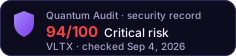
How is this score calculated? → Critical Risk
Executive SummaryAI Copilot

The Valtherix AI Token contract, written in Vyper, implements basic ERC-20 functionality. The audit identified critical vulnerabilities related to immediate ownership renunciation and an unintended native token draining mechanism. These issues pose significant risks to the project's long-term viability and potential loss of funds if native tokens are sent to the contract. Additionally, there are minor issues concerning unused code and redundant state variables.

2 Critical1 Medium1 Low1 Informational
Volume 24h
$243.3K
Liquidity
$424.6K
Price
$0.4209
Token Age
19d
Top 10 Holders
78.4%

Security Findings

Critical

Immediate Ownership Renunciation

C-01The `__init__` function calls `self.transferOwnership(0x0000…0000)`, which immediately transfers ownership to the zero address. This effectively renounces ownership of the contract, meaning no entity will have administrative control over the token contract after deployment. This prevents any future upgrades, parameter changes, or bug fixes, making the contract immutable and unmanageable.
IssueThe `__init__` function calls `self.transferOwnership()`, which immediately transfers ownership to the zero address. This effectively renounces ownership of the contract, meaning no entity will have administrative control over the token contract after deployment. This prevents any future upgrades, parameter changes, or bug fixes, making the contract immutable and unmanageable.
FixIf administrative control is desired, remove the `transferOwnership(0x0)` call from the `__init__` function and instead transfer ownership to a designated multisig wallet or governance contract. If immutability is the explicit design choice, ensure all functionalities are thoroughly audited and tested, and clearly document this design decision.
StatusUnresolved
Critical

Unintended Native Token Draining Mechanism

C-02The `transfer` and `transferFrom` functions contain the line `self.feeWallet.send(value = self.balance)`. This attempts to send the *entire native token balance* (e.g., ETH on Ethereum, MATIC on Polygon) held by the token contract to the `feeWallet` address on every token transfer. Token contracts are generally not intended to hold native tokens, and if native tokens are accidentally sent to this contract, they will be drained to the `feeWallet` with every subsequent token transfer, leading to a critical loss of funds.
IssueThe `transfer` and `transferFrom` functions contain the line `self.feeWallet.send(value = self.balance)`. This attempts to send the *entire native token balance* (e.g., ETH on Ethereum, MATIC on Polygon) held by the token contract to the `feeWallet` address on every token transfer. Token contracts are generally not intended to hold native tokens, and if native tokens are accidentally sent to this contract, they will be drained to the `feeWallet` with every subsequent token transfer, leading to a critical loss of funds.
FixRemove the line `self.feeWallet.send(value = self.balance)` from both `transfer` and `transferFrom` functions. If a fee mechanism is intended, it should be carefully designed to handle token fees (not native token fees from the contract's balance) and clearly documented.
StatusUnresolved
Medium

Unused Interface and Dead Code

M-01The `UniswapRouterV2` interface is imported but never utilized within the contract. Additionally, the `checkSum` function takes six `uint256` parameters, sums them, and returns `True` if the sum is zero, but this function is never called internally or externally and serves no apparent purpose. Unused code increases contract size, deployment costs, and audit complexity without providing any functional benefit.
IssueThe `UniswapRouterV2` interface is imported but never utilized within the contract. Additionally, the `checkSum` function takes six `uint256` parameters, sums them, and returns `True` if the sum is zero, but this function is never called internally or externally and serves no apparent purpose. Unused code increases contract size, deployment costs, and audit complexity without providing any functional benefit.
FixRemove the `interface UniswapRouterV2` declaration if it's not intended for use. Similarly, remove the `checkSum` function if it is dead code. Only include necessary code to reduce contract footprint and improve readability.
StatusUnresolved
Low

Redundant State Variables

L-01The state variables `lastFrom`, `lastTo`, and `sender` are updated in `transfer` and `transferFrom` functions. However, they only store the details of the *last* transaction and are immediately overwritten by the next. They do not contribute to the core ERC-20 functionality, security, or any apparent operational logic of the token. Storing these variables consumes gas and storage unnecessarily.
IssueThe state variables `lastFrom`, `lastTo`, and `sender` are updated in `transfer` and `transferFrom` functions. However, they only store the details of the *last* transaction and are immediately overwritten by the next. They do not contribute to the core ERC-20 functionality, security, or any apparent operational logic of the token. Storing these variables consumes gas and storage unnecessarily.
FixRemove the `lastFrom`, `lastTo`, and `sender` state variables and their assignments from the `transfer` and `transferFrom` functions. If tracking transaction history is required, it should be done off-chain by monitoring emitted events.
StatusUnresolved
Info

Vyper Version and EVM Version Pragmas

I-01The contract includes `# @pragma evm-version cancun` and `#pragma version ^0.3.10`. While Vyper 0.3.10 supports Cancun, the `@pragma evm-version` syntax is more commonly associated with Solidity. For Vyper, specifying the `evm-version` in the compiler command or configuration is typical, rather than as a pragma within the source file.
IssueThe contract includes `# @pragma evm-version cancun` and `#pragma version ^0.3.10`. While Vyper 0.3.10 supports Cancun, the `@pragma evm-version` syntax is more commonly associated with Solidity. For Vyper, specifying the `evm-version` in the compiler command or configuration is typical, rather than as a pragma within the source file.
FixEnsure consistent and standard pragma usage for Vyper. While not a vulnerability, adhering to standard practices improves clarity and tooling compatibility. Consider removing the `@pragma evm-version cancun` line if it's not the standard Vyper way to specify the EVM version.
StatusUnresolved

Category Ratings

TechnicalMedium4/10

The contract implements standard ERC-20 functions for token transfers and approvals (7.1 Architecture). However, a critical design flaw exists where the contract immediately renounces ownership upon deployment (7.3 Access Control), making it unmanageable. A severe code security vulnerability (7.2 Code Security) is present in the `transfer` and `transferFrom` functions, which attempt to send the contract's entire native token balance to a `feeWallet` on every token transfer (7.6 External). This could lead to unintended loss of funds if native tokens are sent to the contract. Unused interfaces and dead code also contribute to unnecessary complexity (7.2 Code Security).

GovernanceHigh1/10

The economic model of the token is primarily standard ERC-20, but a critical flaw introduces an severe economic risk (7.4 Economic). The contract attempts to drain its entire native token balance to a `feeWallet` during every token transfer, which is highly unusual and could lead to significant loss of funds if native tokens are accidentally sent to the contract. From a governance perspective (7.5 Governance), the contract has no governance mechanism or owner, as ownership is renounced immediately upon deployment, rendering it immutable and unmanageable.

UpgradesMedium4/10

The contract is not designed with any upgradeability mechanism (7.7 Upgrades). Furthermore, the immediate renunciation of ownership in the constructor means that even if an upgrade pattern were intended, it would be impossible to implement or manage post-deployment. This makes the contract immutable and any discovered bugs or required feature changes cannot be addressed.

Security Checklist

Contract VerifiedPass
Ownership Renounced?
No Mint FunctionPass
Liquidity LockedFail
Not a ProxyPass

Holder Composition

73.4% in wallets5.0% in contracts
Effective Concentration75.4%

Share held by contracts — treasury, vesting, bridge or staking — is discounted against share held by wallets when the score is computed: a contract cannot decide to sell the way an anonymous holder can, though it can still be drained or voted to sell. Effective concentration is the figure the risk score is actually calculated from.

Liquidity Depth

The risk score reads depth across every pair. The volume figure and the volume-to-liquidity ratio elsewhere on this page describe only the pair this audit analysed, so the two are not directly comparable.

LP Distribution

Top-1 Unlocked Holder100.0%
Top-3 Unlocked100.0%

Key Addresses

Deployer
0xa967…cc68
Unlocked LP Held By
0x08f9…6bbd

No privileged address appears among these holders: the unlocked liquidity sits with independent providers, not with the deployer.

What Raised This Score

  • Ownership status UNKNOWN (owner could not be resolved)
  • Top-10 concentration > 70% (78.4% total → 75.4% effective; 73.4% in EOAs, 5.0% in contracts — extreme)
  • Liquidity not locked, but no owner/deployer address holds LP — market-depth risk, not rug risk
  • LP top1 unlocked holder = 100.0% (independent LP — depth risk)
  • LP top3 unlocked holders = 100.0% (independent LP — depth risk)
  • Token age < 30 days (still settling)
  • 2 Critical finding(s) from audit
  • 1 Medium finding(s) from audit
  • 1 Low finding(s) from audit

Each factor is an on-chain fact recorded at the time of this analysis. The score is computed from them by a deterministic function, so the same contract returns the same score for anyone who runs the audit. How scores are computed

Related Audits

Intuition (TRUST)Critical RiskMineBean (BEAN)Critical RiskTevaera (TEVA)Critical RiskStrike Robot (SR)Critical RiskFLock.io (FLOCK)Critical RiskCoinbase Wrapped MEGA (CBMEGA)Critical Risk

Would You Like a More Detailed Audit of Valtherix AI?

Our AI-powered scanner gives you a deeper, real-time smart contract analysis — free, with every scoring factor shown.

Get Detailed Audit