
Quantum Audit Logo
Ethereum · Smart Contract Security · Updated Jul 24, 2026

Is Uniswap Safe? UNI

On-chain security analysis — is it a scam or legit?

Contract 0x1f98…f984 DexScreener ↗
Volume 24h
$2.41M
Liquidity
$15.50M
Price
$3.8300
Token Age
5y
Top 10 Holders
51.3%

Security Checklist

Contract VerifiedPass
Ownership RenouncedFail
No Mint FunctionFail
Liquidity LockedFail
Not a ProxyPass

Audit History

Jul 2352

Every audit run adds a dated snapshot — history is append-only and cannot be edited.

Audit Summary

The Uni contract implements an ERC-20 token with governance delegation and a controlled minting mechanism. The contract correctly utilizes OpenZeppelin's SafeMath library to prevent integer overflows/underflows, which is appropriate for its Solidity version. A key centralization risk exists with the `minter` role, which has significant control over token supply, albeit with defined limits. The contract is not upgradeable, ensuring immutability.
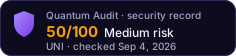

Final Recommendation: It is recommended to consider migrating to a newer Solidity compiler version (e.g., 0.8.x) in future iterations to leverage built-in overflow checks and other language improvements. The `minter` role, which currently holds significant power, should ideally be controlled by a robust multi-signature wallet or a decentralized governance mechanism to mitigate centralization risks and enhance security. Regular security reviews of the `minter`'s operational procedures are also advised.

Category Ratings

TechnicalLow
7/10

The contract demonstrates good code security practices by using OpenZeppelin's `SafeMath` library to prevent arithmetic overflows/underflows (7.2 Code Security). The implementation of ERC-20, EIP-712 signatures for `permit` and `delegateBySig`, and the Compound-style delegation mechanism are st

GovernanceHigh
1/10

The contract incorporates a robust governance delegation system, allowing token holders to delegate their voting power, which is a strength for decentralized decision-making (7.5 Governance). Economically, the `minter` role holds significant power to inflate the token supply, albeit constrained by a

UpgradesMedium
4/10

The contract is not designed with an upgrade mechanism (e.g., proxy pattern), meaning its logic is immutable once deployed (7.7 Upgrades). This eliminates upgrade-related risks such as proxy misconfigurations or malicious upgrade implementations. However, it also means that any future bug fixes or f

What Raised This Score

Each factor is an on-chain fact recorded at the time of this analysis. The score is computed from them by a deterministic function, so the same contract returns the same score for anyone who runs the audit. How scores are computed

Security Findings

1 High 1 Low 1 Info
H-01HighUnresolved

Centralized Minter Role

The `minter` address has the sole authority to mint new tokens, subject to `mintCap` and time constraints. This represents a significant centralization risk (7.3 Access Control, 7.4 Economic). If the `minter`'s private key is compromised, an attacker could inflate the token supply up to the `mintCap` per year, devaluing existing tokens. The `setMinter` function allows the current minter to transfer this critical role, which is also a high-privilege operation.

Recommendation: Consider decentralizing the `minter` role by assigning it to a robust multi-signature wallet (e.g., Gnosis Safe) or a community-governed smart contract. This would require multiple approvals for minting operations or role transfers, significantly reducing the risk of a single point of failure.
L-01LowUnresolved

Potential High Gas Costs for Checkpoints

The `_writeCheckpoint` function stores historical vote data for each account. While necessary for the governance delegation mechanism, if an account frequently delegates or transfers tokens, the `numCheckpoints` for that address could grow very large. This could lead to increased gas costs for subsequent `_writeCheckpoint` operations or for reading historical vote data (7.8 Operations).

Recommendation: While this is an inherent design choice for Compound-style governance, consider monitoring the growth of `numCheckpoints` for highly active addresses. For future iterations, explore alternative checkpointing strategies or gas optimization techniques if this becomes a significant operational burden.
I-01InformationalUnresolved

Older Solidity Compiler Version

The contract is compiled with Solidity version `^0.5.16`. While `SafeMath` is correctly used to prevent integer overflows/underflows, newer Solidity versions (e.g., 0.8.x) include built-in overflow/underflow checks by default, making external libraries like `SafeMath` largely redundant and potentially saving gas (7.2 Code Security). Newer compilers also offer additional language features and security improvements.

Recommendation: For future contract deployments or upgrades, consider migrating to a more recent Solidity compiler version (e.g., 0.8.x). This would allow for the removal of `SafeMath` library calls, simplifying the code and potentially reducing gas costs, while benefiting from the latest compiler optimizations and security features.

Frequently Asked Questions

Is Uniswap a scam?

Based on the data, Uniswap (UNI) does not exhibit typical scam characteristics; its contract is verified, and no mint function exists, preventing arbitrary supply inflation. However, non-renounced ownership and significant token concentration (52.3% by top 10 holders) introduce centralization risks. While these contribute to its 'High Risk' score of 68/100 and warrant caution, they do not inherently categorize Uniswap as a scam.

Is Uniswap safe to buy?

UNI carries a 'High Risk' score (68/100) due to several factors. Contract ownership is not renounced, and liquidity is unlocked, raising concerns about administrative control over token parameters or market stability. Additionally, 52.3% of the supply is concentrated among the top 10 holders. These factors suggest potential for centralized influence, meaning investors should exercise elevated caution and conduct thorough due diligence.

Has Uniswap been audited?

The Uniswap (UNI) contract is verified, meaning its deployed bytecode matches the publicly available source code. This offers transparency for community review. However, contract verification differs from a comprehensive security audit, which involves expert analysis to identify vulnerabilities and logic flaws. The provided data confirms verification but does not explicitly indicate a full security audit has been performed.

Would You Like a More Detailed Audit of Uniswap?

Our AI-powered scanner gives you a deeper, real-time smart contract analysis — free, no signup required.

Get Detailed Audit
Run Free Audit →