The UN1Token protocol implements a complex token system with integrated NFT-like card mechanics and reward distribution. The architecture relies heavily on privileged roles (deployer, mirror, beacon, distributor) that possess significant control over token supply, transfer logic, and external contract dependencies. While the code structure is modular, the high degree of centralization and the presence of uninitialized state variables pose significant risks to system integrity.
Early-stage security check — honeypot & rug-pull analysis
Is Un1corn a Scam?
Not verified
This record has not gone through deep verification and is not being monitored. The score is a dated snapshot — the token’s risk can change at any time.Own this token? Put it under verification →The UN1Token protocol implements a complex token system with integrated NFT-like card mechanics and reward distribution.
Read the full analysis- A privileged address can replace a contract every transfer depends on; held by deployer: Other-Contract
- Owner can change the buy/sell tax; held by beacon: Other-Contract, deployer: Other-Contract, distributor: Other-Contract, mirror: Other-Contract
- A privileged address can change transfer or wallet limits; held by beacon: Other-Contract, distributor: Other-Contract, hook: Other-Contract, mirror: Other-Contract
- Mintable supply — no cap found, dilution unbounded; held by deployer: Other-Contract, mirror: Other-Contract
- Ownership status UNKNOWN
- Liquidity not locked
- Liquidity < $50k
- Top-10 concentration > 30%
- Contract source not verified — its logic cannot be read
- Code: Rounding Loss via Division Before Multiplication
- Code: Uninitialized State Variables
- Code: Predictable Randomness
Exact factors
- A privileged address can replace a contract every transfer depends on; held by deployer: Other-Contract
- Owner can change the buy/sell tax; held by beacon: Other-Contract, deployer: Other-Contract, distributor: Other-Contract, mirror: Other-Contract
- A privileged address can change transfer or wallet limits; held by beacon: Other-Contract, distributor: Other-Contract, hook: Other-Contract, mirror: Other-Contract
- Mintable supply — no cap found, dilution unbounded; held by deployer: Other-Contract, mirror: Other-Contract
- Ownership status UNKNOWN (owner could not be resolved)
- Liquidity NOT locked (100% of the pool; this pool is 100% of DEX liquidity) — held by independent providers — market-depth risk
- Liquidity < $50k ($24,553 across 2 pairs — thin market)
- Top-10 concentration > 30% (97.5% total → 45.3% effective; 10.4% in EOAs, 87.0% in contracts)
- Contract source NOT verified — its logic cannot be read
- Code: Rounding Loss via Division Before Multiplication (Low, static analysis)
- Code: Uninitialized State Variables (High, static analysis)
- Code: Predictable Randomness (High, static analysis)
Each factor is an on-chain fact recorded at the time of this analysis. The score is computed from them by a deterministic function, so the same contract returns the same score for anyone who runs the audit. How scores are computed
Security Checklist
as of audit · Oct 21Holders
as of audit · Oct 21, 2026- Contractstreasury, vesting, bridge, staking87.0%
- Walletsanonymous holders, free to sell10.4%
- Everyone else33 holders2.5%
How holder types affect the score
Share held by contracts — treasury, vesting, bridge or staking — is discounted against share held by wallets when the score is computed: a contract cannot decide to sell the way an anonymous holder can, though it can still be drained or voted to sell. Effective concentration is the figure the risk score is actually calculated from.
Holder balances as recorded by the audit of Oct 21, 2026
Liquidity
as of audit · Oct 21The risk score reads depth across every pair.
The LP tokens of the analysed pool are not locked or burned, so whoever holds them can withdraw that liquidity.
0x629d…eb5cNo privileged address appears among these holders: the unlocked liquidity sits with independent providers, not with the deployer.
Security Findings
HighUninitialized State Variables
Variables related to card management are used before being initialized, which can lead to undefined behavior or system failure.CD-02
Issue
Variables related to card management are used before being initialized, which can lead to undefined behavior or system failure.
Fix
Ensure all state variables are explicitly initialized in the constructor or the initialize function.
Status
Unresolved
HighPredictable Randomness
Randomness is derived from on-chain values that are predictable, allowing users to influence outcomes in the card system.CD-03
Issue
Randomness is derived from on-chain values that are predictable, allowing users to influence outcomes in the card system.
Fix
Use a verifiable randomness source like Chainlink VRF to ensure secure and unpredictable outcomes.
Status
Unresolved
HighDependency Replacement Risk
The deployer can change the address of the external contract that governs token transfers, allowing a malicious actor to redirect or halt all token movements.CP-03
Issue
The deployer can change the address of the external contract that governs token transfers, allowing a malicious actor to redirect or halt all token movements.
Fix
Restrict the ability to change external dependencies to a multi-signature wallet with a mandatory delay period.
Status
Unresolved
MediumPrivileged Minting Capability
The deployer and mirror roles can increase the total token supply through initialize, mirrorTransfer, and compose functions, which may dilute existing holders.CP-01
Issue
The deployer and mirror roles can increase the total token supply through initialize, mirrorTransfer, and compose functions, which may dilute existing holders.
Fix
Implement a hard cap on total supply or require a time-locked governance vote for any minting operations.
Status
Unresolved
MediumCentralized Fee Control
Privileged roles can arbitrarily modify transfer fees, which directly impacts the economic utility of the token.CP-07
Issue
Privileged roles can arbitrarily modify transfer fees, which directly impacts the economic utility of the token.
Fix
Define fee ranges in the contract logic and enforce them to prevent excessive or predatory fee adjustments.
Status
Unresolved
MediumLiquidity not locked
0.0% of the pool's LP is burned or time-locked. 100.0% is held, unlocked, by 1 address(es) other than the owner/deployer. One of them — a wallet, 0x629d…eb5c — holds 100.0% and can remove that share at once; who controls it is not visible on-chain, so it is not treated as an independent provider. Some pools are concentrated-liquidity (V3/V4) positions; shares above are by position as GoPlus reports them.QA-LIQUIDITY
Issue
0.0% of the pool's LP is burned or time-locked. 100.0% is held, unlocked, by 1 address(es) other than the owner/deployer. One of them — a wallet, 0x629d…eb5c — holds 100.0% and can remove that share at once; who controls it is not visible on-chain, so it is not treated as an independent provider. Some pools are concentrated-liquidity (V3/V4) positions; shares above are by position as GoPlus reports them.
Fix
Check the lock's end date and beneficiary on the locker's own page before relying on it.
Status
Acknowledged
LowRounding Loss via Division Before Multiplication
Calculations in _update and related functions perform division before multiplication, leading to precision loss.CD-01
Issue
Calculations in _update and related functions perform division before multiplication, leading to precision loss.
Fix
Reorder operations to perform multiplication before division to maintain precision.
Status
Unresolved
LowArbitrary Limit Modification
Privileged roles can change transaction and wallet limits, potentially leading to unexpected restrictions on user activity.CP-08
Issue
Privileged roles can change transaction and wallet limits, potentially leading to unexpected restrictions on user activity.
Fix
Hardcode reasonable limits or implement a transparent, public process for parameter adjustments.
Status
Unresolved
InfoWho holds the supply
The ten largest holders own 97.5% of supply. What remains: 10.4% in wallets, 87.0% in other contracts. 43 holders in total.QA-HOLDERS
Issue
The ten largest holders own 97.5% of supply. What remains: 10.4% in wallets, 87.0% in other contracts. 43 holders in total.
Fix
Watch the largest wallets that are not exchanges, pools or locks — those are the ones that can move the price.
Status
Acknowledged
InfoNot listed by any independent source
43 holders. Not listed by CoinGecko or any exchange GoPlus tracks. Nothing independent confirms who is behind this token, so every power its contract grants is scored at face value.QA-IDENTITY
Issue
43 holders. Not listed by CoinGecko or any exchange GoPlus tracks. Nothing independent confirms who is behind this token, so every power its contract grants is scored at face value.
Fix
Match the contract address against the project's official channels before trading.
Status
Acknowledged
InfoThe market for this token
Liquidity $25K (DexScreener, all pools). 24h trading volume $95K (DexScreener, all pools).QA-MARKET
Issue
Liquidity $25K (DexScreener, all pools). 24h trading volume $95K (DexScreener, all pools).
Fix
Size any position to the liquidity and daily volume shown — they set how much you can sell and at what price.
Status
Acknowledged
InfoAsset class: Project token
A token issued by a project for use, governance or fundraising. Scored on its contract and market facts. The class itself adds no points; the contract and market facts decide the score. Basis: no class-specific evidence. Tokenomics — Supply: mintable with no on-chain cap found. Control: an owner that could not be resolved. Code: not upgradeable (no proxy). Fees: no buy or sell tax. Market: $25K of DEX liquidity across 2 pools. Launch: under a day of market history.QA-PROFILE
Issue
A token issued by a project for use, governance or fundraising. Scored on its contract and market facts. The class itself adds no points; the contract and market facts decide the score. Basis: no class-specific evidence. Tokenomics — Supply: mintable with no on-chain cap found. Control: an owner that could not be resolved. Code: not upgradeable (no proxy). Fees: no buy or sell tax. Market: $25K of DEX liquidity across 2 pools. Launch: under a day of market history.
Fix
Check the project's own documentation for what the token is used for; this report covers what the contract allows.
Status
Acknowledged
InfoRecently launched — less than a day of market history
The token's oldest DEX pool is less than a day old. Age is not part of the risk score — a new token is not a risky one by default — but a short history means fewer trades and holder changes behind the facts in this report.QA-RECENT
Issue
The token's oldest DEX pool is less than a day old. Age is not part of the risk score — a new token is not a risky one by default — but a short history means fewer trades and holder changes behind the facts in this report.
Fix
Re-check ownership, liquidity and holder distribution as the token matures; those are the facts that move early.
Status
Acknowledged
Analysis
AI Copilotas of audit · Oct 21The architecture utilizes a multi-role system to manage token lifecycle and reward distribution. 7.1 Architecture: Highly modular but complex, relying on external hooks and beacons. 7.2 Code Security: Significant issues identified including uninitialized state variables and predictable randomness. 7.3 Access Control: Centralized control allows privileged roles to modify core token mechanics, including supply and transfer rules.
7.4 Economic: Token supply is dynamic and controlled by privileged roles, creating potential for dilution. 7.5 Governance: No decentralized governance is present; all parameters are managed by specific addresses. 7.6 External: The protocol depends on external contracts (mirror, beacon) which can be updated, introducing supply chain risks.
7.7 Upgrades: The protocol lacks a formal proxy pattern but allows for the replacement of critical external dependencies via the initialize function. 7.8 Operations: Operational security is entirely dependent on the protection of the private keys associated with the privileged roles.
Immediate remediation of uninitialized state variables and the implementation of a secure, verifiable source of randomness are required.
We recommend transitioning from centralized privileged roles to a multi-signature wallet or a decentralized governance contract to mitigate the risk of single-point-of-failure exploits.
Contract & Record
Free for any token on the record. It links to this page and always shows the current score and the date it was checked.
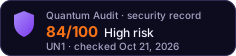
- Oct 21, 202684High
Score changes are recorded as dated snapshots — history is append-only and cannot be edited.
Frequently Asked Questions
What is the UN1 contract address?
The Un1corn (UN1) contract on Ethereum is 0x03edbab5c3a0456567d61ab7f34f3b7e490ef512. Compare it with the address the project itself publishes before trading: other contracts can carry the same name and ticker.
Is Un1corn a scam?
Quantum Audit's risk score for Un1corn is 84/100 (High risk) as of Oct 21, 2026, computed by a deterministic function from on-chain facts — Contract verified: Not verified; Mint: Mintable; Liquidity lock: Not locked; Upgradeability: Fixed code; Honeypot: None found; Buy / sell tax: 0% / 0%. A score is a dated snapshot of those facts, not a guarantee; each one is listed on this page.
Is UN1 liquidity locked?
Liquidity lock: Not locked (as of Oct 21, 2026). Total DEX liquidity: $24.6K.
Who holds UN1?
As of Oct 21, 2026, the 10 largest holders own 97.5% of the supply across 43 holders. The Holders section on this page shows who they are by holder type.
Would You Like a More Detailed Audit of Un1corn?
This token is brand new. Run a deeper AI-powered analysis of the contract code — free and instant.
Get Detailed Audit Is this your token? Publish your own audit on this page