Quantum Audit Logo

Is Plumbing Safe?

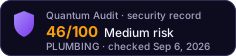
On-chain security analysis — is it a scam or legit?

Plumbing PLUMBING
0xb200…4d01
Base Not verifiedLast checked today 1 audit on record
Executive SummaryAI Copilot

This audit was conducted without access to the contract's source code. Therefore, a comprehensive security analysis for vulnerabilities such as reentrancy, access control flaws, or integer issues could not be performed. The findings are informational and based on general best practices for EVM smart contracts.

6 Informational
Volume 24h
$162.8K
Liquidity
$54.3K
Price
$0.0001603
Token Age
25d
Top 10 Holders
61.0%

Security Findings

Info

No Source Code Provided for Audit

I-01The audit was conducted without access to the contract's Solidity source code. This severely limits the ability to perform a comprehensive security analysis, identify specific vulnerabilities (7.2 Code Security), or verify adherence to best practices. Users interacting with this contract cannot independently verify its logic or security properties.
IssueThe audit was conducted without access to the contract's Solidity source code. This severely limits the ability to perform a comprehensive security analysis, identify specific vulnerabilities (7.2 Code Security), or verify adherence to best practices. Users interacting with this contract cannot independently verify its logic or security properties.
FixIt is strongly recommended to publish and verify the contract's source code on block explorers (e.g., Etherscan, Basescan). This enhances transparency, allows for community review, and enables thorough security audits.
StatusUnresolved
Info

Access Control Mechanisms Unknown

I-02Without source code, the access control mechanisms (7.3 Access Control) governing critical functions are unknown. Improper access control can lead to unauthorized state changes, fund manipulation, or denial-of-service attacks. It is unclear if roles are properly defined and enforced.
IssueWithout source code, the access control mechanisms (7.3 Access Control) governing critical functions are unknown. Improper access control can lead to unauthorized state changes, fund manipulation, or denial-of-service attacks. It is unclear if roles are properly defined and enforced.
FixImplement robust access control using established patterns (e.g., OpenZeppelin's Ownable or AccessControl). Ensure that sensitive functions are restricted to authorized addresses and that ownership transfer processes are secure.
StatusUnresolved
Info

Reentrancy Protection Status Unknown

I-03The presence and correctness of reentrancy protection mechanisms (7.2 Code Security) cannot be verified. Reentrancy vulnerabilities can allow an attacker to repeatedly call a function before the initial call has completed, leading to drained funds or unexpected state changes.
IssueThe presence and correctness of reentrancy protection mechanisms (7.2 Code Security) cannot be verified. Reentrancy vulnerabilities can allow an attacker to repeatedly call a function before the initial call has completed, leading to drained funds or unexpected state changes.
FixAlways use the Checks-Effects-Interactions pattern and consider reentrancy guards (e.g., OpenZeppelin's ReentrancyGuard) for any function that performs external calls and modifies state.
StatusUnresolved
Info

Integer Overflow/Underflow Safety Unknown

I-04The contract's handling of arithmetic operations (7.2 Code Security) is unknown. Without source code, it's impossible to confirm if integer overflow/underflow vulnerabilities are mitigated, which could lead to incorrect calculations, unexpected state, or fund loss.
IssueThe contract's handling of arithmetic operations (7.2 Code Security) is unknown. Without source code, it's impossible to confirm if integer overflow/underflow vulnerabilities are mitigated, which could lead to incorrect calculations, unexpected state, or fund loss.
FixUtilize Solidity versions 0.8.0 and above, which include default overflow/underflow checks. For older versions, use SafeMath libraries or similar constructs to prevent these issues in all arithmetic operations.
StatusUnresolved
Info

External Call Security Unknown

I-05Any interactions with external contracts (7.6 External) or addresses are unknown. Improper handling of external calls can introduce various risks, including reentrancy, unexpected reverts, or gas limit issues. The contract's resilience to malicious external contracts cannot be assessed.
IssueAny interactions with external contracts (7.6 External) or addresses are unknown. Improper handling of external calls can introduce various risks, including reentrancy, unexpected reverts, or gas limit issues. The contract's resilience to malicious external contracts cannot be assessed.
FixWhen making external calls, minimize trust in the callee. Isolate external calls to the end of functions, handle potential reverts gracefully, and implement reentrancy protection. Consider using call limits or whitelists for trusted external contracts.
StatusUnresolved
Info

Operational Security Practices Unknown

I-06The operational security practices (7.8 Operations) for managing the contract, such as multi-signature wallets for critical operations, emergency pause mechanisms, or upgrade procedures, are unknown. Lack of robust operational security can expose the protocol to single points of failure or slow response times during incidents.
IssueThe operational security practices (7.8 Operations) for managing the contract, such as multi-signature wallets for critical operations, emergency pause mechanisms, or upgrade procedures, are unknown. Lack of robust operational security can expose the protocol to single points of failure or slow response times during incidents.
FixImplement multi-signature wallets for critical administrative functions. Consider an emergency pause mechanism for rapid response to exploits. Establish clear operational procedures for upgrades, parameter changes, and incident response.
StatusUnresolved

Category Ratings

TechnicalLow8/10

Without access to the contract's source code (7.2 Code Security), a detailed technical analysis is not possible. Therefore, no specific architectural patterns (7.1 Architecture) or code-level vulnerabilities can be identified. General best practices for EVM contracts regarding reentrancy and integer safety are assumed to be critical for any deployed contract.

GovernanceHigh2/10

The economic model (7.4 Economic) and governance structure (7.5 Governance) cannot be assessed without contract source code or external documentation. Access control mechanisms (7.3 Access Control) are also unknown. Any contract handling significant value should implement robust economic incentives and decentralized governance where appropriate.

UpgradesMedium6/10

The upgradeability status (7.7 Upgrades) of the contract is unknown without source code. If the contract is upgradeable, proper proxy patterns (e.g., UUPS, Transparent) and safe upgrade procedures are crucial to prevent critical vulnerabilities. If not upgradeable, immutability provides security but lacks flexibility.

Security Checklist

Contract VerifiedPass
Ownership Renounced?
No Mint Function?
Liquidity LockedFail
Not a ProxyPass
HoneypotNoneBuy Tax0.0%Sell Tax0.0%

Holder Composition

12.0% in wallets49.0% in contracts
Effective Concentration31.6%

Share held by contracts — treasury, vesting, bridge or staking — is discounted against share held by wallets when the score is computed: a contract cannot decide to sell the way an anonymous holder can, though it can still be drained or voted to sell. Effective concentration is the figure the risk score is actually calculated from.

Liquidity Depth

The risk score reads depth across every pair. The volume figure and the volume-to-liquidity ratio elsewhere on this page describe only the pair this audit analysed, so the two are not directly comparable.

LP Distribution

Top-1 Unlocked Holder100.0%
Top-3 Unlocked100.0%

Key Addresses

Unlocked LP Held By
0xd1c6…a0c0

No privileged address appears among these holders: the unlocked liquidity sits with independent providers, not with the deployer.

What Raised This Score

  • Ownership status UNKNOWN (owner could not be resolved)
  • Mint capability UNKNOWN (implementation ABI unreadable)
  • Top-10 concentration > 30% (61.0% total → 31.6% effective; 12.0% in EOAs, 49.0% in contracts — moderate)
  • Liquidity not locked, but no owner/deployer address holds LP — market-depth risk, not rug risk
  • LP top1 unlocked holder = 100.0% (independent LP — depth risk)
  • LP top3 unlocked holders = 100.0% (independent LP — depth risk)
  • Token age < 30 days (still settling)

Each factor is an on-chain fact recorded at the time of this analysis. The score is computed from them by a deterministic function, so the same contract returns the same score for anyone who runs the audit. How scores are computed

Related Audits

aeonHigh RiskRobo Token (ROBO)High RiskNockchain (NOCK)Medium RiskViciCoin (VCNT)High RiskgitlawbHigh RiskSolana (Universal) (USOL)Medium Risk

Would You Like a More Detailed Audit of Plumbing?

Our AI-powered scanner gives you a deeper, real-time smart contract analysis — free, with every scoring factor shown.

Get Detailed Audit