
This report is based on a security audit of the contract at 0xfe67d6f5adbacf718f7ce0328a8c7e43bba5f6b3. No source code was provided for analysis, therefore a comprehensive security assessment could not be performed. The risk levels and findings reflect the absence of code rather than an actual analysis of the contract's logic.
Early-stage security check — honeypot & rug-pull analysis
Is Orthogonal a Scam?
Not verified
This record has not gone through deep verification and is not being monitored. The score is a dated snapshot — the token’s risk can change at any time.Own this token? Put it under verification →This report is based on a security audit of the contract at 0xfe67d6f5adbacf718f7ce0328a8c7e43bba5f6b3. No source code was provided for analysis, therefore a comprehensive security assessment could not be performed.
Read the full analysis- Ownership status UNKNOWN
- Mint capability UNKNOWN
- Contract source not verified
- Top-10 concentration > 50%
- LP top1 unlocked holder = 99.8%
- LP top3 unlocked holders = 100.0%
- LP claimed locked but only 0.0% actually locked
- Token age < 7 days
Exact factors
- Ownership status UNKNOWN (owner could not be resolved)
- Mint capability UNKNOWN (implementation ABI unreadable)
- Contract source NOT verified
- Top-10 concentration > 50% (81.9% total → 62.0% effective; 48.7% in EOAs, 33.2% in contracts — heavy)
- LP top1 unlocked holder = 99.8% (independent LP — depth risk)
- LP top3 unlocked holders = 100.0% (independent LP — depth risk)
- LP claimed locked but only 0.0% actually locked
- Token age < 7 days (early, volatile)
Security Checklist
as of audit · Sep 17Holders
as of audit · Sep 17, 2026- Contractstreasury, vesting, bridge, staking33.2%
- Walletsanonymous holders, free to sell48.7%
- Everyone elsethe rest of the supply18.1%
How holder types affect the score
Share held by contracts — treasury, vesting, bridge or staking — is discounted against share held by wallets when the score is computed: a contract cannot decide to sell the way an anonymous holder can, though it can still be drained or voted to sell. Effective concentration is the figure the risk score is actually calculated from.
Holder balances as recorded by the audit of Sep 17, 2026
Liquidity
as of audit · Sep 17The LP tokens of the analysed pool are locked or burned.
0x52e5…45b40x1d2a…158cNo privileged address appears among these holders: the unlocked liquidity sits with independent providers, not with the deployer.
Security Findings
InfoNo code-level findings — contract source is not verified on the explorer
The contract's source code has not been published or verified on the block explorer, so only its deployed bytecode and on-chain behaviour were available.I-01
Issue
The contract's source code has not been published or verified on the block explorer, so only its deployed bytecode and on-chain behaviour were available. No source-level vulnerability could be confirmed or ruled out. The assessment on this page rests on LP lock/burn state, holder concentration.
Fix
Treat an unverified contract as unaudited at the code level. Ask the team to verify the source on the explorer, which makes an independent review possible.
Status
Acknowledged
Analysis
AI Copilotas of audit · Sep 17Due to the absence of source code, a technical risk assessment (7.1 Architecture, 7.2 Code Security, 7.3 Access Control) could not be conducted. No specific vulnerabilities related to reentrancy, integer overflows, or access control flaws can be identified without code. The technical risk is marked as Low only because no issues could be identified from an empty codebase.
Without source code, an assessment of economic (7.4 Economic) and governance (7.5 Governance) risks is not possible. Potential issues like oracle manipulation, flash loan vulnerabilities, or centralized control mechanisms cannot be evaluated. The economic and governance risk is marked as Low only because no issues could be identified from an empty codebase.
The upgradeability (7.7 Upgrades) and operational (7.8 Operations) aspects of the contract cannot be determined without source code. It is unknown if the contract uses a proxy pattern, has upgrade mechanisms, or if operational controls are properly implemented. The upgrade risk is marked as Low only because no issues could be identified from an empty codebase.
For any smart contract deployment, it is crucial to ensure that the full, verified source code is publicly available.
This transparency allows for community review and independent security audits, which are essential steps in identifying and mitigating potential vulnerabilities. Always prioritize deploying contracts with well-tested, audited, and publicly accessible code.
Contract & Record
Free for any token on the record. It links to this page and always shows the current score and the date it was checked.
- Sep 17, 202669High
Score changes are recorded as dated snapshots — history is append-only and cannot be edited.
Frequently Asked Questions
What is the ORGOL contract address?
The Orthogonal (ORGOL) contract on Arbitrum is 0xfe67d6f5adbacf718f7ce0328a8c7e43bba5f6b3. Compare it with the address the project itself publishes before trading: other contracts can carry the same name and ticker.
Is Orthogonal a scam?
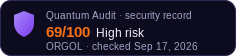
Quantum Audit's risk score for Orthogonal is 69/100 (High risk) as of Sep 17, 2026, computed by a deterministic function from on-chain facts — Contract verified: Not verified; Liquidity lock: Locked; Upgradeability: Fixed code; Honeypot: None found; Buy / sell tax: 0% / 0%. A score is a dated snapshot of those facts, not a guarantee; each one is listed on this page.
Is ORGOL liquidity locked?
Liquidity lock: Locked (as of Sep 17, 2026). Total DEX liquidity: $105.5K.
Who holds ORGOL?
As of Sep 17, 2026, the 10 largest holders own 81.9% of the supply. The Holders section on this page shows who they are by holder type.
Would You Like a More Detailed Audit of Orthogonal?
This token is brand new. Run a deeper AI-powered analysis of the contract code — free and instant.
Get Detailed Audit Is this your token? Add your links and get it Verified