
This audit report covers the provided Solidity source code for the NOXToken project. The analysis was significantly limited as the primary NOXToken contract implementation, which would define custom token logic, was not provided. The audit focused on the included OpenZeppelin Context and ERC20 contracts. While these foundational components are robust, a comprehensive security assessment of the NOXToken's specific functionality, tokenomics, and access control mechanisms cannot be completed without the full source code.
Honeypot, rug-pull and ownership checks
Is NOXCAT a Scam?
Not verified
This record has not gone through deep verification and is not being monitored. The score is a dated snapshot — the token’s risk can change at any time.Own this token? Put it under verification →This audit report covers the provided Solidity source code for the NOXToken project.
Read the full analysis- Ownership status UNKNOWN
- Top-10 concentration > 30%
- Liquidity not locked, but no owner/deployer address holds LP — market-depth risk, not rug risk
- Liquidity < $10k
- LP top1 unlocked holder = 100.0%
- LP top3 unlocked holders = 100.0%
Exact factors
- Ownership status UNKNOWN (owner could not be resolved)
- Top-10 concentration > 30% (100.0% total → 40.0% effective; 0.0% in EOAs, 100.0% in contracts — moderate)
- Liquidity not locked, but no owner/deployer address holds LP — market-depth risk, not rug risk
- Liquidity < $10k ($174 across 1 pairs — easily drained)
- LP top1 unlocked holder = 100.0% (independent LP — depth risk)
- LP top3 unlocked holders = 100.0% (independent LP — depth risk)
Security Checklist
as of audit · Sep 4Holders
as of audit · Sep 4, 2026- Contractstreasury, vesting, bridge, staking100.0%
How holder types affect the score
Share held by contracts — treasury, vesting, bridge or staking — is discounted against share held by wallets when the score is computed: a contract cannot decide to sell the way an anonymous holder can, though it can still be drained or voted to sell. Effective concentration is the figure the risk score is actually calculated from.
Holder balances as recorded by the audit of Sep 4, 2026
Liquidity
as of audit · Sep 4The LP tokens of the analysed pool are not locked or burned, so whoever holds them can withdraw that liquidity.
0x3d6a…2dedNo privileged address appears among these holders: the unlocked liquidity sits with independent providers, not with the deployer.
Security Findings
MediumIncomplete Source Code Provided for Audit
Not confirmed by static analysis (the model's own reading of the source).M-01
Issue
Not confirmed by static analysis (the model's own reading of the source). The audit was conducted on a partial set of source code files. Specifically, the main NOXToken contract, which would define the token's unique logic, supply mechanisms (e.g., minting, burning), and specific access control roles, was not provided. Only standard OpenZeppelin Context and ERC20 libraries were available for review. This prevents a comprehensive security assessment of the actual token implementation and its specific functionalities.
Fix
Provide the complete and accurate source code for the NOXToken contract, including all inherited contracts and any custom logic. This is essential for a full security audit to identify potential vulnerabilities specific to the project's implementation.
Status
Unresolved
LowPotential approve Race Condition (Mitigated by Alternatives)
Not confirmed by static analysis (the model's own reading of the source).L-01
approve Race Condition (Mitigated by Alternatives)Issue
Not confirmed by static analysis (the model's own reading of the source). The standard ERC20 approve function is susceptible to a race condition. If a user approves an amount, and then attempts to change that approval to a different amount, a malicious actor observing the transaction could front-run the second approve call by spending the original allowance. This could lead to the malicious actor spending both the original and the new allowance. While the contract provides increaseAllowance and decreaseAllowance to mitigate this, users might still interact directly with approve.
Fix
Educate users to exclusively use increaseAllowance and decreaseAllowance instead of directly calling approve when modifying existing allowances. Ensure any front-end interfaces or integrations also prioritize these safer functions.
Status
Unresolved
InfoReliance on Standard OpenZeppelin Libraries
Not confirmed by static analysis (the model's own reading of the source).I-01
Issue
Not confirmed by static analysis (the model's own reading of the source). The project utilizes well-vetted and widely adopted OpenZeppelin Contracts for its foundational ERC20 implementation (Context.sol, ERC20.sol). These libraries are subject to extensive community review and professional audits, significantly reducing the risk of common vulnerabilities in the base token functionality.
Fix
Continue to monitor OpenZeppelin's security advisories and updates. Ensure that any custom logic built on top of these libraries maintains the same high security standards.
Status
Resolved
InfoFixed Decimals Value
Not confirmed by static analysis (the model's own reading of the source).I-02
Issue
Not confirmed by static analysis (the model's own reading of the source). The decimals() function in the ERC20 contract returns a fixed value of 18. This is the standard and most common number of decimal places for ERC20 tokens, mimicking Ethereum's Wei. This consistency aids in integration with existing DeFi infrastructure and wallets.
Fix
No action required, as 18 decimals is a widely accepted standard. Ensure all external interfaces and applications correctly interpret this decimal value.
Status
Resolved
InfoNon-Upgradeable Contract Architecture
Not confirmed by static analysis (the model's own reading of the source).I-03
Issue
Not confirmed by static analysis (the model's own reading of the source). The contract is not implemented using a proxy pattern, meaning it is not upgradeable. This simplifies the contract's architecture and removes the complexities and potential risks associated with upgrade mechanisms, such as proxy storage collisions or logic errors during upgrades. Once deployed, its code is immutable.
Fix
No action required. This design choice eliminates upgrade-related risks. Ensure that the initial deployment is thoroughly tested, as no future code changes are possible.
Status
Resolved
Analysis
AI Copilotas of audit · Sep 4The provided contracts, Context.sol and ERC20.sol, are standard, well-audited OpenZeppelin libraries (7.2 Code Security). They implement robust ERC20 functionality, including mitigations for allowance race conditions via increaseAllowance and decreaseAllowance. However, the core NOXToken contract, which would contain any custom logic, minting, burning, or specific access control (7.3 Access Control), was not provided. This significantly limits the technical assessment, as potential vulnerabilities in custom implementations remain unexamined (7.1 Architecture).
Without the full NOXToken contract source code, it is impossible to assess the project's specific economic model or governance mechanisms (7.4 Economic, 7.5 Governance). Details such as total supply, minting/burning capabilities, fee structures, or any privileged roles that could impact token value or distribution are unknown. This lack of information prevents a meaningful evaluation of potential economic exploits or governance risks.
Based on the provided information, the contract is not deployed as a proxy (7.7 Upgrades). This simplifies the architecture by eliminating risks associated with upgradeability, such as proxy storage collisions or incorrect implementation logic. The contract is immutable once deployed, ensuring predictable behavior without future upgrade complexities.
To enable a complete and thorough security audit, it is imperative to provide the full source code for the NOXToken contract, including any custom logic, inheritance, and deployment scripts.
This will allow for a comprehensive review of its specific functionality, access control, and tokenomics, which are currently unassessed. Additionally, consider implementing a robust testing framework, including unit, integration, and fuzz tests, to ensure all custom logic behaves as expected under various conditions. Engage in continuous security practices, such as bug bounty programs and regular security reviews, to maintain a high level of protocol security.
Contract & Record
Free for any token on the record. It links to this page and always shows the current score and the date it was checked.
- Sep 4, 202646Medium
- Jul 27, 202641Medium
- Jul 25, 202665High
Score changes are recorded as dated snapshots — history is append-only and cannot be edited.
Frequently Asked Questions
Is NOXCAT a scam?
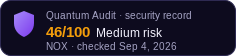
Based on automated analysis, NOXCAT scores 46/100 (Medium Risk) on our risk scale. No honeypot was detected, but always verify independently before investing.
Is NOXCAT safe to buy?
Our scanner flagged a risk score of 46/100. Ownership has not been renounced, which is a risk factor. DYOR before purchasing any token.
Has NOXCAT been audited?
The contract has not been verified on-chain. Verification is not the same as a full security audit. Use Quantum Audit's free tool to run a deeper analysis of the contract code.
Would You Like a More Detailed Audit of NOXCAT?
Paste the contract address into our AI-powered scanner for a deeper real-time report — free, with every scoring factor shown.
Get Detailed Audit Is this your token? Add your links and get it Verified