

On-chain security analysis — is it a scam or legit?
Is this your token? Publish your own audit on this page →
ANP1wJ…pump
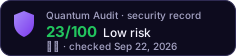
The Kiyomasa SPL Token Mint is configured with no active mint or freeze authorities, indicating a fixed supply and immutable account states. No high-risk flags were reported by third-party registries, and the token does not utilize potentially risky Token-2022 extensions like transfer hooks or default frozen accounts. Holder distribution data was unavailable, preventing a full assessment of supply concentration.
The risk score reads depth across every pair. The volume figure and the volume-to-liquidity ratio elsewhere on this page describe only the pair this audit analysed, so the two are not directly comparable.
Each factor is an on-chain fact recorded at the time of this analysis. The score is computed from them by a deterministic function, so the same contract returns the same score for anyone who runs the audit. How scores are computed
Based on available data, Kiyomasa (清正) exhibits characteristics often associated with high-risk projects, such as an unverified contract and unlocked liquidity, which are concerning. However, ownership has been renounced and no mint function exists, mitigating certain developer-controlled rug pull vectors. While these red flags necessitate extreme caution and vigilance from investors, we cannot definitively label it a scam based solely on the provided data.
Kiyomasa (清正) carries significant security risks that suggest it is not a safe investment. The contract is unverified, preventing public code review and potential hidden vulnerabilities. Crucially, liquidity is not locked, meaning the funds enabling trading can be removed by liquidity providers, risking a 'rug pull' and rendering tokens untradable. These fundamental issues, alongside some holder concentration, indicate a high-risk environment for potential buyers.
There is no information indicating Kiyomasa (清正) has undergone a formal security audit. Moreover, the contract is explicitly listed as 'False' for verification. This means its source code is not publicly available or confirmed to match the deployed bytecode on the blockchain. This lack of transparency and an independent audit makes it challenging to assess the contract's integrity and security, posing a significant risk.
Our AI-powered scanner gives you a deeper, real-time smart contract analysis — free, with every scoring factor shown.
Get Detailed Audit