The KgenOFT contract is an Omnichain Fungible Token (OFT) implementation on the Base network. It incorporates standard LayerZero OFT logic alongside centralized administrative controls for pausing, blacklisting, and fee management. While the architecture follows established standards, the presence of significant administrative privileges introduces centralization risks that token holders should be aware of.
On-chain security analysis — is it a scam or legit?
Is KGEN Safe?
Not verified
This record has not gone through deep verification and is not being monitored. The score is a dated snapshot — the token’s risk can change at any time.Own this token? Put it under verification →The KgenOFT contract is an Omnichain Fungible Token (OFT) implementation on the Base network.
Read the full analysis- Owner can pause all transfers
- Owner can blacklist or freeze individual holders
- Mintable supply — no cap found, dilution unbounded; held by endpoint: Other-Contract
- LP lock status UNKNOWN — the deepest pool's LP could not be read; this pool is 91% of DEX liquidity
- Liquidity not locked
- Top-10 concentration > 70%
Exact factors
- Owner can pause all transfers
- Owner can blacklist or freeze individual holders
- Mintable supply — no cap found, dilution unbounded; held by endpoint: Other-Contract
- LP lock status UNKNOWN — the deepest pool's LP could not be read; this pool is 91% of DEX liquidity
- Liquidity NOT locked (100% of the pool; this pool is 9% of DEX liquidity) — held by independent providers — market-depth risk
- Top-10 concentration > 70% (100.0% total → 93.8% effective; 90.5% in EOAs, 8.2% in contracts; 1.3% burned, locked or in pools excluded)
Each factor is an on-chain fact recorded at the time of this analysis. The score is computed from them by a deterministic function, so the same contract returns the same score for anyone who runs the audit. How scores are computed
Security Checklist
as of audit · Nov 12Holders
as of audit · Nov 12, 2026- Contractstreasury, vesting, bridge, staking8.2%
- Walletsanonymous holders, free to sell90.5%
- DEX poolsthe pools' own liquidity1.3%
How holder types affect the score
Share held by contracts — treasury, vesting, bridge or staking — is discounted against share held by wallets when the score is computed: a contract cannot decide to sell the way an anonymous holder can, though it can still be drained or voted to sell. Effective concentration is the figure the risk score is actually calculated from.
Holder balances as recorded by the audit of Nov 12, 2026
Liquidity
as of audit · Nov 12The risk score reads depth across every pair.
The LP tokens of the checked pool, Uniswap v3, are not locked or burned, so whoever holds them can withdraw that liquidity. The LP of the deepest pool (90.8% of depth) could not be read, so whether it is locked is unknown.
0x7bb5…8a1cNo privileged address appears among these holders: the unlocked liquidity sits with independent providers, not with the deployer.
Security Findings
MediumMinting Capability via Cross-Chain Operations
The contract allows for the minting of new tokens through cross-chain messaging functions (send, lzReceive). This increases the total supply and can dilute existing token holders if not managed correctly by the LayerZero endpoint.CP-01
Issue
The contract allows for the minting of new tokens through cross-chain messaging functions (send, lzReceive). This increases the total supply and can dilute existing token holders if not managed correctly by the LayerZero endpoint.
Fix
Ensure that the LayerZero endpoint and associated peer contracts are secured and that minting parameters are strictly audited.
Status
Unresolved
MediumAdministrative Pause Functionality
The setPaused function allows a designated role to halt all token transfers. This provides a mechanism to stop malicious activity but also allows the controller to freeze all user liquidity at will.CP-04
Issue
The setPaused function allows a designated role to halt all token transfers. This provides a mechanism to stop malicious activity but also allows the controller to freeze all user liquidity at will.
Fix
Restrict the PAUSER_ROLE to a highly secure, multi-signature wallet and document the specific emergency scenarios under which this function will be used.
Status
Unresolved
MediumBlacklist Control over Token Holders
The batchSetBlacklistStatus and setBlacklistStatus functions allow the controller to prevent specific addresses from transferring or selling their tokens. This creates a risk where individual holders can be censored or have their assets locked.CP-06
Issue
The batchSetBlacklistStatus and setBlacklistStatus functions allow the controller to prevent specific addresses from transferring or selling their tokens. This creates a risk where individual holders can be censored or have their assets locked.
Fix
Implement a transparent policy for blacklisting and consider using a timelock or multi-sig requirement for these actions to prevent arbitrary or malicious usage.
Status
Unresolved
MediumLiquidity not locked
0.0% of the pool's LP is burned or time-locked. 100.0% is held, unlocked, by 1 address(es) other than the owner/deployer. One of them — a wallet, 0x7bb5…8a1c — holds 100.0% and can remove that share at once; who controls it is not visible on-chain, so it is not treated as an independent provider. Some pools are concentrated-liquidity (V3/V4) positions; shares above are by position as GoPlus reports them. This assessment covers the main pool, which holds 91% of the token's DEX liquidity; the other pools were not assessed.QA-LIQUIDITY
Issue
0.0% of the pool's LP is burned or time-locked. 100.0% is held, unlocked, by 1 address(es) other than the owner/deployer. One of them — a wallet, 0x7bb5…8a1c — holds 100.0% and can remove that share at once; who controls it is not visible on-chain, so it is not treated as an independent provider. Some pools are concentrated-liquidity (V3/V4) positions; shares above are by position as GoPlus reports them. This assessment covers the main pool, which holds 91% of the token's DEX liquidity; the other pools were not assessed.
Fix
Check the lock's end date and beneficiary on the locker's own page before relying on it.
Status
Acknowledged
InfoWho holds the supply
The ten largest holders own 100.0% of supply. Of that, 1.3% in DEX pools — not holders that can sell, so excluded from the concentration score. What remains: 90.5% in wallets, 8.2% in other contracts. 96 holders in total.QA-HOLDERS
Issue
The ten largest holders own 100.0% of supply. Of that, 1.3% in DEX pools — not holders that can sell, so excluded from the concentration score. What remains: 90.5% in wallets, 8.2% in other contracts. 96 holders in total.
Fix
Watch the largest wallets that are not exchanges, pools or locks — those are the ones that can move the price.
Status
Acknowledged
InfoListed, but not independently verified
Listed on CoinGecko as KGeN (KGEN), market cap $23M, rank #737. 96 holders.QA-IDENTITY
Issue
Listed on CoinGecko as KGeN (KGEN), market cap $23M, rank #737. 96 holders.
Fix
Match the contract address against the project's official channels before trading.
Status
Acknowledged
InfoThe market for this token
Liquidity $258K (DexScreener, all pools). 24h trading volume $12.3M (CoinGecko, all markets, daily snapshot). 24h trading volume $545K (DexScreener, all pools).QA-MARKET
Issue
Liquidity $258K (DexScreener, all pools). 24h trading volume $12.3M (CoinGecko, all markets, daily snapshot). 24h trading volume $545K (DexScreener, all pools).
Fix
Size any position to the liquidity and daily volume shown — they set how much you can sell and at what price.
Status
Acknowledged
InfoAsset class: Wrapped or bridged asset
A token representing another asset's units 1:1, backed by a wrapping contract, a custodian or a bridge. The class itself adds no points; the contract and market facts decide the score. Basis: a copy of the coin from its home chain (aptos), minted here by LayerZero (lzReceive). Tokenomics — Supply: minted here by LayerZero (lzReceive) against tokens locked or burned on other chains. Control: a 2-of-3 multisig. Code: not upgradeable (no proxy). Fees: no buy or sell tax. Market: $258K of DEX liquidity across 2 pools. Launch: 62 days of market history.QA-PROFILE
Issue
A token representing another asset's units 1:1, backed by a wrapping contract, a custodian or a bridge. The class itself adds no points; the contract and market facts decide the score. Basis: a copy of the coin from its home chain (aptos), minted here by LayerZero (lzReceive). Tokenomics — Supply: minted here by LayerZero (lzReceive) against tokens locked or burned on other chains. Control: a 2-of-3 multisig. Code: not upgradeable (no proxy). Fees: no buy or sell tax. Market: $258K of DEX liquidity across 2 pools. Launch: 62 days of market history.
Fix
The backing is the risk: check who holds the underlying asset and how redemption works.
Status
Acknowledged
Analysis
AI Copilotas of audit · Nov 12The contract utilizes a robust inheritance structure including ReentrancyGuard and Ownable2Step to prevent common exploits. 7.1 Architecture is modular, leveraging LayerZero's OFT standard for cross-chain interoperability. 7.2 Code Security is high, with clear separation of concerns and non-reentrant modifiers on sensitive functions. 7.3 Access Control is strictly enforced via RBAC, though the breadth of administrative power remains a notable design choice.
7.4 Economic and 7.5 Governance aspects are heavily centralized under the protocol owner and designated roles. The ability to blacklist addresses and pause transfers provides emergency response capabilities but grants the controller significant influence over user assets. 7.6 External dependencies are limited to the LayerZero endpoint, which is standard for this architecture.
7.7 Upgrades are not implemented via proxy patterns in this contract, ensuring immutability of the core logic. 7.8 Operations are managed through standard administrative functions. The lack of upgradeability reduces the risk of malicious logic injection post-deployment.
The protocol should consider implementing a timelock for all administrative functions that modify transfer rules or blacklist status to increase transparency and trust.
Additionally, ensuring that the roles responsible for these actions are held by a multi-signature wallet or a decentralized governance contract is recommended to mitigate single-point-of-failure risks. Users should monitor the contract's administrative actions and the status of the blacklist. The current implementation is secure from a technical standpoint, but the centralization of power requires reliance on the integrity of the protocol's management team.
Contract & Record
Free for any token on the record. It links to this page and always shows the current score and the date it was checked.
- Nov 12, 202675High
Score changes are recorded as dated snapshots — history is append-only and cannot be edited.
Frequently Asked Questions
What is the KGEN contract address?
The KGEN contract on Base is 0xf3d5b4c34ed623478cc5141861776e6cf7ae3a1e. Compare it with the address the project itself publishes before trading: other contracts can carry the same name and ticker.
Is KGEN a scam?
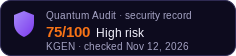
Quantum Audit's risk score for KGEN is 75/100 (High risk) as of Nov 12, 2026, computed by a deterministic function from on-chain facts — Contract verified: Verified; Ownership: Retained; Mint: Mintable; Liquidity lock: Not locked; Upgradeability: Fixed code; Honeypot: None found; Buy / sell tax: 0% / 0%. A score is a dated snapshot of those facts, not a guarantee; each one is listed on this page.
Is KGEN liquidity locked?
Liquidity lock: Not locked (as of Nov 12, 2026). Total DEX liquidity: $258.4K.
Who holds KGEN?
As of Nov 12, 2026, the 10 largest holders own 100.0% of the supply across 96 holders. The Holders section on this page shows who they are by holder type.
Would You Like a More Detailed Audit of KGEN?
Our AI-powered scanner gives you a deeper, real-time smart contract analysis — free, with every scoring factor shown.
Get Detailed Audit Is this your token? Add your links and get it Verified