
The protocol implements an upgradeable ERC-20 token with minting and burning capabilities managed by a multisig owner. The architecture follows standard UUPS proxy patterns and utilizes OpenZeppelin's Ownable2Step for secure ownership transfers. While the code is well-structured, the centralization of minting authority poses a significant economic risk to token holders.
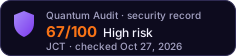

On-chain security analysis — is it a scam or legit?
Is JANCTION Safe?
Not verified
This record has not gone through deep verification and is not being monitored. The score is a dated snapshot — the token’s risk can change at any time.Own this token? Put it under verification →The protocol implements an upgradeable ERC-20 token with minting and burning capabilities managed by a multisig owner.
Read the full analysis- Mintable supply, nominal cap 385%/year — effectively unbounded
- Upgradeable proxy — the admin can replace the logic
- Liquidity not locked
- Liquidity < $50k
- Top-10 concentration > 30%
- Code: State Variable Shadowing
Exact factors
- Mintable supply, nominal cap 385%/year — effectively unbounded
- Upgradeable proxy — the admin can replace the logic
- Liquidity NOT locked (100% of the pool; this pool is 97% of DEX liquidity) — who holds it cannot be verified
- Liquidity < $50k ($41,096 across 2 pairs — thin market)
- Top-10 concentration > 30% (78.2% total → 43.1% effective; 19.7% in EOAs, 58.5% in contracts)
- Code: State Variable Shadowing (High, static analysis)
Each factor is an on-chain fact recorded at the time of this analysis. The score is computed from them by a deterministic function, so the same contract returns the same score for anyone who runs the audit. How scores are computed
Security Checklist
as of audit · Oct 27Holders
as of audit · Oct 27, 2026- Contractstreasury, vesting, bridge, staking58.5%
- Walletsanonymous holders, free to sell19.7%
- Everyone else15,855 holders21.8%
How holder types affect the score
Share held by contracts — treasury, vesting, bridge or staking — is discounted against share held by wallets when the score is computed: a contract cannot decide to sell the way an anonymous holder can, though it can still be drained or voted to sell. Effective concentration is the figure the risk score is actually calculated from.
Holder balances as recorded by the audit of Oct 27, 2026
Liquidity
as of audit · Oct 27The risk score reads depth across every pair.
The LP tokens of the analysed pool are not locked or burned, so whoever holds them can withdraw that liquidity.
0x13f6…5e120x2ee3…55d50x72b2…839f0x41ad…f7ed0x8e0a…76c10x5e91…fac10xe320…e523Security Findings
HighState Variable Shadowing
The contract contains instances where local variables or inherited state variables shadow existing state, which can lead to unintended logic execution or incorrect state updates during contract interactions.CD-01
Issue
The contract contains instances where local variables or inherited state variables shadow existing state, which can lead to unintended logic execution or incorrect state updates during contract interactions.
Fix
Rename shadowed variables to ensure clarity and prevent accidental overwriting of critical state data.
Status
Unresolved
MediumCentralized Minting Authority
The mint(address,uint256) function allows addresses with the 'minter' role to create new tokens at will. This centralizes control over the total supply and allows for the dilution of existing token holders.CP-01
Issue
The mint(address,uint256) function allows addresses with the 'minter' role to create new tokens at will. This centralizes control over the total supply and allows for the dilution of existing token holders.
Fix
Restrict the minting role to a timelocked multisig or a decentralized governance contract to ensure transparency and prevent unilateral supply changes.
Status
Unresolved
MediumLiquidity not locked
0.0% of the pool's LP is burned or time-locked. 100.0% is held, unlocked, by 1 address(es) other than the owner/deployer. One of them — a contract, 0x13f6…5e12 — holds 99.9% and can remove that share at once; who controls it is not visible on-chain, so it is not treated as an independent provider. Some pools are concentrated-liquidity (V3/V4) positions; shares above are by position as GoPlus reports them.QA-LIQUIDITY
Issue
0.0% of the pool's LP is burned or time-locked. 100.0% is held, unlocked, by 1 address(es) other than the owner/deployer. One of them — a contract, 0x13f6…5e12 — holds 99.9% and can remove that share at once; who controls it is not visible on-chain, so it is not treated as an independent provider. Some pools are concentrated-liquidity (V3/V4) positions; shares above are by position as GoPlus reports them.
Fix
Check the lock's end date and beneficiary on the locker's own page before relying on it.
Status
Acknowledged
InfoWho holds the supply
The ten largest holders own 78.2% of supply. What remains: 19.7% in wallets, 58.5% in other contracts. 15,865 holders in total.QA-HOLDERS
Issue
The ten largest holders own 78.2% of supply. What remains: 19.7% in wallets, 58.5% in other contracts. 15,865 holders in total.
Fix
Watch the largest wallets that are not exchanges, pools or locks — those are the ones that can move the price.
Status
Acknowledged
InfoIdentity verified by independent sources
Listed on CoinGecko as Janction (JCT), market cap $88M, rank #297. 15,865 holders. Verified by: CoinGecko.QA-IDENTITY
Issue
Listed on CoinGecko as Janction (JCT), market cap $88M, rank #297. 15,865 holders. Verified by: CoinGecko.
Fix
Match the contract address against the project's official channels before trading.
Status
Acknowledged
InfoThe market for this token
Liquidity $41K (DexScreener, all pools). 24h trading volume $49.6M (CoinGecko, all markets, daily snapshot). 24h trading volume $301K (DexScreener, all pools).QA-MARKET
Issue
Liquidity $41K (DexScreener, all pools). 24h trading volume $49.6M (CoinGecko, all markets, daily snapshot). 24h trading volume $301K (DexScreener, all pools).
Fix
Size any position to the liquidity and daily volume shown — they set how much you can sell and at what price.
Status
Acknowledged
InfoAsset class: Project token
A token issued by a project for use, governance or fundraising. Scored on its contract and market facts. The class itself adds no points; the contract and market facts decide the score. Basis: no class-specific evidence. Tokenomics — Supply: mintable, capped at 384.6% of supply per year. Control: a 5-of-7 multisig. Code: upgradeable proxy. Fees: no buy or sell tax. Market: $41K of DEX liquidity across 2 pools. Launch: 351 days of market history.QA-PROFILE
Issue
A token issued by a project for use, governance or fundraising. Scored on its contract and market facts. The class itself adds no points; the contract and market facts decide the score. Basis: no class-specific evidence. Tokenomics — Supply: mintable, capped at 384.6% of supply per year. Control: a 5-of-7 multisig. Code: upgradeable proxy. Fees: no buy or sell tax. Market: $41K of DEX liquidity across 2 pools. Launch: 351 days of market history.
Fix
Check the project's own documentation for what the token is used for; this report covers what the contract allows.
Status
Acknowledged
Analysis
AI Copilotas of audit · Oct 27The implementation utilizes robust, battle-tested libraries for proxy management and token standards (7.1 Architecture, 7.2 Code Security). Access control is strictly enforced via modifiers like onlyMinter and onlyOwner (7.3 Access Control). The codebase is clean and follows modern Solidity patterns, though the complexity of the upgradeable structure requires careful management of storage layouts.
The economic model relies on centralized minting authority, which allows for potential supply inflation (7.4 Economic). Governance is managed via a 5-of-7 multisig, providing a reasonable balance between security and operational agility (7.5 Governance). External dependencies are limited to standard ERC-20 interfaces, reducing external integration risks (7.6 External).
The contract employs the UUPS proxy pattern, which is the industry standard for upgradeable contracts (7.7 Upgrades). The implementation includes necessary safety checks to prevent bricking the proxy during upgrades. Operational procedures for upgrades are well-defined through the multisig owner (7.8 Operations).
The protocol should implement a timelock controller for all privileged functions, including minting and contract upgrades, to provide transparency and a window for community response.
Additionally, consider setting a hard cap on the total supply if not already enforced to mitigate the risk of excessive dilution.
Contract & Record
Free for any token on the record. It links to this page and always shows the current score and the date it was checked.
- Oct 27, 202667High
Score changes are recorded as dated snapshots — history is append-only and cannot be edited.
Would You Like a More Detailed Audit of JANCTION?
Our AI-powered scanner gives you a deeper, real-time smart contract analysis — free, with every scoring factor shown.
Get Detailed Audit Is this your token? Add your links and get it Verified