
Quantum Audit Logo

Is Invesqo QQQ Safe?

On-chain security analysis — is it a scam or legit?

Is this your token? Publish your own audit on this page →

Invesqo QQQ QQQB
0x2058…efc7
BNB Chain Not verifiedLast checked 3d ago 2 audits on record
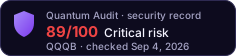
How is this score calculated? → Critical Risk
Executive SummaryAI Copilot

The audit of the SecuritiesToken contract, serving as the implementation for a Beacon Proxy, identified a critical vulnerability related to the initialization of the admin role, which could lead to permanent loss of administrative control. Additional medium and low-severity issues were found concerning zero-address checks for external dependencies and inherent centralization risks. The contract utilizes standard OpenZeppelin upgradeable patterns and role-based access control.

1 Critical1 Medium1 Low1 Informational
Volume 24h
$22.82M
Liquidity
$2.52M
Price
$718.6000
Token Age
16d
Top 10 Holders
81.7%

Security Findings

Critical

Missing Zero Address Check for Admin Role in `initialize`

C-01The `initialize` function, which sets up the initial `DEFAULT_ADMIN_ROLE`, does not validate that the `admin_` parameter is not the zero address (`address(0)`). If `address(0)` is provided during initialization, the `DEFAULT_ADMIN_ROLE` will be granted to the zero address, making it impossible to manage roles, enable/disable minting/burning, or perform any other administrative functions. This would lead to a permanent lockout of administrative control over the contract.
IssueThe `initialize` function, which sets up the initial `DEFAULT_ADMIN_ROLE`, does not validate that the `admin_` parameter is not the zero address (`address(0)`). If `address(0)` is provided during initialization, the `DEFAULT_ADMIN_ROLE` will be granted to the zero address, making it impossible to manage roles, enable/disable minting/burning, or perform any other administrative functions. This would lead to a permanent lockout of administrative control over the contract.
FixAdd a check in the `initialize` function to ensure `admin_` is not `address(0)` before granting the `DEFAULT_ADMIN_ROLE`. For example: `if (admin_ == address(0)) revert ZeroAddress();`
StatusUnresolved
Medium

Missing Zero Address Checks for External Client Contracts

M-01The `initialize` function accepts `compliance_` and `pauseManager_` addresses for external client contracts without validating that these addresses are not the zero address (`address(0)`). While not directly leading to a loss of funds, setting these critical external dependencies to `address(0)` could result in unexpected runtime errors, non-functional compliance checks, or an inability to pause the token, severely impacting the contract's intended behavior and operational stability.
IssueThe `initialize` function accepts `compliance_` and `pauseManager_` addresses for external client contracts without validating that these addresses are not the zero address (`address(0)`). While not directly leading to a loss of funds, setting these critical external dependencies to `address(0)` could result in unexpected runtime errors, non-functional compliance checks, or an inability to pause the token, severely impacting the contract's intended behavior and operational stability.
FixImplement zero-address checks for `compliance_` and `pauseManager_` parameters in the `initialize` function. For example: `if (compliance_ == address(0)) revert ZeroAddress();` and `if (pauseManager_ == address(0)) revert ZeroAddress();`
StatusUnresolved
Low

High Centralization Risk with DEFAULT_ADMIN_ROLE

L-01The `DEFAULT_ADMIN_ROLE` holds extensive power over the `SecuritiesToken` contract. This role can set the token's name, symbol, and identifier, enable/disable minting and burning, and grant/revoke any other role, including the `ISSUER_ROLE`. While common for security tokens requiring centralized control, this concentration of power means that a compromise of the single entity holding the `DEFAULT_ADMIN_ROLE` could lead to significant operational and economic risks, including unauthorized token issuance or manipulation of token metadata.
IssueThe `DEFAULT_ADMIN_ROLE` holds extensive power over the `SecuritiesToken` contract. This role can set the token's name, symbol, and identifier, enable/disable minting and burning, and grant/revoke any other role, including the `ISSUER_ROLE`. While common for security tokens requiring centralized control, this concentration of power means that a compromise of the single entity holding the `DEFAULT_ADMIN_ROLE` could lead to significant operational and economic risks, including unauthorized token issuance or manipulation of token metadata.
FixConsider implementing a multi-signature wallet or a time-locked governance mechanism for the `DEFAULT_ADMIN_ROLE` to distribute control and introduce a delay for critical operations. This would enhance security by requiring multiple approvals for sensitive actions and providing a window for intervention.
StatusUnresolved
Info

Reliance on External Compliance and Pause Managers

I-01The `SecuritiesToken` contract integrates `ComplianceClientUpgradeable` and `PauseManagerClientUpgradeable`, making its core functionalities (transfers, minting, burning) dependent on the logic and availability of these external contracts. The security, reliability, and upgradeability of these external dependencies are paramount, as any vulnerability or malfunction in them could directly impact the `SecuritiesToken`'s operations and user experience.
IssueThe `SecuritiesToken` contract integrates `ComplianceClientUpgradeable` and `PauseManagerClientUpgradeable`, making its core functionalities (transfers, minting, burning) dependent on the logic and availability of these external contracts. The security, reliability, and upgradeability of these external dependencies are paramount, as any vulnerability or malfunction in them could directly impact the `SecuritiesToken`'s operations and user experience.
FixEnsure that the external `ComplianceClientUpgradeable` and `PauseManagerClientUpgradeable` contracts are thoroughly audited, well-maintained, and controlled by robust governance mechanisms. Implement monitoring for these external contracts to detect any unusual behavior or potential compromises promptly.
StatusUnresolved

Category Ratings

TechnicalMedium4/10

The contract leverages OpenZeppelin's upgradeable patterns and AccessControlEnumerable for robust role management (7.1 Architecture, 7.3 Access Control). Custom error types enhance readability and debugging (7.2 Code Security). However, a critical flaw exists in the `initialize` function where the `admin_` address is not validated against the zero address, potentially leading to an unrecoverable loss of administrative control (7.3 Access Control). Additionally, external compliance and pause manager addresses lack zero-address checks, which could cause operational issues (7.6 External).

GovernanceHigh1/10

The token's economic model relies on a centralized `DEFAULT_ADMIN_ROLE` for critical operations such as enabling/disabling minting/burning, and managing all other roles (7.4 Economic, 7.5 Governance). This centralization, while common for security tokens, introduces a single point of failure. The contract's functionality is also heavily dependent on external Compliance and Pause Manager contracts, whose security and governance directly impact the token's transferability and availability (7.6 External).

UpgradesHigh1/10

The contract correctly implements OpenZeppelin's upgradeable proxy pattern, utilizing `_disableInitializers()` in the constructor and the `initializer` modifier for the `initialize` function (7.7 Upgrades). This approach minimizes the risk of re-initialization and ensures proper deployment within a proxy architecture. No apparent storage collision risks or other upgrade-specific vulnerabilities were identified in the provided code snippet.

Security Checklist

Contract VerifiedPass
Ownership Renounced?
No Mint FunctionFail
Liquidity LockedFail
Not a ProxyFail

Proxy Upgrade Controls

Proxy TypeBeacon
ImplementationVerified source

Holder Composition

71.4% in wallets10.3% in contracts
Effective Concentration75.5%

Share held by contracts — treasury, vesting, bridge or staking — is discounted against share held by wallets when the score is computed: a contract cannot decide to sell the way an anonymous holder can, though it can still be drained or voted to sell. Effective concentration is the figure the risk score is actually calculated from.

Liquidity Depth

Show 3 more pairsShow less

The risk score reads depth across every pair. The volume figure and the volume-to-liquidity ratio elsewhere on this page describe only the pair this audit analysed, so the two are not directly comparable.

LP Distribution

Top-1 Unlocked Holder42.1%
Top-3 Unlocked78.4%

Key Addresses

Deployer
0x64fd…8d53
Unlocked LP Held By
0x2f7d…5ef00x556b…d59e0x7b87…b51e0x64fd…2f280x97d2…f1820xde6a…c0550xb46b…224e0xc37e…87e10xe7d2…371b0x1fee…ed6f

No privileged address appears among these holders: the unlocked liquidity sits with independent providers, not with the deployer.

What Raised This Score

  • Ownership status UNKNOWN (owner could not be resolved)
  • Mintable supply — no cap found, dilution unbounded
  • Proxy contract (upgradeable — admin can replace logic)
  • Complex proxy pattern (BEACON)
  • Top-10 concentration > 70% (81.7% total → 75.5% effective; 71.4% in EOAs, 10.3% in contracts — extreme)
  • Liquidity not locked, but no owner/deployer address holds LP — market-depth risk, not rug risk
  • Token age < 30 days (still settling)
  • 1 Critical finding(s) from audit
  • 1 Medium finding(s) from audit
  • 1 Low finding(s) from audit

Each factor is an on-chain fact recorded at the time of this analysis. The score is computed from them by a deterministic function, so the same contract returns the same score for anyone who runs the audit. How scores are computed

Frequently Asked Questions

Is Invesqo QQQ a scam?

Based on automated analysis, Invesqo QQQ scores 63/100 (High Risk) on our risk scale. No honeypot was detected, but always verify independently before investing.

Is Invesqo QQQ safe to buy?

Our scanner flagged a risk score of 63/100. Ownership has not been renounced, which is a risk factor. DYOR before purchasing any token.

Has Invesqo QQQ been audited?

The contract has not been verified on-chain. Verification is not the same as a full security audit. Use Quantum Audit's free tool to run a deeper analysis of the contract code.

Related Audits

MonkeyCritical RiskMonkeyCritical RiskWIKI CAT (WKC)Critical RiskTether Gold (XAUT)Critical RiskBlock Street (BSB)Critical RiskLIGHTCritical Risk

Would You Like a More Detailed Audit of Invesqo QQQ?

Our AI-powered scanner gives you a deeper, real-time smart contract analysis — free, with every scoring factor shown.

Get Detailed Audit