
The Fren Pet Token contract is an ERC20 token with burnable capabilities, integrating with Uniswap V2 for liquidity management. It features a complex tokenomics model including transaction fees, anti-whale mechanisms, a blacklist, and a pre-migration phase. The contract leverages OpenZeppelin and Solmate libraries for standard functionalities and security. While the code demonstrates good practices in using established libraries and includes reentrancy protection for liquidity operations, it exhibits a high degree of centralization through extensive owner privileges. The owner has significant control over critical parameters such as fees, trading status, and user blacklisting, which introduces considerable trust assumptions and potential economic risks for token holders.

On-chain security analysis — is it a scam or legit?
Is Fren Pet Safe?
Not verified
This record has not gone through deep verification and is not being monitored. The score is a dated snapshot — the token’s risk can change at any time.Own this token? Put it under verification →The Fren Pet Token contract is an ERC20 token with burnable capabilities, integrating with Uniswap V2 for liquidity management.
Read the full analysis- Ownership not renounced — owner is a contract
- Top-10 concentration > 30%
- Liquidity not locked, but no owner/deployer address holds LP — market-depth risk, not rug risk
- LP top1 unlocked holder = 98.0%
- LP top3 unlocked holders = 100.0%
- 2 High finding(s) from audit
- 2 Medium finding(s) from audit
- 2 Low finding(s) from audit
Exact factors
- Ownership NOT renounced — owner is a contract (governance/executor, not an EOA)
- Top-10 concentration > 30% (71.6% total → 37.1% effective; 14.1% in EOAs, 57.6% in contracts — moderate)
- Liquidity not locked, but no owner/deployer address holds LP — market-depth risk, not rug risk
- LP top1 unlocked holder = 98.0% (independent LP — depth risk, pool = 100% of DEX liquidity)
- LP top3 unlocked holders = 100.0% (independent LP — depth risk, pool = 100% of DEX liquidity)
- 2 High finding(s) from audit
- 2 Medium finding(s) from audit
- 2 Low finding(s) from audit
Each factor is an on-chain fact recorded at the time of this analysis. The score is computed from them by a deterministic function, so the same contract returns the same score for anyone who runs the audit. How scores are computed
Security Checklist
as of audit · Sep 4Holders
as of audit · Sep 4, 2026- Contractstreasury, vesting, bridge, staking57.6%
- Walletsanonymous holders, free to sell14.1%
- Everyone elsethe rest of the supply28.4%
How holder types affect the score
Share held by contracts — treasury, vesting, bridge or staking — is discounted against share held by wallets when the score is computed: a contract cannot decide to sell the way an anonymous holder can, though it can still be drained or voted to sell. Effective concentration is the figure the risk score is actually calculated from.
Holder balances as recorded by the audit of Sep 4, 2026
Liquidity
as of audit · Sep 4- Uniswap v2WETHAnalysed$806.3K99.6%
- BaseswapWETH$3.5K0.4%
- AerodromeWETH$150.0%
- Uniswap v4USDC$70.0%
- SushiswapWETH$10.0%
The risk score reads depth across every pair.
The LP tokens of the analysed pool are not locked or burned, so whoever holds them can withdraw that liquidity.
0x038d…25340xe764…90950xb6d4…4d0a0xf493…eb1e0x9bd2…168c0x8099…43b70x2934…eff80x3ec2…39870x8392…3a6d0x89b9…1276No privileged address appears among these holders: the unlocked liquidity sits with independent providers, not with the deployer.
Security Findings
HighExtensive Owner Privileges and Centralization Risk
The FrenPetToken contract grants the owner (via Ownable) extensive control over critical parameters and functionalities. This includes the ability to: update buy and sell fees up to 25% each, set maximum transaction amounts and maximum wallet holdings (potentially to zero, halting transfers), enable/disable trading, blacklist any address, and control the pre-migration phase. This high degree of centralization introduces significant trust assumptions and a single point of failure. A compromised or malicious owner could severely impact token holders. (7.3 Access Control, 7.4 Economic, 7.5 Governance, 7.8 Operations)H-01
Issue
The FrenPetToken contract grants the owner (via Ownable) extensive control over critical parameters and functionalities. This includes the ability to: update buy and sell fees up to 25% each, set maximum transaction amounts and maximum wallet holdings (potentially to zero, halting transfers), enable/disable trading, blacklist any address, and control the pre-migration phase. This high degree of centralization introduces significant trust assumptions and a single point of failure. A compromised or malicious owner could severely impact token holders. (7.3 Access Control, 7.4 Economic, 7.5 Governance, 7.8 Operations)
Fix
Consider implementing a multi-signature wallet for critical owner functions or a time-locked contract for sensitive parameter changes to reduce the risk associated with a single point of control. Clearly communicate the extent of owner privileges to the community.
Status
Unresolved
HighPotential for Excessive Transaction Fees
The owner has the capability to set buyTotalFees and sellTotalFees up to 25% (2500 basis points) each. While the current default fees are 5% and 5% respectively, the updateBuyFees and updateSellFees functions allow the owner to increase these significantly. Such high transaction fees could render the token illiquid, discourage trading, and effectively drain value from token holders with each transaction. (7.4 Economic)H-02
Issue
The owner has the capability to set buyTotalFees and sellTotalFees up to 25% (2500 basis points) each. While the current default fees are 5% and 5% respectively, the updateBuyFees and updateSellFees functions allow the owner to increase these significantly. Such high transaction fees could render the token illiquid, discourage trading, and effectively drain value from token holders with each transaction. (7.4 Economic)
Fix
Implement a maximum cap for fees that is lower than 25%, or introduce a community governance mechanism to approve fee changes. Clearly document the fee structure and potential for changes.
Status
Unresolved
MediumAnti-whale Mechanism Limitations
The maxTransactionAmount and maxWallet limits are designed to prevent large transactions and concentrated holdings. However, these mechanisms can be bypassed by sophisticated users through splitting transactions across multiple wallets or by using multiple addresses to accumulate tokens beyond the maxWallet limit. While common in token contracts, this limits the effectiveness of the anti-whale measures. (7.4 Economic)M-01
Issue
The maxTransactionAmount and maxWallet limits are designed to prevent large transactions and concentrated holdings. However, these mechanisms can be bypassed by sophisticated users through splitting transactions across multiple wallets or by using multiple addresses to accumulate tokens beyond the maxWallet limit. While common in token contracts, this limits the effectiveness of the anti-whale measures. (7.4 Economic)
Fix
Acknowledge that anti-whale mechanisms have inherent limitations. For more robust control, consider alternative strategies or clearly communicate these limitations to users.
Status
Unresolved
MediumPre-migration Phase Operational Risk
The contract includes a preMigrationPhase and a preMigrationTransferrable mapping, allowing the owner to control token transfers during a specific phase. This adds significant complexity to the transfer logic and grants the owner granular control over who can transfer tokens during this period. Mismanagement or errors in setting these parameters could lead to unintended restrictions on token movement or operational issues during a migration event. (7.8 Operations, 7.1 Architecture)M-02
Issue
The contract includes a preMigrationPhase and a preMigrationTransferrable mapping, allowing the owner to control token transfers during a specific phase. This adds significant complexity to the transfer logic and grants the owner granular control over who can transfer tokens during this period. Mismanagement or errors in setting these parameters could lead to unintended restrictions on token movement or operational issues during a migration event. (7.8 Operations, 7.1 Architecture)
Fix
Ensure thorough testing of the pre-migration phase logic. Clearly define and communicate the conditions and duration of this phase to users. Consider if such a complex mechanism is strictly necessary or if simpler, more transparent migration strategies could be employed.
Status
Unresolved
LowRedundant SafeMath Usage
The contract imports and uses SafeMath for uint256 operations. However, the contract is compiled with Solidity 0.8.19, which includes built-in overflow and underflow checks for all arithmetic operations by default. The explicit use of SafeMath is therefore redundant and adds unnecessary code complexity without providing additional security benefits in this Solidity version. (7.2 Code Security)L-01
Issue
The contract imports and uses SafeMath for uint256 operations. However, the contract is compiled with Solidity 0.8.19, which includes built-in overflow and underflow checks for all arithmetic operations by default. The explicit use of SafeMath is therefore redundant and adds unnecessary code complexity without providing additional security benefits in this Solidity version. (7.2 Code Security)
Fix
Remove the using SafeMath for uint256; statement and all explicit SafeMath calls. This will simplify the code without compromising security.
Status
Unresolved
LowHardcoded Uniswap Router Address
The Uniswap V2 Router address (0x327D…5d86) is hardcoded in the constructor. While this is a common practice, it means that if the Uniswap router contract were to be upgraded, deprecated, or compromised, the FrenPetToken contract's swapAndLiquify functionality would cease to work correctly, requiring a new deployment of the token contract to update the address. (7.6 External)L-02
Issue
The Uniswap V2 Router address () is hardcoded in the constructor. While this is a common practice, it means that if the Uniswap router contract were to be upgraded, deprecated, or compromised, the FrenPetToken contract's swapAndLiquify functionality would cease to work correctly, requiring a new deployment of the token contract to update the address. (7.6 External)
Fix
For future contracts, consider making critical external contract addresses configurable by the owner (e.g., via an onlyOwner function) to allow for updates without redeploying the entire token.
Status
Unresolved
InfoComplex Transfer Logic
The _transfer function in FrenPetToken is highly complex due to the numerous conditional checks for fees, anti-whale limits, blacklist status, trading activity, and the pre-migration phase. This intricate logic, while designed to implement specific tokenomics, increases the cognitive load for auditors and developers, making it more challenging to reason about correctness and potentially increasing the risk of subtle bugs or unexpected interactions. (7.2 Code Security, 7.1 Architecture)I-01
Issue
The _transfer function in FrenPetToken is highly complex due to the numerous conditional checks for fees, anti-whale limits, blacklist status, trading activity, and the pre-migration phase. This intricate logic, while designed to implement specific tokenomics, increases the cognitive load for auditors and developers, making it more challenging to reason about correctness and potentially increasing the risk of subtle bugs or unexpected interactions. (7.2 Code Security, 7.1 Architecture)
Fix
While the current implementation appears functionally correct, consider refactoring complex logic into smaller, more focused internal functions in future contracts to improve readability, testability, and maintainability. Ensure comprehensive unit and integration tests cover all possible execution paths within the _transfer function.
Status
Unresolved
Analysis
AI Copilotas of audit · Sep 4The contract's architecture (7.1) is a standard ERC20 token with added DeFi features, utilizing well-audited OpenZeppelin and Solmate libraries for core functionalities. Code security (7.2) is generally robust, with SafeTransferLib used for external transfers and a reentrancy guard implemented for swapAndLiquify. However, the _transfer function is notably complex, increasing the potential for subtle bugs. Access control (7.3) is managed via Ownable, granting the deployer extensive privileges over critical contract parameters and operations.
The economic model (7.4) is highly dependent on owner actions, as fees can be set up to 25% for both buy and sell transactions, potentially leading to excessive taxation. The anti-whale mechanisms, while present, can be bypassed. Governance (7.5) is entirely centralized, with the owner having unilateral control over all critical parameters, including the ability to blacklist users and pause trading. This introduces significant trust assumptions and a single point of failure. External dependencies (7.6) on Uniswap V2 are standard, but the hardcoded router address limits flexibility.
The contract is not designed to be upgradeable, meaning its logic is immutable once deployed. This eliminates upgrade-related risks but requires any future changes to be implemented via a new contract deployment.
To enhance the security and decentralization of the Fren Pet Token, it is strongly recommended to reduce the extensive owner privileges.
Consider implementing a multi-signature wallet for critical administrative functions or introducing a time-lock for sensitive parameter changes, such as fee adjustments or blacklist modifications. Additionally, clearly communicate the current fee structure and the potential for changes to the community to manage expectations and foster transparency.
Contract & Record
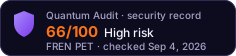
Free for any token on the record. It links to this page and always shows the current score and the date it was checked.
- Aug 11, 202666High
Score changes are recorded as dated snapshots — history is append-only and cannot be edited.






Would You Like a More Detailed Audit of Fren Pet?
Our AI-powered scanner gives you a deeper, real-time smart contract analysis — free, with every scoring factor shown.
Get Detailed Audit Is this your token? Publish your own audit on this page