

The ENJToken contract is an ERC-20 token with significant centralized control. The owner has the ability to halt all public token transfers and manage large token allocations for team, advisors, and unsold tokens. Two findings were identified: a medium-severity issue where the owner can control the transfer switch, and a high-severity issue related to shadowing state variables.
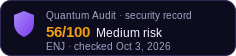

On-chain security analysis — is it a scam or legit?
Is Enjin Coin Safe?
Not verified
This record has not gone through deep verification and is not being monitored. The score is a dated snapshot — the token’s risk can change at any time.Own this token? Put it under verification →The ENJToken contract is an ERC-20 token with significant centralized control.
Read the full analysis- A privileged address controls a switch that decides whether transfers go through
- Liquidity not locked
- Top-10 concentration > 30%
- Code: Potential for hidden or conflicting state variables
Exact factors
- A privileged address controls a switch that decides whether transfers go through
- Liquidity NOT locked (100% of the pool; this pool is 88% of DEX liquidity) — held by independent providers — market-depth risk
- Top-10 concentration > 30% (78.6% total → 31.4% effective; 28.9% in EOAs, 6.4% in contracts; 43.4% burned, locked or in pools excluded)
- Code: Potential for hidden or conflicting state variables (High, static analysis)
Security Checklist
as of audit · Oct 3Holders
as of audit · Oct 3, 2026- Contractstreasury, vesting, bridge, staking6.4%
- Walletsanonymous holders, free to sell28.9%
- Burnedout of circulation43.4%
- Everyone else151,333 holders21.4%
How holder types affect the score
Share held by contracts — treasury, vesting, bridge or staking — is discounted against share held by wallets when the score is computed: a contract cannot decide to sell the way an anonymous holder can, though it can still be drained or voted to sell. Effective concentration is the figure the risk score is actually calculated from.
Holder balances as recorded by the audit of Oct 3, 2026
Liquidity
as of audit · Oct 3- Uniswap v2WETHAnalysed$72.3K87.8%
- Uniswap v3WETH$7.5K9.0%
- DefiswapWETH$1.7K2.0%
- DefiswapCRO$8611.0%
- Uniswap v2UNI$260.0%
- ShibaswapMATIC$220.0%
Show 3 more pairs
The LP tokens of the analysed pool are not locked or burned, so whoever holds them can withdraw that liquidity.
0x35ab…9c970x0118…53f00x8f11…2c7d0xd6fc…85a30x0141…12ac0xbf92…3e870xd331…7d4c0x2e52…ec6a0x965e…46160xdc8d…b59eNo privileged address appears among these holders: the unlocked liquidity sits with independent providers, not with the deployer.
Security Findings
HighPotential for hidden or conflicting state variables
The static analysis identified a 'shadowing state' issue.CD-01
Issue
The static analysis identified a 'shadowing state' issue. This means that a variable in the ENJToken contract might have the same name as a variable in one of its inherited contracts, potentially leading to unexpected behavior or vulnerabilities where the contract uses one variable when it intends to use another. This could affect critical operations or calculations within the token contract.
Fix
This is a technical issue that could lead to unpredictable behavior. Token holders should be aware that such a low-level coding issue could have unforeseen consequences on the token's functionality or security. The contract developer should review the inheritance hierarchy and variable declarations to ensure no critical state variables are being unintentionally shadowed.
Status
Unresolved
MediumOwner can stop all token transfers
The allowTransfers() function, which can only be called by the contract owner, controls a switch (isReleasedToPublic) that determines whether token transfers are permitted for regular users.CP-05
Issue
The allowTransfers() function, which can only be called by the contract owner, controls a switch (isReleasedToPublic) that determines whether token transfers are permitted for regular users. If this switch is off, most token transfers will fail. This means the owner has the power to unilaterally halt all public trading or movement of tokens at any time.
Fix
Token holders should understand that the owner has the ability to freeze token transfers. For future contracts, consider removing such a centralized kill switch or implementing a decentralized governance mechanism (e.g., a DAO) to control it, or a timelock to provide notice.
Status
Unresolved
MediumLiquidity not locked
0.0% of the pool's LP is burned or time-locked. 83.0% is held, unlocked, by 10 address(es) other than the owner/deployer.QA-LIQUIDITY
Issue
0.0% of the pool's LP is burned or time-locked. 83.0% is held, unlocked, by 10 address(es) other than the owner/deployer. No single one holds a majority: their exits thin the market rather than hand anyone the pool. Some pools are concentrated-liquidity (V3/V4) positions; shares above are by position as GoPlus reports them. This assessment covers the main pool, which holds 88% of the token's DEX liquidity; the other pools were not assessed.
Fix
Check the lock's end date and beneficiary on the locker's own page before relying on it.
Status
Acknowledged
MediumThe market for this token
Liquidity $82K (DexScreener, all pools). 24h trading volume $143.4M (CoinGecko, all markets, daily snapshot).QA-MARKET
Issue
Liquidity $82K (DexScreener, all pools). 24h trading volume $143.4M (CoinGecko, all markets, daily snapshot). 24h trading volume $53K (DexScreener, all pools). CoinGecko's record for this coin: all-time high $4.82 on 2021-11-25; the price is now 99.2365% below it.
Fix
Size any position to the liquidity and daily volume shown — they set how much you can sell and at what price.
Status
Acknowledged
InfoWho holds the supply
The ten largest holders own 78.6% of supply. Of that, 43.4% burned — not holders that can sell, so excluded from the concentration score.QA-HOLDERS
Issue
The ten largest holders own 78.6% of supply. Of that, 43.4% burned — not holders that can sell, so excluded from the concentration score. What remains: 28.9% in wallets, 6.4% in other contracts. 151,343 holders in total.
Fix
Watch the largest wallets that are not exchanges, pools or locks — those are the ones that can move the price.
Status
Acknowledged
InfoIdentity verified by independent sources
Listed on CoinGecko as Enjin Coin (ENJ), market cap $74M, rank #362. Traded on Binance, Coinbase.QA-IDENTITY
Issue
Listed on CoinGecko as Enjin Coin (ENJ), market cap $74M, rank #362. Traded on Binance, Coinbase. 151,343 holders. Verified by: CoinGecko, exchange listings.
Fix
Match the contract address against the project's official channels before trading.
Status
Acknowledged
InfoAsset class: Project token
A token issued by a project for use, governance or fundraising.QA-PROFILE
Issue
A token issued by a project for use, governance or fundraising. Basis: no class-specific evidence. Tokenomics — Supply: fixed — the contract has no mint function. Control: a single wallet (EOA). Code: not upgradeable (no proxy). Fees: no buy or sell tax. Market: $82K of DEX liquidity across 9 pools. Launch: 2328 days of market history.
Fix
Check the project's own documentation for what the token is used for; this report covers what the contract allows.
Status
Acknowledged
Analysis
AI Copilotas of audit · Oct 3The ENJToken contract implements standard ERC-20 functionality, allowing for token transfers and approvals. Key security features include ownerOnly modifiers restricting critical functions to the contract owner (7.3 Access Control). However, a significant technical risk (7.2 Code Security) is the potential for shadowing state variables (CD-01), which can lead to unexpected behavior or vulnerabilities. Additionally, the owner can unilaterally control the isReleasedToPublic switch via allowTransfers(), which directly impacts the ability of token holders to transfer tokens (CP-05).
The contract exhibits a high degree of centralized control, posing significant governance and economic risks (7.4 Economic, 7.5 Governance). The owner can execute functions like releaseEnjinTeamTokens(), releaseAdvisorTokens(), and retrieveUnsoldTokens(), which directly affect token distribution and supply. Critically, the allowTransfers() function, restricted to the owner, can enable or disable all public token transfers, giving the owner immense power over the token's liquidity and market. This centralization means token holders are highly dependent on the owner's integrity and security.
This contract is not designed to be upgradeable, as indicated by is_proxy: false (7.7 Upgrades). This eliminates risks associated with upgrade mechanisms, such as proxy implementation vulnerabilities or improper upgrade paths. However, it also means that any discovered vulnerabilities or desired feature changes would require a new contract deployment and a token migration process, which can be complex and costly.
Token holders should be aware of the significant centralized control held by the contract owner, particularly the ability to halt transfers and manage large token allocations.
It is crucial for the owner to implement robust security practices for their private keys to prevent unauthorized access and malicious actions. Future iterations of such contracts should consider decentralizing critical control functions or implementing multi-signature wallets for sensitive operations to reduce single points of failure and enhance trust.
Contract & Record
Free for any token on the record. It links to this page and always shows the current score and the date it was checked.
- Oct 3, 202656Medium
Score changes are recorded as dated snapshots — history is append-only and cannot be edited.
Would You Like a More Detailed Audit of Enjin Coin?
Our AI-powered scanner gives you a deeper, real-time smart contract analysis — free, with every scoring factor shown.
Get Detailed Audit Is this your token? Add your links and get it Verified