
Quantum Audit Logo
Launch App

On-chain security analysis — is it a scam or legit?

Is Checkmate Safe?

CHECKBase
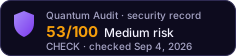
Not verified This record has not gone through deep verification and is not being monitored. The score is a dated snapshot — the token’s risk can change at any time.Own this token? Put it under verification →
Last checked Sep 4, 2026 · 1 audit on record
SummaryAI Copilot

The ERC20FixedSupply contract implements a standard fixed-supply ERC-20 token with additional features like batch transfers, permit functionality, token recovery, and meta-transaction support.

Read the full analysis
What raised the score
  • Ownership not renounced — owner is an EOA
  • Top-10 concentration > 30%
  • Liquidity not locked, but no owner/deployer address holds LP — market-depth risk, not rug risk
  • Liquidity < $50k
  • LP top1 unlocked holder = 92.7%
  • LP top3 unlocked holders = 98.1%
  • 1 Medium finding(s) from audit
  • 1 Low finding(s) from audit
Exact factors
  • Ownership NOT renounced — owner is an EOA (single private key)
  • Top-10 concentration > 30% (91.4% total → 45.4% effective; 14.8% in EOAs, 76.7% in contracts — moderate)
  • Liquidity not locked, but no owner/deployer address holds LP — market-depth risk, not rug risk
  • Liquidity < $50k ($32,820 across 10 pairs — thin market)
  • LP top1 unlocked holder = 92.7% (independent LP — depth risk, pool = 88% of DEX liquidity)
  • LP top3 unlocked holders = 98.1% (independent LP — depth risk, pool = 88% of DEX liquidity)
  • 1 Medium finding(s) from audit
  • 1 Low finding(s) from audit

Each factor is an on-chain fact recorded at the time of this analysis. The score is computed from them by a deterministic function, so the same contract returns the same score for anyone who runs the audit. How scores are computed

Security Checklist

as of audit · Sep 43 of 5 checks passed
Contract verifiedVerified
OwnershipRetained
MintNo mint
Liquidity lockNot locked
UpgradeabilityFixed code

Holders

as of audit · Sep 4, 2026
76.7%Contracts14.8%Wallets8.6%Everyone else
76.7%Contracts14.8%Wallets8.6%
ContractsWalletsEveryone elseBubble area = share of supply
91.4%of supply sits with the top 10 holders
  • Contractstreasury, vesting, bridge, staking76.7%
  • Walletsanonymous holders, free to sell14.8%
  • Everyone elsethe rest of the supply8.6%
Effective concentrationwhat the score reads45.4%
How holder types affect the score

Share held by contracts — treasury, vesting, bridge or staking — is discounted against share held by wallets when the score is computed: a contract cannot decide to sell the way an anonymous holder can, though it can still be drained or voted to sell. Effective concentration is the figure the risk score is actually calculated from.

Holder balances as recorded by the audit of Sep 4, 2026

Liquidity

as of audit · Sep 4$32.8K across 10 pairs
LP tokensNot locked

The LP tokens of the analysed pool are not locked or burned, so whoever holds them can withdraw that liquidity.

Analysed pool$28.9KShare of depth87.9%
Top-1 Unlocked Holder92.7%
Top-3 Unlocked98.1%
Unlocked LP held by
0xcc2b…49070x73fc…1ee50x75d7…5f1d0x5c3b…25af0x9211…61b70x9b05…520a

No privileged address appears among these holders: the unlocked liquidity sits with independent providers, not with the deployer.

Security Findings

1 Medium1 Low2 Info
Medium

Centralized Ownership

The ContractOwnership pattern grants significant control to a single owner address, including the ability to transfer ownership and potentially recover tokens via TokenRecovery. This introduces a single point of failure, where compromise of the owner's private key could lead to unauthorized control over critical contract functions.M-01

Issue

The ContractOwnership pattern grants significant control to a single owner address, including the ability to transfer ownership and potentially recover tokens via TokenRecovery. This introduces a single point of failure, where compromise of the owner's private key could lead to unauthorized control over critical contract functions.

Fix

Consider implementing a multi-signature wallet (e.g., Gnosis Safe) for the contract owner to distribute control and reduce the risk of a single point of failure. For highly sensitive operations, explore time-locked transactions or a more decentralized governance mechanism.

Status

Unresolved

Low

Potential Front-Running in ERC20Permit

The permit function, while adhering to the EIP-2612 standard, can be susceptible to front-running attacks. An attacker observing a signed permit message could execute the transferFrom before the legitimate user, potentially leading to unexpected transaction ordering or a 'sandwich attack' if the deadline is set too far in the future or not used effectively.L-01

Issue

The permit function, while adhering to the EIP-2612 standard, can be susceptible to front-running attacks. An attacker observing a signed permit message could execute the transferFrom before the legitimate user, potentially leading to unexpected transaction ordering or a 'sandwich attack' if the deadline is set too far in the future or not used effectively.

Fix

Users should be advised to set a reasonable and short deadline for permit signatures to minimize the window for front-running. Developers should ensure the ERC20Permit implementation correctly validates deadline and nonce to prevent replay attacks.

Status

Unresolved

Info

Storage Layout Pattern for Non-Upgradeable Contract

The contract utilizes a storage layout pattern (e.g., Layout structs, LAYOUT_STORAGE_SLOT, PROXY_INIT_PHASE_SLOT) typically found in upgradeable proxy implementation contracts. While this contract is not explicitly a proxy, this design choice might be confusing or lead to issues if it were later used as an implementation without proper proxy setup, potentially causing storage collisions or unexpected behavior.I-01

Issue

The contract utilizes a storage layout pattern (e.g., Layout structs, LAYOUT_STORAGE_SLOT, PROXY_INIT_PHASE_SLOT) typically found in upgradeable proxy implementation contracts. While this contract is not explicitly a proxy, this design choice might be confusing or lead to issues if it were later used as an implementation without proper proxy setup, potentially causing storage collisions or unexpected behavior.

Fix

Clarify in documentation whether this contract is intended to be used as a standalone token or as an implementation for a proxy. If standalone, consider simplifying storage management if the proxy-specific patterns are not strictly necessary. If it is intended for future proxy use, ensure the proxy setup is robust and compatible with this storage pattern.

Status

Unresolved

Info

Dependency on External Forwarder Registry

The ForwarderRegistryContext relies on an external IForwarderRegistry for meta-transaction functionality. The security and trustworthiness of this external registry are critical for the proper and secure operation of meta-transactions within this token contract. Any compromise or malfunction of the registry could impact the ability to process meta-transactions.I-02

Issue

The ForwarderRegistryContext relies on an external IForwarderRegistry for meta-transaction functionality. The security and trustworthiness of this external registry are critical for the proper and secure operation of meta-transactions within this token contract. Any compromise or malfunction of the registry could impact the ability to process meta-transactions.

Fix

Ensure the IForwarderRegistry contract is thoroughly audited, well-maintained, and controlled by a secure, preferably decentralized, entity. Document the expected behavior and security considerations of the forwarder registry for users and integrators.

Status

Unresolved

Analysis

AI Copilotas of audit · Sep 4
Executive SummaryWhat the contract is and what the review found

The ERC20FixedSupply contract implements a standard fixed-supply ERC-20 token with additional features like batch transfers, permit functionality, token recovery, and meta-transaction support. The contract utilizes a modular architecture with library-based storage. No critical vulnerabilities were identified, but centralized ownership and potential front-running in permit functions are noted.

Technical8/10Low risk

The contract demonstrates a robust modular architecture, leveraging multiple OpenZeppelin-style extensions for ERC-20 functionality (7.1 Architecture). It includes features like safe transfers, batch transfers, and meta-transaction support, enhancing usability and security (7.2 Code Security). Access control is managed via ContractOwnership, ensuring only the designated owner can perform privileged actions like transferOwnership (7.3 Access Control). However, the reliance on a single owner introduces a centralization risk.

Governance1/10High risk

The economic model is a fixed-supply ERC-20 token, with all tokens minted during construction, preventing inflationary risks post-deployment (7.4 Economic). Governance is centralized, with a single owner controlling critical functions such as transferOwnership and potentially TokenRecovery (7.5 Governance). This centralization means the project's security heavily depends on the owner's integrity and operational security.

Upgrades6/10Medium risk

The contract is not designed as an upgradeable proxy, as indicated by is_proxy: false. However, it employs storage layout patterns (e.g., Layout structs, LAYOUT_STORAGE_SLOT, PROXY_INIT_PHASE_SLOT) commonly associated with upgradeable contracts (7.7 Upgrades). While this doesn't pose a direct vulnerability for a standalone contract, it could lead to confusion or issues if the contract were mistakenly used as an implementation for a proxy without proper setup.

Final RecommendationWhat to do about this score

Implement robust operational security practices for the contract owner's private key to mitigate the risks associated with centralized control.

Consider exploring multi-signature wallets or time-locked ownership transfers for enhanced security and decentralization. Ensure the external IForwarderRegistry is thoroughly audited and maintained, as its security directly impacts the meta-transaction functionality of this token.

Contract & Record

1 audit on record
TypeToken
NetworkBase
Token age1y
Contract0x9126…86eb
Deployer0x9de1…8bdb
Badge for your website
Checkmate security record badge

Free for any token on the record. It links to this page and always shows the current score and the date it was checked.

Audit History
  1. Sep 4, 202653Medium
  2. Aug 13, 202648Medium

Score changes are recorded as dated snapshots — history is append-only and cannot be edited.

Would You Like a More Detailed Audit of Checkmate?

Our AI-powered scanner gives you a deeper, real-time smart contract analysis — free, with every scoring factor shown.

Get Detailed Audit Is this your token? Publish your own audit on this page