
Quantum Audit Logo

Is CAT a Scam?

Honeypot, rug-pull and ownership checks

Is this your token? Publish your own audit on this page →

CAT CAT
0x0667…9424
BNB Chain Not verifiedLast checked 3d ago 1 audit on record
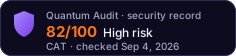
How is this score calculated? → Critical Risk
Executive SummaryAI Copilot

The project comprises an ERC-20 token (CATToken), a claim distribution contract (CatClaim), and an ERC-721 NFT collection (PolyJetClub). All contracts are built upon OpenZeppelin standards and utilize Solidity 0.8.28. The primary security concern is the high degree of centralized control across all contracts, where a 3/5 multisig owner holds extensive power over critical operations, including token blacklisting, fund management, claim distributions, and NFT minting. While technically sound, this centralization introduces significant trust assumptions and potential for economic manipulation.

1 High3 Medium1 Low1 Informational
i Our automated scanner reviewed CAT (CAT) on BNB Chain. 3 of 5 security checks passed — see the full breakdown below.
Volume 24h
$732.2K
Liquidity
$15.52M
Price
$1.6000
Age
2mo
Top 10 Holders
95.1%

Security Findings

High

Centralized Control Across All Contracts

H-01All three contracts (`CATToken`, `CatClaim`, `PolyJetClub`) are `Ownable` and explicitly prevent ownership renouncement. This design concentrates extensive power in a single 3/5 multisig address, which controls all critical operations including token blacklisting, fund transfers from blacklisted accounts, claim amount management, NFT minting, and pausing. This introduces a significant single point of control and high trust requirement in the owner (7.3, 7.5, 7.8).
IssueAll three contracts (`CATToken`, `CatClaim`, `PolyJetClub`) are `Ownable` and explicitly prevent ownership renouncement. This design concentrates extensive power in a single 3/5 multisig address, which controls all critical operations including token blacklisting, fund transfers from blacklisted accounts, claim amount management, NFT minting, and pausing. This introduces a significant single point of control and high trust requirement in the owner (7.3, 7.5, 7.8).
FixConsider implementing time-locks for highly sensitive owner-controlled functions to introduce a delay before execution, allowing for community review or emergency intervention. Explore progressive decentralization strategies, such as transitioning to a DAO-based governance model for critical decisions like blacklisting or major fund movements, reducing reliance on a single multisig.
StatusUnresolved
Medium

Owner's Power Over Blacklisted Funds

M-01In `CATToken`, the `transferBlackFunds` function allows the owner to unilaterally transfer all tokens from a blacklisted address to any non-blacklisted recipient. While intended for recovery or enforcement, this grants significant power to the owner over user funds, which could be misused or lead to disputes if not handled transparently (7.3, 7.4).
IssueIn `CATToken`, the `transferBlackFunds` function allows the owner to unilaterally transfer all tokens from a blacklisted address to any non-blacklisted recipient. While intended for recovery or enforcement, this grants significant power to the owner over user funds, which could be misused or lead to disputes if not handled transparently (7.3, 7.4).
FixImplement a clear policy and transparent process for the use of `transferBlackFunds`, communicating the conditions under which it will be invoked. Consider requiring a multi-signature approval or a time-lock for such transfers to add an additional layer of security and accountability.
StatusUnresolved
Medium

Owner's Control Over Claimable Amounts and Funds

M-02In `CatClaim`, the owner has exclusive control over setting and resetting claimable amounts for any user via `setClaimableAmount` and `setClaimableAmounts`. Additionally, the owner can deposit and withdraw all CAT tokens from the contract using `depositCat` and `withdrawCat`. This centralization means the owner has full discretion over who can claim, how much, and can manage or drain the contract's funds at any time (7.3, 7.4).
IssueIn `CatClaim`, the owner has exclusive control over setting and resetting claimable amounts for any user via `setClaimableAmount` and `setClaimableAmounts`. Additionally, the owner can deposit and withdraw all CAT tokens from the contract using `depositCat` and `withdrawCat`. This centralization means the owner has full discretion over who can claim, how much, and can manage or drain the contract's funds at any time (7.3, 7.4).
FixIf possible, explore mechanisms to decentralize the setting of claimable amounts, perhaps through a pre-defined schedule or a community-governed process. For fund withdrawals, consider implementing a time-lock or requiring a higher threshold of multisig signers for large amounts to enhance security and trust.
StatusUnresolved
Medium

Owner's Control Over NFT Minting and Metadata

M-03In `PolyJetClub`, the owner possesses exclusive rights to mint all NFTs up to `MAX_SUPPLY` via `mint` and `batchMint`, and can change the `baseURI` at any time using `setBaseURI`. This centralization allows the owner to control the entire distribution and metadata of the NFT collection, potentially impacting its perceived value or authenticity if the owner's key is compromised or acts maliciously (7.3, 7.4).
IssueIn `PolyJetClub`, the owner possesses exclusive rights to mint all NFTs up to `MAX_SUPPLY` via `mint` and `batchMint`, and can change the `baseURI` at any time using `setBaseURI`. This centralization allows the owner to control the entire distribution and metadata of the NFT collection, potentially impacting its perceived value or authenticity if the owner's key is compromised or acts maliciously (7.3, 7.4).
FixConsider implementing a time-lock for `setBaseURI` to provide transparency before metadata changes. For minting, if a public sale or decentralized distribution is planned, ensure the owner's minting capabilities are limited or phased out after initial distribution, or integrate a transparent minting schedule.
StatusUnresolved
Low

Pausability Centralization

L-01All contracts implement pausable functionality, allowing the owner to halt core contract operations (e.g., token transfers, claims, NFT minting) at will. While a common emergency mechanism, this feature is entirely controlled by the owner, which could disrupt user activity or be used to freeze assets without immediate recourse (7.3, 7.8).
IssueAll contracts implement pausable functionality, allowing the owner to halt core contract operations (e.g., token transfers, claims, NFT minting) at will. While a common emergency mechanism, this feature is entirely controlled by the owner, which could disrupt user activity or be used to freeze assets without immediate recourse (7.3, 7.8).
FixClearly document the conditions under which the pause functionality would be invoked. For enhanced decentralization, consider requiring a multi-signature approval or a time-lock for pausing and unpausing, especially for prolonged periods, to prevent arbitrary halts.
StatusUnresolved
Info

Immutable Contract Design

I-01The contracts are deployed as immutable implementations and do not incorporate any upgradeability mechanisms (e.g., proxy patterns). While this eliminates risks associated with complex upgrade processes, it means that any future bug fixes, feature enhancements, or changes to the protocol logic would necessitate a complete redeployment of the contracts and a migration of assets, which can be a complex and costly process (7.7).
IssueThe contracts are deployed as immutable implementations and do not incorporate any upgradeability mechanisms (e.g., proxy patterns). While this eliminates risks associated with complex upgrade processes, it means that any future bug fixes, feature enhancements, or changes to the protocol logic would necessitate a complete redeployment of the contracts and a migration of assets, which can be a complex and costly process (7.7).
FixEnsure comprehensive testing and auditing are conducted prior to deployment, given the immutability of the contracts. For future projects, evaluate the trade-offs between immutability and upgradeability based on the project's long-term vision and potential for evolving requirements.
StatusUnresolved

Category Ratings

TechnicalMedium6/10

The technical implementation demonstrates strong adherence to best practices, leveraging battle-tested OpenZeppelin libraries for ERC-20, ERC-721, Ownable, Pausable, and ReentrancyGuard functionalities. Solidity 0.8.28 is used, mitigating common integer overflow/underflow issues. For instance, `CatClaim` correctly employs `ReentrancyGuard` for its `claim` function, preventing reentrancy attacks. The code is generally clean, well-structured, and uses custom error messages effectively. No significant technical vulnerabilities like reentrancy (where not guarded), oracle manipulation, or complex logical flaws were identified (7.2).

GovernanceHigh1/10

The governance and economic model exhibits a high degree of centralization, with a 3/5 multisig owner retaining extensive control over all core contract functionalities. This includes the ability to blacklist token holders and transfer their funds in `CATToken` (7.4), manage all claimable amounts and withdraw funds from `CatClaim` (7.4), and control NFT minting and metadata in `PolyJetClub` (7.4). While a multisig mitigates single-point-of-failure, the concentration of power introduces significant trust assumptions and potential for economic manipulation or abuse (7.5). Ownership renouncement is explicitly disabled across all contracts, solidifying this centralized control (7.3).

UpgradesMedium6/10

The contracts are deployed as immutable, non-upgradeable implementations. This design choice eliminates risks associated with proxy patterns, such as storage collisions, logic errors during upgrades, or unauthorized upgrade paths (7.7). However, it also means that any future bug fixes, feature enhancements, or changes to the protocol logic would necessitate a complete redeployment of the contracts and a migration of assets, which can be a complex and costly process.

Security Checklist

Contract VerifiedPass
Ownership RenouncedFail
No Mint FunctionPass
Liquidity LockedFail
Not a ProxyPass

Holder Composition

5.5% in wallets89.7% in contracts
Effective Concentration41.3%

Share held by contracts — treasury, vesting, bridge or staking — is discounted against share held by wallets when the score is computed: a contract cannot decide to sell the way an anonymous holder can, though it can still be drained or voted to sell. Effective concentration is the figure the risk score is actually calculated from.

Liquidity Depth

The risk score reads depth across every pair. The volume figure and the volume-to-liquidity ratio elsewhere on this page describe only the pair this audit analysed, so the two are not directly comparable.

LP Distribution

Top-1 Unlocked Holder63.1%
Top-3 Unlocked99.7%

Key Addresses

Deployer
0x6a3b…2e69
Unlocked LP Held By
0x0385…c4f80x8abe…7ba40x2494…1a270x80fd…7e360x0123…426a0xdff8…99ca0x1c70…460c0xa3e5…15940x818e…8b2f0x80b9…8ca8

A privileged address — the deployer, the owner, or the token contract itself — is among these holders, so that party can withdraw liquidity.

What Raised This Score

  • Ownership NOT renounced — strong Multisig (3-of-5)
  • Top-10 concentration > 30% (95.1% total → 41.3% effective; 5.5% in EOAs, 89.7% in contracts — moderate)
  • Liquidity NOT locked (owner can withdraw — rug-pull risk)
  • LP top1 unlocked holder = 63.1% (exit-liquidity risk)
  • LP top3 unlocked holders = 99.7% (exit-liquidity risk)
  • 1 High finding(s) from audit
  • 3 Medium finding(s) from audit
  • 1 Low finding(s) from audit

Each factor is an on-chain fact recorded at the time of this analysis. The score is computed from them by a deterministic function, so the same contract returns the same score for anyone who runs the audit. How scores are computed

Related Audits

United Stables (U)Critical RiskNVIDIA Corp (NVDAB)Critical RiskGiggle Tom (TOM)Critical RiskDexeCritical RiskArcium (ARX)Critical RiskSolstice (SLX)Critical Risk

Would You Like a More Detailed Audit of CAT?

Paste the contract address into our AI-powered scanner for a deeper real-time report — free, with every scoring factor shown.

Get Detailed Audit