Quantum Audit Logo

Is Brok Safe?

On-chain security analysis — is it a scam or legit?

Is this your token? Publish your own audit on this page →

Brok BROK
0xcedf…4444
BNB Chain Not verifiedLast checked 3d ago 1 audit on record
Executive SummaryAI Copilot

The `FourERC20` contract is an incomplete implementation of an ERC-20 token, lacking essential core functionality such as balance updates, token minting, and burning. While it leverages OpenZeppelin's robust base for standard ERC-20 interfaces, its current state renders it non-functional as a standalone token. Critical issues prevent any token supply management or transfers, making the contract unusable.
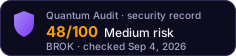
1 Critical3 High
Volume 24h
$232.5500
Liquidity
$8.0K
Price
$0.000005589
Token Age
4mo
Top 10 Holders
86.2%

Security Findings

Critical

Incomplete Core Token Logic (`_update` function)

C-01The `_update` internal virtual function, which is fundamental for all balance modifications (minting, burning, transferring), is not implemented in the `FourERC20` contract. This omission renders the entire ERC-20 contract non-functional, as no tokens can be created, moved between accounts, or destroyed. Any attempt to call functions like `transfer`, `transferFrom`, `_mint`, or `_burn` will fail at runtime.
IssueThe `_update` internal virtual function, which is fundamental for all balance modifications (minting, burning, transferring), is not implemented in the `FourERC20` contract. This omission renders the entire ERC-20 contract non-functional, as no tokens can be created, moved between accounts, or destroyed. Any attempt to call functions like `transfer`, `transferFrom`, `_mint`, or `_burn` will fail at runtime.
FixImplement the `_update` internal virtual function to handle the actual balance changes for `from` and `to` addresses, including checks for zero addresses and sufficient balances. This is the foundational logic for all token movements.
StatusUnresolved
High

Uninitialized Token Metadata

H-01The `_init` internal function, responsible for setting the token's `_name` and `_symbol`, is not called within the `FourERC20` contract. Consequently, the `name()` and `symbol()` public view functions will return empty strings. This leads to poor user experience, potential display issues in wallets and explorers, and integration problems with exchanges or other DeFi protocols that rely on this metadata.
IssueThe `_init` internal function, responsible for setting the token's `_name` and `_symbol`, is not called within the `FourERC20` contract. Consequently, the `name()` and `symbol()` public view functions will return empty strings. This leads to poor user experience, potential display issues in wallets and explorers, and integration problems with exchanges or other DeFi protocols that rely on this metadata.
FixEnsure that the `_init` function is called in the constructor of a derived contract, passing the desired `name_` and `symbol_` values. This will properly initialize the token's metadata upon deployment.
StatusUnresolved
High

Missing Minting Mechanism

H-02The `_mint` internal virtual function, which is responsible for increasing the total supply and an account's balance, lacks a concrete implementation. Without this, no new tokens can be introduced into circulation, preventing the token from having any initial supply or dynamic supply management. This issue is a direct consequence of the unimplemented `_update` function.
IssueThe `_mint` internal virtual function, which is responsible for increasing the total supply and an account's balance, lacks a concrete implementation. Without this, no new tokens can be introduced into circulation, preventing the token from having any initial supply or dynamic supply management. This issue is a direct consequence of the unimplemented `_update` function.
FixImplement the `_mint` function, which should internally call the `_update` function (once `_update` is implemented) to correctly adjust the `_totalSupply` and the recipient's balance. Consider adding access control to the public-facing minting function in a derived contract.
StatusUnresolved
High

Missing Burning Mechanism

H-03Similar to minting, the `_burn` internal virtual function, which is responsible for decreasing the total supply and an account's balance, is not implemented. This prevents any tokens from being removed from circulation, which can be necessary for various tokenomics models or to recover from errors. This issue is also a direct consequence of the unimplemented `_update` function.
IssueSimilar to minting, the `_burn` internal virtual function, which is responsible for decreasing the total supply and an account's balance, is not implemented. This prevents any tokens from being removed from circulation, which can be necessary for various tokenomics models or to recover from errors. This issue is also a direct consequence of the unimplemented `_update` function.
FixImplement the `_burn` function, which should internally call the `_update` function (once `_update` is implemented) to correctly adjust the `_totalSupply` and the sender's balance. Ensure proper checks, such as requiring sufficient balance, are in place.
StatusUnresolved

Category Ratings

TechnicalMedium5/10

The contract utilizes OpenZeppelin's `Context`, `IERC20`, and `IERC20Metadata` components, providing a structured foundation (7.2 Code Security). However, the `FourERC20` contract is an incomplete implementation, critically missing the concrete implementation of the `_update` internal virtual function, which is essential for all balance modifications (7.1 Architecture). This directly prevents token minting, burning, and transfers. Additionally, the token's `name` and `symbol` are not initialized, leading to empty metadata (7.8 Operations).

GovernanceHigh2/10

The economic model is severely impacted as the token is non-functional; no tokens can be minted, transferred, or burned, rendering it without any intrinsic value or utility (7.4 Economic). This prevents any form of economic activity or value accrual. The contract does not include any specific governance mechanisms (7.5 Governance).

UpgradesLow8/10

The provided contract is a standard, non-upgradeable implementation and does not incorporate any proxy patterns (7.7 Upgrades). Therefore, direct upgrade risks are not applicable. Any future modifications would necessitate a new contract deployment and a migration process.

Security Checklist

Contract VerifiedPass
Ownership RenouncedPass
No Mint FunctionPass
Liquidity LockedPass
Not a ProxyPass

Holder Composition

7.1% in wallets79.2% in contracts
Effective Concentration38.7%

Share held by contracts — treasury, vesting, bridge or staking — is discounted against share held by wallets when the score is computed: a contract cannot decide to sell the way an anonymous holder can, though it can still be drained or voted to sell. Effective concentration is the figure the risk score is actually calculated from.

Liquidity Depth

The risk score reads depth across every pair. The volume figure and the volume-to-liquidity ratio elsewhere on this page describe only the pair this audit analysed, so the two are not directly comparable.

LP Distribution

LP Burned100.0% · ≈ permanent lock
LP Locked100.0% · Null Address

Key Addresses

Deployer
0x9933…8062

What Raised This Score

  • Top-10 concentration > 30% (86.2% total → 38.7% effective; 7.1% in EOAs, 79.2% in contracts — moderate)
  • Liquidity < $10k ($8,007 across 1 pairs — easily drained)
  • 1 Critical finding(s) from audit
  • 3 High finding(s) from audit

Each factor is an on-chain fact recorded at the time of this analysis. The score is computed from them by a deterministic function, so the same contract returns the same score for anyone who runs the audit. How scores are computed

Related Audits

BSquared Token (B2)High RiskCRYSTAL STONESHigh RiskIce Open Network (ION)High RiskEthereum Token (ETH)High RiskUSELESS COIN (USELESS)High RiskCSI888 (CSI)High Risk

Would You Like a More Detailed Audit of Brok?

Our AI-powered scanner gives you a deeper, real-time smart contract analysis — free, with every scoring factor shown.

Get Detailed Audit