

The BrewToken contract is a standard ERC-20 implementation, inheriting from OpenZeppelin's battle-tested contracts. It features minimal custom logic, primarily setting immutable addresses and an initial metadata URI. The contract exhibits a low overall risk profile due to its simplicity and reliance on well-audited libraries. Key considerations include the centralized initial token distribution and the non-upgradeable nature of the contract.
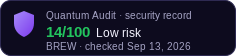

On-chain security analysis — is it a scam or legit?
Is BREW Safe?
Not verified
This record has not gone through deep verification and is not being monitored. The score is a dated snapshot — the token’s risk can change at any time.Own this token? Put it under verification →The BrewToken contract is a standard ERC-20 implementation, inheriting from OpenZeppelin's battle-tested contracts.
Read the full analysis- Ownership status UNKNOWN
- Liquidity not locked, but no owner/deployer address holds LP — market-depth risk, not rug risk
- LP top1 unlocked holder = 77.6%
- LP top3 unlocked holders = 92.6%
- Token age < 30 days
Exact factors
- Ownership status UNKNOWN (owner could not be resolved)
- Liquidity not locked, but no owner/deployer address holds LP — market-depth risk, not rug risk
- LP top1 unlocked holder = 77.6% (independent LP — depth risk, pool = 74% of DEX liquidity)
- LP top3 unlocked holders = 92.6% (independent LP — depth risk, pool = 74% of DEX liquidity)
- Token age < 30 days (still settling)
Security Checklist
as of audit · Sep 13Holders
as of audit · Sep 13, 2026- Contractstreasury, vesting, bridge, staking15.0%
- Walletsanonymous holders, free to sell10.6%
- Everyone elsethe rest of the supply74.4%
How holder types affect the score
Share held by contracts — treasury, vesting, bridge or staking — is discounted against share held by wallets when the score is computed: a contract cannot decide to sell the way an anonymous holder can, though it can still be drained or voted to sell. Effective concentration is the figure the risk score is actually calculated from.
Holder balances as recorded by the audit of Sep 13, 2026
Liquidity
as of audit · Sep 13The LP tokens of the analysed pool are not locked or burned, so whoever holds them can withdraw that liquidity.
0x3366…f0d40xcd81…36e30xfea9…43880x2e44…97aa0x96da…66000xa156…24d90x7953…78e40xadab…f5940x689a…503c0x20ab…35faNo privileged address appears among these holders: the unlocked liquidity sits with independent providers, not with the deployer.
Security Findings
LowCentralized Initial Token Distribution
Not confirmed by static analysis (the model's own reading of the source).L-01
Issue
Not confirmed by static analysis (the model's own reading of the source). During deployment, the entire totalSupply_ is minted to a single recipient_ address. While common for initial token launches, this represents a centralized point of control for the entire token supply at inception (7.4 Economic). The security of this single address is paramount for the integrity of the token supply.
Fix
Ensure the recipient_ address is a secure, multi-signature wallet or a well-audited distribution mechanism to mitigate risks associated with a single point of failure and potential compromise of the initial token supply.
Status
Unresolved
LowNon-Upgradeability of Contract
Not confirmed by static analysis (the model's own reading of the source).L-02
Issue
Not confirmed by static analysis (the model's own reading of the source). The BrewToken contract is implemented as a standard, non-upgradeable contract. This means that once deployed, its logic cannot be modified or updated. While this removes risks associated with upgrade mechanisms (7.7 Upgrades), it also means that any discovered vulnerabilities or desired feature enhancements would require deploying an entirely new token contract, which can be disruptive and costly.
Fix
Projects should carefully consider their long-term needs. If future modifications or bug fixes are anticipated, a proxy pattern (e.g., UUPS) should be considered for future contracts. For this specific contract, acknowledge the immutability and plan accordingly for its lifecycle.
Status
Unresolved
InfoStandard OpenZeppelin ERC-20 Implementation
Not confirmed by static analysis (the model's own reading of the source).I-01
Issue
Not confirmed by static analysis (the model's own reading of the source). The BrewToken contract correctly implements the ERC-20 standard by inheriting from OpenZeppelin's battle-tested ERC20 contract. This significantly reduces the likelihood of common ERC-20 vulnerabilities (7.2 Code Security). The contract also uses Solidity 0.8.x, benefiting from default overflow/underflow checks and explicit unchecked blocks where appropriate.
Fix
No specific recommendation, as this is a strength of the contract's design and implementation.
Status
Unresolved
InfoImmutability of Key Parameters
Not confirmed by static analysis (the model's own reading of the source).I-02
Issue
Not confirmed by static analysis (the model's own reading of the source). The creator, brewFactory, and metadataURI variables are declared as immutable and set only during the constructor. This ensures that these critical parameters cannot be changed after deployment, providing predictability and reducing potential attack vectors related to parameter manipulation (7.3 Access Control).
Fix
No specific recommendation, as this design choice enhances the security and predictability of the contract.
Status
Unresolved
Analysis
AI Copilotas of audit · Sep 13The technical architecture (7.1 Architecture) of BrewToken is straightforward, implementing a standard ERC-20 token. It leverages OpenZeppelin's secure and audited ERC-20 library, significantly enhancing code security (7.2 Code Security) and mitigating common vulnerabilities like reentrancy and integer overflows. Access control (7.3 Access Control) is minimal, limited to the standard ERC-20 functions, with key parameters like creator, brewFactory, and metadataURI being immutable after deployment, which is a strength. No complex external interactions (7.6 External) are present.
The economic model (7.4 Economic) involves a single initial minting event to a specified recipient, leading to a centralized initial token distribution. There are no explicit governance mechanisms (7.5 Governance) or operational roles (7.8 Operations) defined within the contract itself, simplifying its structure but placing responsibility for the initial token holder's security. The immutability of creator and brewFactory provides clarity on key addresses.
The BrewToken contract is not designed with upgradeability (7.7 Upgrades) in mind, meaning its logic cannot be modified post-deployment. This eliminates risks associated with proxy patterns and upgrade mechanisms, such as improper upgrade paths or malicious upgrades. However, it also means that any future bug fixes or feature enhancements would necessitate a new contract deployment, which could be disruptive.
The BrewToken contract is a robust and secure implementation of the ERC-20 standard, primarily due to its reliance on OpenZeppelin's audited libraries and minimal custom logic.
Projects should ensure the security of the recipient_ address used during deployment, as it will hold the entire initial token supply. Additionally, acknowledge the non-upgradeable nature of the contract and plan for any future changes accordingly, potentially considering a proxy pattern for future token iterations if flexibility is desired.
Contract & Record
Free for any token on the record. It links to this page and always shows the current score and the date it was checked.
- Sep 13, 202614Low
Score changes are recorded as dated snapshots — history is append-only and cannot be edited.
Frequently Asked Questions
What is the BREW contract address?
The BREW contract on BNB Chain is 0xfa6d9b504848606eb9aec04ccc161d169b3f2159. Compare it with the address the project itself publishes before trading: other contracts can carry the same name and ticker.
Is BREW a scam?
Quantum Audit's risk score for BREW is 14/100 (Low risk) as of Sep 13, 2026, computed by a deterministic function from on-chain facts — Contract verified: Verified; Mint: No mint; Liquidity lock: Not locked; Upgradeability: Fixed code; Honeypot: None found; Buy / sell tax: 0% / 0%. A score is a dated snapshot of those facts, not a guarantee; each one is listed on this page.
Is BREW liquidity locked?
Liquidity lock: Not locked (as of Sep 13, 2026). Total DEX liquidity: $1.17M.
Who holds BREW?
As of Sep 13, 2026, the 10 largest holders own 25.6% of the supply. The Holders section on this page shows who they are by holder type.
Would You Like a More Detailed Audit of BREW?
Our AI-powered scanner gives you a deeper, real-time smart contract analysis — free, with every scoring factor shown.
Get Detailed Audit Is this your token? Add your links and get it Verified