
Quantum Audit Logo

Is Beam Safe?

On-chain security analysis — is it a scam or legit?

Is this your token? Publish your own audit on this page →

Beam BEAM
0x62d0…bfce
Ethereum Not verifiedLast checked 2d ago 2 audits on record
Executive SummaryAI Copilot

The BeamToken contract implements an ERC20 token with voting capabilities and role-based access control for minting and burning. The contract leverages battle-tested OpenZeppelin libraries, contributing to a solid technical foundation. However, significant centralization exists in the control over token supply and administrative roles, posing a high economic and governance risk.

1 High1 Medium1 Low2 Informational
Volume 24h
$129.5K
Liquidity
$3.06M
Price
$0.00156
Token Age
2y
Top 10 Holders
56.8%

Security Findings

High

Centralized Minting and Burning Capabilities

H-01The `BeamToken` contract includes `mint` and `burn` functions, controlled by `MINTER_ROLE` and `BURNER_ROLE` respectively. These roles, along with the `DEFAULT_ADMIN_ROLE`, are initially assigned to the contract deployer. This centralization allows the role holders to arbitrarily increase or decrease the total supply of tokens without any on-chain checks or community consensus. This poses a significant economic risk as it can lead to token dilution or manipulation of supply (7.4 Economic, 7.3 Access Control).
IssueThe `BeamToken` contract includes `mint` and `burn` functions, controlled by `MINTER_ROLE` and `BURNER_ROLE` respectively. These roles, along with the `DEFAULT_ADMIN_ROLE`, are initially assigned to the contract deployer. This centralization allows the role holders to arbitrarily increase or decrease the total supply of tokens without any on-chain checks or community consensus. This poses a significant economic risk as it can lead to token dilution or manipulation of supply (7.4 Economic, 7.3 Access Control).
FixTransfer the `MINTER_ROLE` and `BURNER_ROLE` to a multi-signature wallet or a robust DAO governance contract. Implement a transparent minting policy, potentially with a maximum supply cap or a time-locked minting schedule, to limit the potential for abuse and provide predictability to token holders. Consider removing the burn functionality if not strictly necessary, or restrict it to specific, auditable scenarios.
StatusUnresolved
Medium

Centralized Administrative Control

M-01The `DEFAULT_ADMIN_ROLE` is granted to the contract deployer in the constructor. This role has the power to grant and revoke all other roles, including itself, `MINTER_ROLE`, and `BURNER_ROLE`. This creates a single point of failure where a compromised or malicious admin account could gain full control over the token's critical functions, including the ability to assign minting and burning privileges to any address (7.5 Governance, 7.3 Access Control).
IssueThe `DEFAULT_ADMIN_ROLE` is granted to the contract deployer in the constructor. This role has the power to grant and revoke all other roles, including itself, `MINTER_ROLE`, and `BURNER_ROLE`. This creates a single point of failure where a compromised or malicious admin account could gain full control over the token's critical functions, including the ability to assign minting and burning privileges to any address (7.5 Governance, 7.3 Access Control).
FixImmediately transfer the `DEFAULT_ADMIN_ROLE` to a secure multi-signature wallet or a well-established DAO governance system. Ensure that the multi-signature wallet has a sufficient number of signers and a robust operational security policy. Regularly review and audit the addresses holding administrative roles.
StatusUnresolved
Low

Custom `onlyHasRole` Modifier

L-01The contract defines a custom modifier `onlyHasRole(bytes32 _role)` which duplicates the functionality of the `onlyRole(bytes32 role)` modifier provided by the inherited OpenZeppelin `AccessControl` contract. While functionally equivalent, using a custom modifier introduces an unnecessary deviation from standard library usage and could potentially lead to subtle inconsistencies or errors if not maintained carefully (7.2 Code Security).
IssueThe contract defines a custom modifier `onlyHasRole(bytes32 _role)` which duplicates the functionality of the `onlyRole(bytes32 role)` modifier provided by the inherited OpenZeppelin `AccessControl` contract. While functionally equivalent, using a custom modifier introduces an unnecessary deviation from standard library usage and could potentially lead to subtle inconsistencies or errors if not maintained carefully (7.2 Code Security).
FixReplace the custom `onlyHasRole` modifier with the standard `onlyRole` modifier provided by OpenZeppelin's `AccessControl` contract for consistency and to leverage battle-tested code. For example, `modifier onlyHasRole(bytes32 _role)` can be replaced with `onlyRole(_role)` directly.
StatusUnresolved
Info

No Explicit Total Supply Cap

I-01The `BeamToken` contract does not implement an explicit maximum total supply (hard cap) for the token. While the `MINTER_ROLE` controls the minting process, there is no inherent limit enforced by the contract itself on how many tokens can be minted over time. This design choice means the total supply is entirely dependent on the discretion and policy of the `MINTER_ROLE` holder (7.4 Economic).
IssueThe `BeamToken` contract does not implement an explicit maximum total supply (hard cap) for the token. While the `MINTER_ROLE` controls the minting process, there is no inherent limit enforced by the contract itself on how many tokens can be minted over time. This design choice means the total supply is entirely dependent on the discretion and policy of the `MINTER_ROLE` holder (7.4 Economic).
FixConsider implementing a maximum total supply (hard cap) in the contract if the project intends for the token to have a finite supply. Alternatively, if an elastic supply is desired, clearly document the minting policy and mechanisms to ensure transparency and predictability for token holders. If a hard cap is implemented, ensure the `mint` function checks against this cap.
StatusUnresolved
Info

Non-Upgradeable Contract Design

I-02The `BeamToken` contract is deployed as a standard, non-upgradeable contract. This means that its logic cannot be modified or updated after deployment. While this eliminates risks associated with upgrade mechanisms (e.g., proxy vulnerabilities), it also means that any discovered bugs, necessary feature enhancements, or changes in economic parameters would require a complete redeployment of a new contract and a migration of existing tokens, which can be a complex and disruptive process for users (7.7 Upgrades, 7.1 Architecture).
IssueThe `BeamToken` contract is deployed as a standard, non-upgradeable contract. This means that its logic cannot be modified or updated after deployment. While this eliminates risks associated with upgrade mechanisms (e.g., proxy vulnerabilities), it also means that any discovered bugs, necessary feature enhancements, or changes in economic parameters would require a complete redeployment of a new contract and a migration of existing tokens, which can be a complex and disruptive process for users (7.7 Upgrades, 7.1 Architecture).
FixAcknowledge the implications of a non-upgradeable design. For future contracts or if flexibility is desired, consider implementing an upgradeable proxy pattern (e.g., UUPS or Transparent Proxy) from OpenZeppelin. If remaining non-upgradeable, ensure thorough testing and auditing to minimize the likelihood of needing future changes.
StatusUnresolved

Category Ratings

TechnicalLow7/10

The BeamToken contract demonstrates strong technical foundations by utilizing well-audited OpenZeppelin libraries for its core ERC20, voting, and access control functionalities (7.2 Code Security). The Solidity version 0.8.6 mitigates common integer overflow/underflow vulnerabilities. Custom logic includes restrictions on transferring and minting to the contract address itself, which is a specific design choice (7.1 Architecture). A minor observation is the use of a custom `onlyHasRole` modifier instead of the standard `onlyRole` from AccessControl, which could be unified for consistency.

GovernanceHigh2/10

The contract design presents a high economic and governance risk due to significant centralization (7.4 Economic, 7.5 Governance). The `DEFAULT_ADMIN_ROLE` is assigned to the deployer, granting full control over all other roles, including `MINTER_ROLE` and `BURNER_ROLE`. This means a single entity or a small group of entities can arbitrarily mint new tokens, dilute existing holders, or burn tokens, directly impacting the token's supply and value. There is no on-chain governance mechanism to decentralize these critical powers, making the system highly dependent on the integrity of the role holders (7.3 Access Control).

UpgradesHigh3/10

The BeamToken contract is implemented as a standard, non-upgradeable contract (7.7 Upgrades). This design choice eliminates upgrade-related risks such as proxy misconfigurations or logic errors during upgrades. However, it also means that any future changes or bug fixes to the contract logic would require a new deployment and migration of tokens, which can be a complex and costly process.

Security Checklist

Contract VerifiedPass
Ownership Renounced?
No Mint FunctionFail
Liquidity LockedFail
Not a ProxyPass

Holder Composition

26.7% in wallets30.0% in contracts
Effective Concentration38.8%

Share held by contracts — treasury, vesting, bridge or staking — is discounted against share held by wallets when the score is computed: a contract cannot decide to sell the way an anonymous holder can, though it can still be drained or voted to sell. Effective concentration is the figure the risk score is actually calculated from.

Liquidity Depth

The risk score reads depth across every pair. The volume figure and the volume-to-liquidity ratio elsewhere on this page describe only the pair this audit analysed, so the two are not directly comparable.

LP Distribution

Top-1 Unlocked Holder42.1%
Top-3 Unlocked85.3%

Key Addresses

Deployer
0xf4fb…62ef
Unlocked LP Held By
0xa99f…bb430x8aa0…a95f0x1ef1…210d0xd023…cf050x29fc…f1000xee38…86470x7e30…fc3e0xbed1…11f60xc69c…9d6b0xfbab…4aa8

No privileged address appears among these holders: the unlocked liquidity sits with independent providers, not with the deployer.

What Raised This Score

  • Ownership status UNKNOWN (owner could not be resolved)
  • Mintable supply — no cap found, dilution unbounded
  • Top-10 concentration > 30% (56.8% total → 38.8% effective; 26.7% in EOAs, 30.0% in contracts — moderate)
  • Liquidity not locked, but no owner/deployer address holds LP — market-depth risk, not rug risk
  • LP top3 unlocked holders = 85.3% (independent LP — depth risk, pool = 85% of DEX liquidity)
  • 1 High finding(s) from audit
  • 1 Medium finding(s) from audit
  • 1 Low finding(s) from audit

Each factor is an on-chain fact recorded at the time of this analysis. The score is computed from them by a deterministic function, so the same contract returns the same score for anyone who runs the audit. How scores are computed

Frequently Asked Questions

Is Beam a scam?

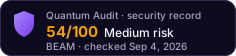
Based on automated analysis, Beam scores 68/100 (High Risk) on our risk scale. No honeypot was detected, but always verify independently before investing.

Is Beam safe to buy?

Our scanner flagged a risk score of 68/100. Ownership has not been renounced, which is a risk factor. DYOR before purchasing any token.

Has Beam been audited?

The contract has not been verified on-chain. Verification is not the same as a full security audit. Use Quantum Audit's free tool to run a deeper analysis of the contract code.

Related Audits

MorphoHigh RiskSuperVerse (SUPER)High Risk00 Token (00)High RiskIxs Token (IXS)High RiskAlberich Token (ALBRH)High RiskSpice (SFI)High Risk

Would You Like a More Detailed Audit of Beam?

Our AI-powered scanner gives you a deeper, real-time smart contract analysis — free, with every scoring factor shown.

Get Detailed Audit