
Quantum Audit Logo
Launch App

On-chain security analysis — is it a scam or legit?

Is Autonomi Safe?

ANTArbitrum
Not verified This record has not gone through deep verification and is not being monitored. The score is a dated snapshot — the token’s risk can change at any time.Own this token? Put it under verification →
Last checked Sep 4, 2026 · 2 audits on record
SummaryAI Copilot

The AutonomiNetworkToken contract is a standard ERC20 token implementation, leveraging battle-tested OpenZeppelin libraries for its core functionalities including burnable, permit, and voting features.

Read the full analysis
What raised the score
  • Ownership status UNKNOWN
  • Top-10 concentration > 70%
  • Liquidity not locked, but no owner/deployer address holds LP — market-depth risk, not rug risk
  • LP top1 unlocked holder = 99.9%
  • LP top3 unlocked holders = 100.0%
Exact factors
  • Ownership status UNKNOWN (owner could not be resolved)
  • Top-10 concentration > 70% (80.9% total → 72.0% effective; 66.2% in EOAs, 14.7% in contracts — extreme)
  • Liquidity not locked, but no owner/deployer address holds LP — market-depth risk, not rug risk
  • LP top1 unlocked holder = 99.9% (independent LP — depth risk)
  • LP top3 unlocked holders = 100.0% (independent LP — depth risk)

How scores are computed

Security Checklist

as of audit · Sep 43 of 5 checks passed
Contract verifiedVerified
OwnershipUnknown
MintNo mint
Liquidity lockNot locked
UpgradeabilityFixed code

Holders

as of audit · Sep 4, 2026
14.7%Contracts66.2%Wallets19.1%Everyone else
ContractsWalletsEveryone elseBubble area = share of supply
80.9%of supply sits with the top 10 holders
  • Contractstreasury, vesting, bridge, staking14.7%
  • Walletsanonymous holders, free to sell66.2%
  • Everyone elsethe rest of the supply19.1%
Effective concentrationwhat the score reads72.0%
How holder types affect the score

Share held by contracts — treasury, vesting, bridge or staking — is discounted against share held by wallets when the score is computed: a contract cannot decide to sell the way an anonymous holder can, though it can still be drained or voted to sell. Effective concentration is the figure the risk score is actually calculated from.

Holder balances as recorded by the audit of Sep 4, 2026

Liquidity

as of audit · Sep 4$94.1K
LP tokensNot locked

The LP tokens of the analysed pool are not locked or burned, so whoever holds them can withdraw that liquidity.

Analysed pool$94.1KShare of depth100.0%
Top-1 Unlocked Holder99.9%
Top-3 Unlocked100.0%
Unlocked LP held by
0x1d24…108c0xb713…b0e40x167f…7d4e0xc56f…fca7

No privileged address appears among these holders: the unlocked liquidity sits with independent providers, not with the deployer.

Security Findings

1 Medium2 Info
Medium

Centralized Initial Token Distribution

Not confirmed by static analysis (the model's own reading of the source).M-01

Issue

Not confirmed by static analysis (the model's own reading of the source). The contract's constructor mints the entire initial supply of 1.2 billion tokens to a single autonomi address. This design choice results in a highly centralized token distribution at deployment, giving the controlling entity significant influence over governance (via ERC20Votes) and potential economic power (7.4 Economic, 7.5 Governance). A compromise of this single address could have severe consequences for the protocol.

Fix

Implement robust security measures for the autonomi address, such as a multi-signature wallet (e.g., Gnosis Safe) with a diverse set of signers. Consider a strategy for progressive decentralization of the token supply over time, distributing tokens to various stakeholders or a community treasury to reduce single-point-of-failure risks.

Status

Unresolved

Info

Lack of Emergency Pause Mechanism

Not confirmed by static analysis (the model's own reading of the source).I-01

Issue

Not confirmed by static analysis (the model's own reading of the source). The AutonomiNetworkToken contract does not include an emergency pause mechanism. While this is common for simple ERC20 tokens and reduces complexity, it means that in the event of a critical vulnerability or exploit in an integrated system, token transfers cannot be halted (7.8 Operations).

Fix

Evaluate whether an emergency pause functionality is necessary for the broader Autonomi Network ecosystem. If deemed critical for future integrations or potential risks, consider wrapping this token with a pausable contract or implementing a governance-controlled pause in a future version or related contract.

Status

Unresolved

Info

Potential Front-running of ERC20Permit

Not confirmed by static analysis (the model's own reading of the source).I-02

Issue

Not confirmed by static analysis (the model's own reading of the source). The ERC20Permit functionality allows users to sign off-chain approvals. While correctly implemented using OpenZeppelin's battle-tested code, the nature of permit transactions means they can be susceptible to front-running (7.2 Code Security). A malicious actor could observe a pending permit transaction and submit their own transaction with a higher gas price to execute the permit call before the legitimate user, potentially manipulating the order of operations.

Fix

Users should be aware of the potential for front-running when using permit signatures. Off-chain systems integrating permit should implement mechanisms to mitigate front-running, such as using transaction relays that can submit transactions privately or with appropriate timing, or by educating users on best practices for submitting signed messages.

Status

Unresolved

Analysis

AI Copilotas of audit · Sep 4
Executive SummaryWhat the contract is and what the review found

The AutonomiNetworkToken contract is a standard ERC20 token implementation, leveraging battle-tested OpenZeppelin libraries for its core functionalities including burnable, permit, and voting features. The technical implementation is robust, with no critical or high-severity vulnerabilities identified. The primary risks are related to the initial centralized distribution of tokens, which impacts governance and economic decentralization.

Technical8/10Low risk

The contract demonstrates high technical quality by inheriting from well-audited OpenZeppelin Contracts (v5.0.0), including ERC20, ERC20Burnable, ERC20Permit, and ERC20Votes. This approach significantly reduces the likelihood of common vulnerabilities (7.2 Code Security). The custom logic is minimal, limited to the constructor and required overrides, which are correctly implemented. No reentrancy, integer overflow/underflow, or other critical technical flaws were identified (7.2 Code Security).

Governance1/10High risk

The contract implements ERC20Votes, enabling on-chain governance capabilities (7.5 Governance). However, the entire initial supply of 1.2 billion tokens is minted to a single 'autonomi' address in the constructor, creating a high degree of centralization (7.4 Economic). This centralized control over the initial token supply poses a significant risk to the project's decentralization goals and could lead to governance manipulation if not managed carefully (7.3 Access Control).

Upgrades6/10Medium risk

The AutonomiNetworkToken contract is not designed as an upgradeable proxy contract (7.7 Upgrades). This eliminates the complexities and potential risks associated with upgrade mechanisms, such as storage collisions, proxy logic errors, or improper upgrade path management. The contract is immutable once deployed, providing a fixed and predictable codebase.

Final RecommendationWhat to do about this score

It is recommended to carefully manage the 'autonomi' address that receives the initial token supply, implementing robust multi-signature controls and secure key management practices to mitigate the risks associated with centralization.

Consider a phased distribution strategy for the initial token supply to enhance decentralization over time. For future developments, evaluate the need for emergency pause functionality for critical operations, although it is not strictly necessary for a basic ERC20 token.

Contract & Record

2 audits on record
TypeAutonomiNetworkToken
NetworkArbitrum
Token age1y
Contract0xa78d…b684
Deployer0xf141…32a1
Badge for your website
Autonomi security record badge

Free for any token on the record. It links to this page and always shows the current score and the date it was checked.

Audit History
  1. Sep 4, 202644Medium
  2. Jul 27, 202648Medium
  3. Jul 24, 202667High

Score changes are recorded as dated snapshots — history is append-only and cannot be edited.

Frequently Asked Questions

Is Autonomi a scam?

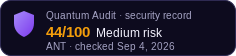
Based on automated analysis, Autonomi scores 44/100 (Medium Risk) on our risk scale. No honeypot was detected, but always verify independently before investing.

Is Autonomi safe to buy?

Our scanner flagged a risk score of 44/100. Ownership has not been renounced, which is a risk factor. DYOR before purchasing any token.

Has Autonomi been audited?

The contract has not been verified on-chain. Verification is not the same as a full security audit. Use Quantum Audit's free tool to run a deeper analysis of the contract code.

Would You Like a More Detailed Audit of Autonomi?

Our AI-powered scanner gives you a deeper, real-time smart contract analysis — free, with every scoring factor shown.

Get Detailed Audit Is this your token? Add your links and get it Verified