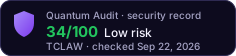
Traderclaw (TCLAW) operates on the Solana blockchain and presents a critical risk profile, indicated by its 75/100 risk score. A primary concern is the unverified contract, which prevents public scrutiny and independent security analysis of its code. Compounding this, ownership of the contract has not been renounced, leaving significant control in the hands of the deployer, who could potentially alter contract functions or parameters. Furthermore, the project's liquidity, currently at $161,239 with a 24-hour volume of $456,226, is not locked. This absence of locked liquidity introduces a substantial rug pull risk, as funds could be withdrawn at any time. While the absence of a mint function prevents arbitrary new token creation and the top 10 holders account for 0.0% of the supply, these positive signals are heavily overshadowed by fundamental transparency and security shortcomings.
The most critical red flags for Traderclaw (TCLAW) revolve around fundamental contract integrity and fund security. First, the contract remains unverified, meaning investors cannot independently review the code to understand its true functionality or identify potential vulnerabilities. This lack of transparency is a severe impediment to trust. Second, ownership has not been renounced, granting the deployer unilateral control over the contract, including potential future modifications or the ability to manipulate token parameters. Crucially, the liquidity, valued at $161,239, is not locked. This makes the project highly susceptible to a rug pull, where the development team could withdraw all pooled assets, leaving investors with valueless tokens. These combined factors signify extreme investment risk.
Traderclaw (TCLAW) exhibits several characteristics often associated with high-risk or potentially fraudulent projects. The unverified contract, unrenounced ownership, and unlocked liquidity create an environment where malicious actions like a rug pull are possible. While the data doesn't definitively prove it's a scam, these critical security vulnerabilities make it extremely risky and raise significant concerns about investor protection.
Based on the available data, Traderclaw (TCLAW) carries a critical risk score of 75/100, indicating it is not safe for investment. The primary concerns include the unverified contract, which prevents code scrutiny, and the unrenounced ownership, leaving control with the deployer. Most significantly, the absence of locked liquidity means pooled funds can be withdrawn at any time, posing a severe rug pull threat to buyers.
For a comprehensive security audit to be performed and verifiable, the token's smart contract must first be publicly verified. Traderclaw's contract is currently unverified, making any independent security audit impossible. Without a verified contract, the actual code functioning remains opaque, preventing external validation of its security and intended behavior.
Run a deeper audit of Traderclaw's contract code — free, instant, no account needed.
Run Full Audit