Solana · Smart Contract Security · Updated May 14, 2026

Andes Virus ANDV

Automated on-chain security analysis

Contract jvktlf…pump DexScreener ↗
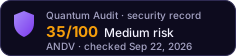
High Risk
Volume 24h
$189.8K
Liquidity
$67.6K
Price
$0.0004631
Token Age
7d
Top 10 Holders
0.0%

Security Checklist

Contract VerifiedFail
Ownership RenouncedFail
No Mint FunctionPass
Liquidity LockedFail
Not a ProxyPass

Security Analysis

Andes Virus (ANDV) on the Solana blockchain currently presents a high-risk investment profile, underscored by a risk score of 65/100. A primary concern is the unverified contract, which means the underlying code has not been published or confirmed on the blockchain explorer, severely limiting transparency and the ability for independent security scrutiny. Furthermore, contract ownership has not been renounced, leaving the deployer with significant administrative control, including the potential to modify parameters or exert influence over the token's future, despite the absence of a mint function. Liquidity, amounting to $67,603, is also not locked, introducing a direct 'rug pull' risk where funds could be withdrawn. While the top 10 holders collectively own 0.0% of the supply, indicating low whale concentration, these fundamental security omissions demand extreme investor caution. The token has seen a 24-hour volume of $189,813.

The most critical security vulnerabilities for Andes Virus (ANDV) are the unverified contract, unrenounced ownership, and unlocked liquidity. An unverified contract prevents any independent party from examining the code for malicious functions or bugs, creating a significant trust vacuum. Compounding this, the unrenounced ownership means the contract creator maintains full administrative control, which carries inherent risks for manipulation. Crucially, the liquidity not being locked exposes investors to a substantial 'rug pull' threat, where the project deployer could withdraw the entire liquidity pool, rendering tokens worthless. These factors collectively indicate a highly speculative and hazardous investment.

Frequently Asked Questions

Is Andes Virus a scam?

Based on the available data, Andes Virus (ANDV) exhibits multiple characteristics common in high-risk, potentially manipulative projects. The unverified contract, unrenounced ownership, and unlocked liquidity are significant red flags that create conditions ripe for malicious activities, including a 'rug pull.' While a definitive scam label requires further proof, these critical security flaws align with patterns observed in fraudulent schemes, warranting extreme caution.

Is Andes Virus safe to buy?

No, Andes Virus (ANDV) is not considered safe to buy based on its high-risk profile (65/100). The absence of contract verification makes its code untrustworthy, and the unrenounced ownership grants the deployer extensive control. Most critically, the unlocked liquidity presents a severe 'rug pull' risk, allowing the project creator to potentially withdraw all pooled funds. These factors make any investment highly speculative and susceptible to complete loss.

Has Andes Virus been audited?

No, Andes Virus (ANDV) has not been audited. Furthermore, its contract is not verified on the blockchain. This lack of verification means the deployed contract code has not been publicly confirmed or matched with its source code. Without this fundamental transparency, an independent security audit is impossible, leaving investors unable to assess the contract's integrity or security features.

Audit Any Smart Contract — Free

Paste any contract address and get an instant AI-powered security report in seconds.

Run Free Audit
Run Free Audit →